What is 5G Really? A Simple Mental Model
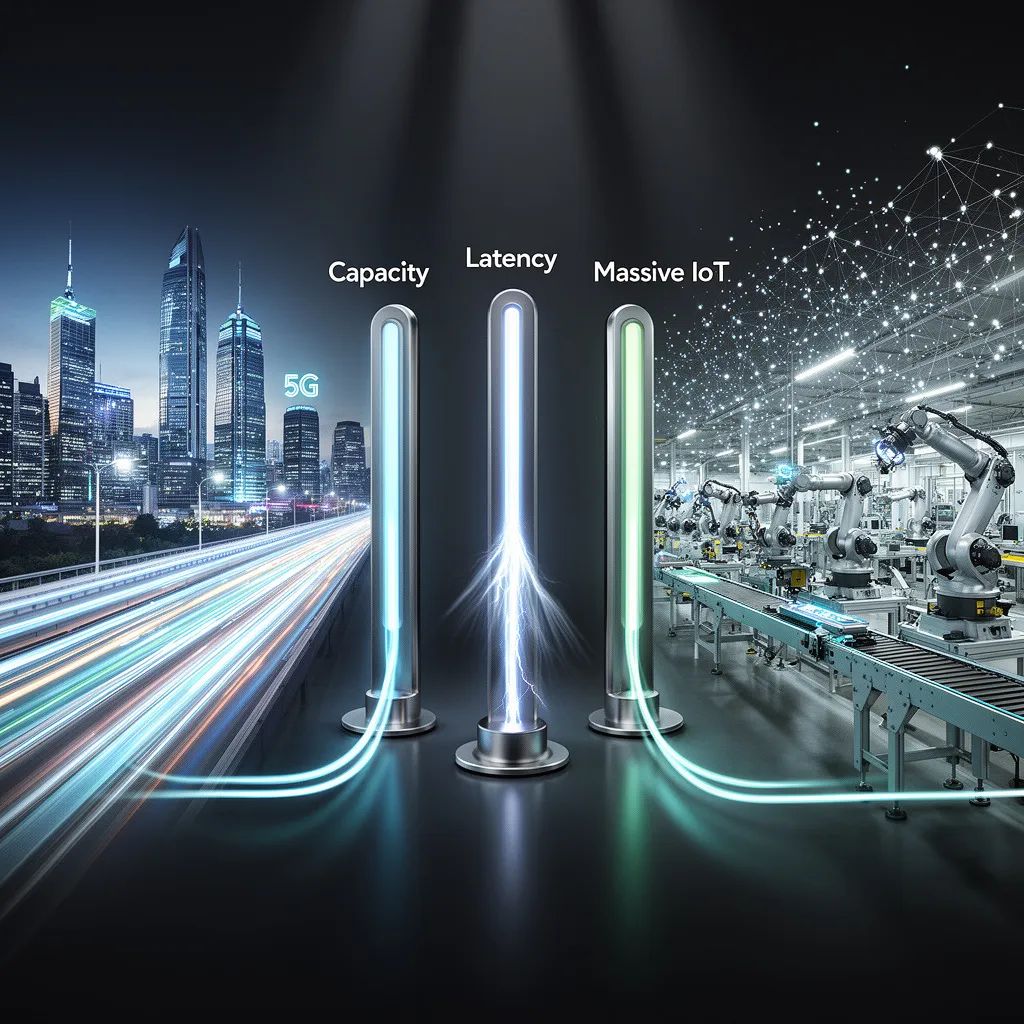
5G is best understood as three levers—Capacity, Latency, and Massive IoT—and its real value comes from matching the right lever to the right use case and business outcome.
What is 5G Really? A Simple Mental Model
When people hear “5G”, they often think it’s just “4G but faster”. Sometimes it is. But the real idea is simpler (and more useful) if you see 5G as a toolbox built around 3 promises. Not marketing promises—engineering capabilities that can be turned into business outcomes.
##Think of 5G as a 3-lever model:
- Capacity means the network can serve many more users and devices at the same time, like adding more lanes to a highway so traffic keeps moving even at rush hour.
- Latency means the network can react faster, like reducing the “reaction time” between a command and a response, which only becomes valuable when an application truly needs it.
- Massive IoT means the network can connect a huge number of sensors efficiently, like turning a city or factory into a living system that can be monitored in real time.
Now the key lesson: those levers are not equally valuable for every customer.
Most consumers rarely pay extra for lower latency, because they don’t “feel” it in daily apps. They do notice better consistency, fewer drops, and smoother video calls—usually driven by capacity, coverage, and smart optimization.
Enterprises are different. They pay for outcomes:
- Predictable performance for operations.
- Reliable connectivity for automation.
- Controlled security and local policies.
- Visibility and stability that reduce downtime risk.
So instead of asking “Is our 5G fast?”, a better question is: “What lever are we improving, for which use case, and what measurable outcome does it enable?”
That’s the mental model that keeps 5G strategy grounded: technology → capability → use case → business value.
#5G #Telecom #RAN #TelecomStrategy #DigitalTransformation #NetworkAutomation #AIinTelecom #PrivateNetworks #ORAN #SMO