Multivendor cSON Governance
National Unified Governance
Enforced unified cSON governance across Verizon's Samsung, Nokia, and Ericsson footprint.
Designing production-grade cSON architectures and SMO-driven automation to transform RAN operations.

"Industrializing Network Excellence"
Focused on bridging the gap between theoretical architecture and production reality. My mission is to streamline SON implementations, enabling autonomous network operations that drive real business value.
Designing production-grade Centralized SON architectures that scale. Expertise in closed-loop control systems and multivendor integration.
Transitioning legacy SON functions into rApps/xApps within O-RAN architectures. Leveraging SMO for intent-based network management.
Advanced parameter tuning and KPI optimization for NR NSA/SA. focusing on spectral efficiency and mobility management.
Enforced unified cSON governance across Verizon's Samsung, Nokia, and Ericsson footprint.
Integrated O-CU/O-DU components with Capgemini's SMO platform for centralized O-RAN assurance.
Engineered scalable cSON architectures for Tier-1 operators to automate LTE and 5G optimization.





Proven delivery across multivendor production environments and FOA/FFA validation gates.
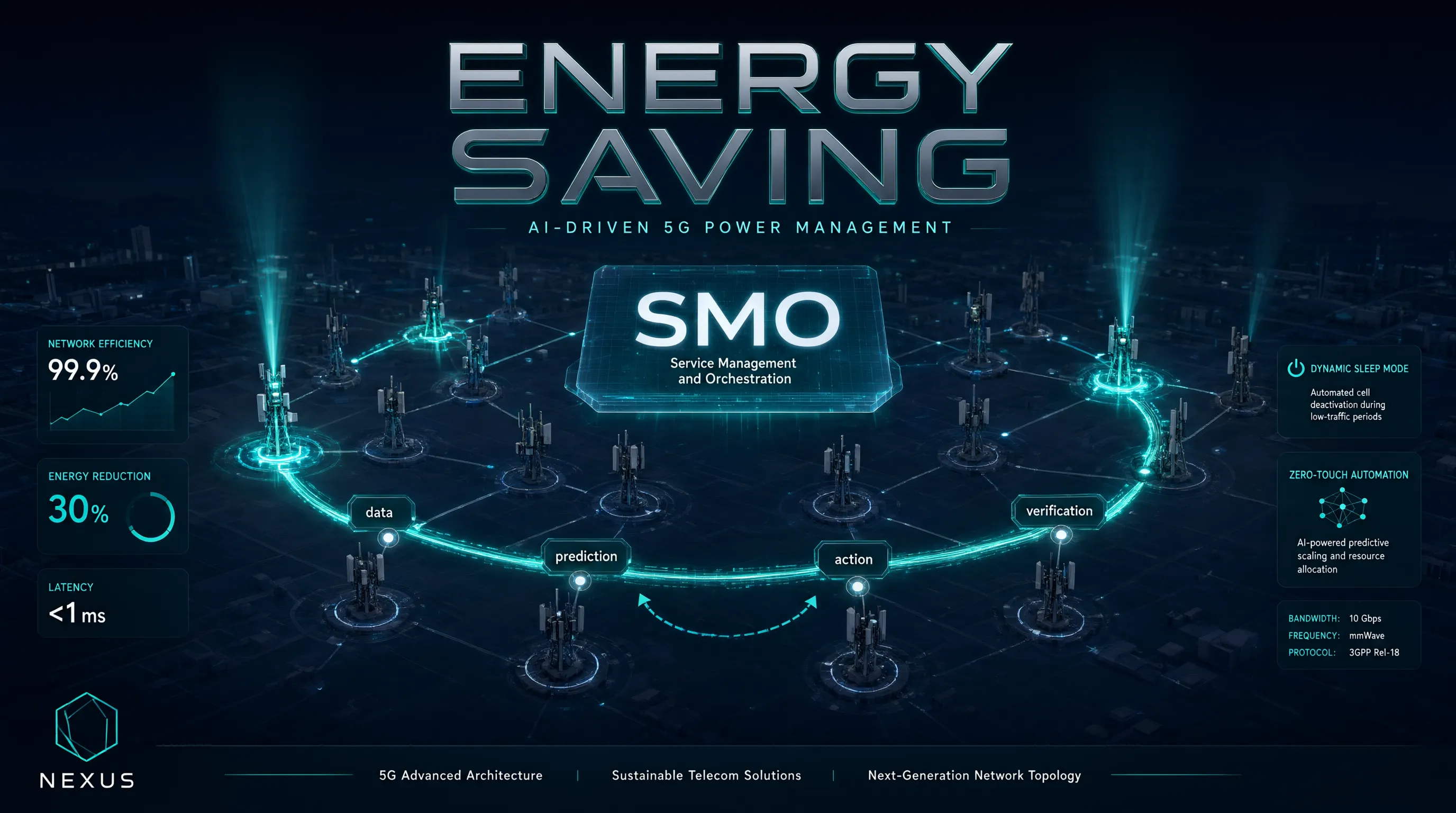
Learn how to build a closed loop for AI for RAN energy saving, from traffic prediction and rApp decisions to KPI verification, guardrails and rollback.
Read More
Descubre cómo AI-RAN convierte la red de acceso en una plataforma de cómputo, con sus tres frentes: AI for RAN, AI and RAN y AI on RAN.
Read More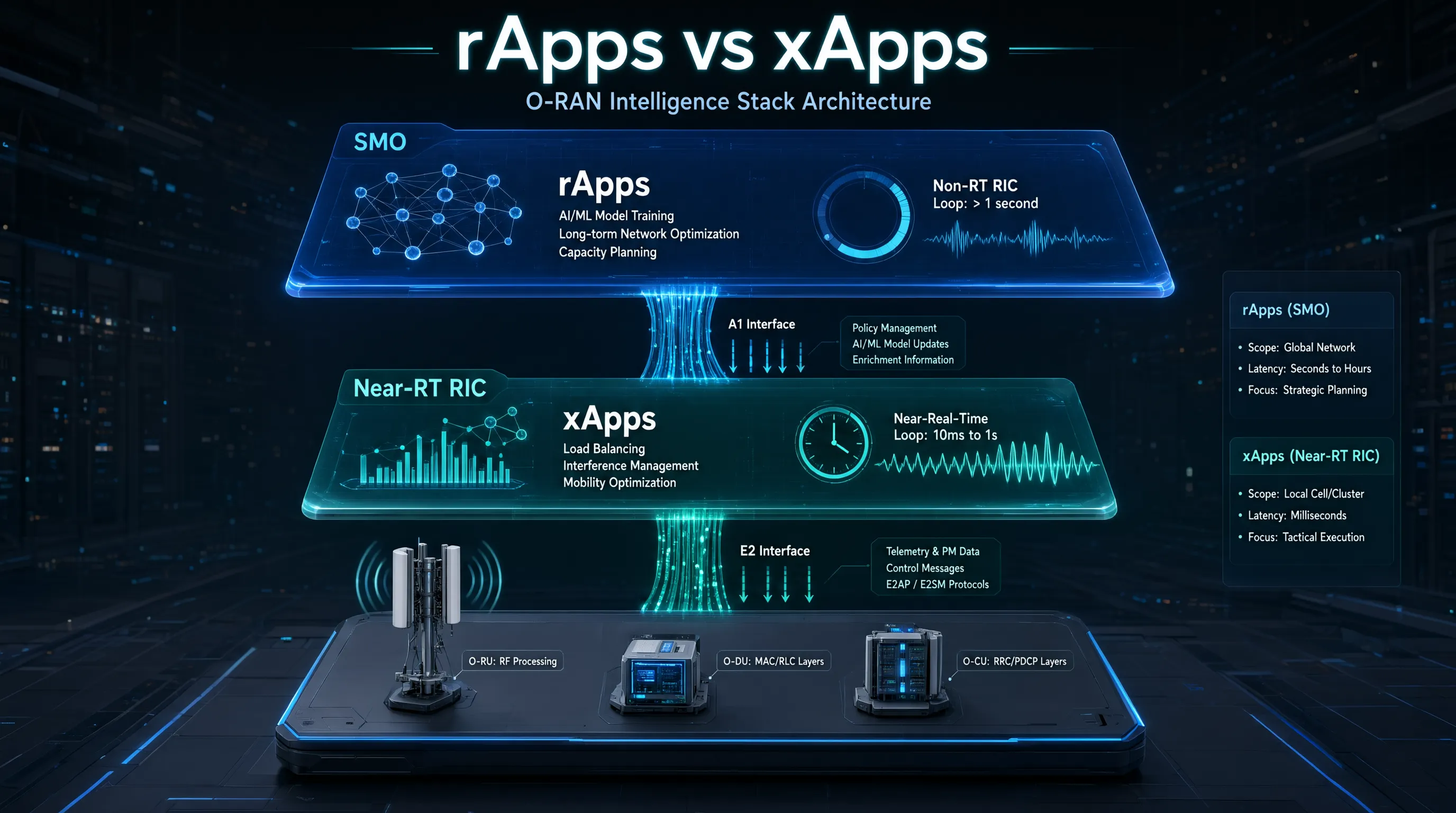
Learn where intelligence lives in O-RAN by comparing rApps on the Non-RT RIC and xApps on the Near-RT RIC, and how A1 and E2 connect their control loops.
Read More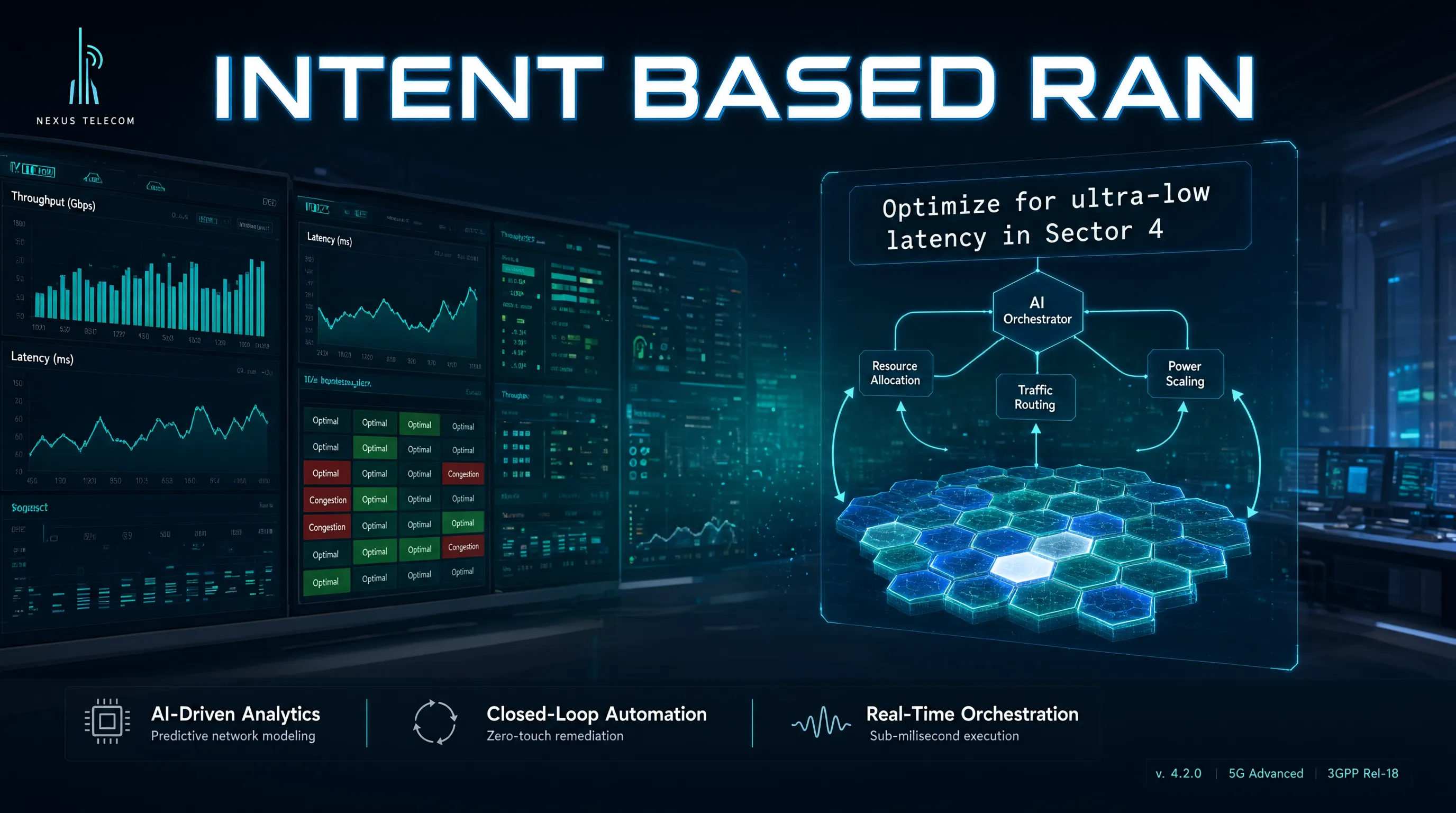
Discover how intent based RAN operations replace reactive KPI dashboards with outcome driven policies, closed loops and SMO enforcement in 5G networks.
Read More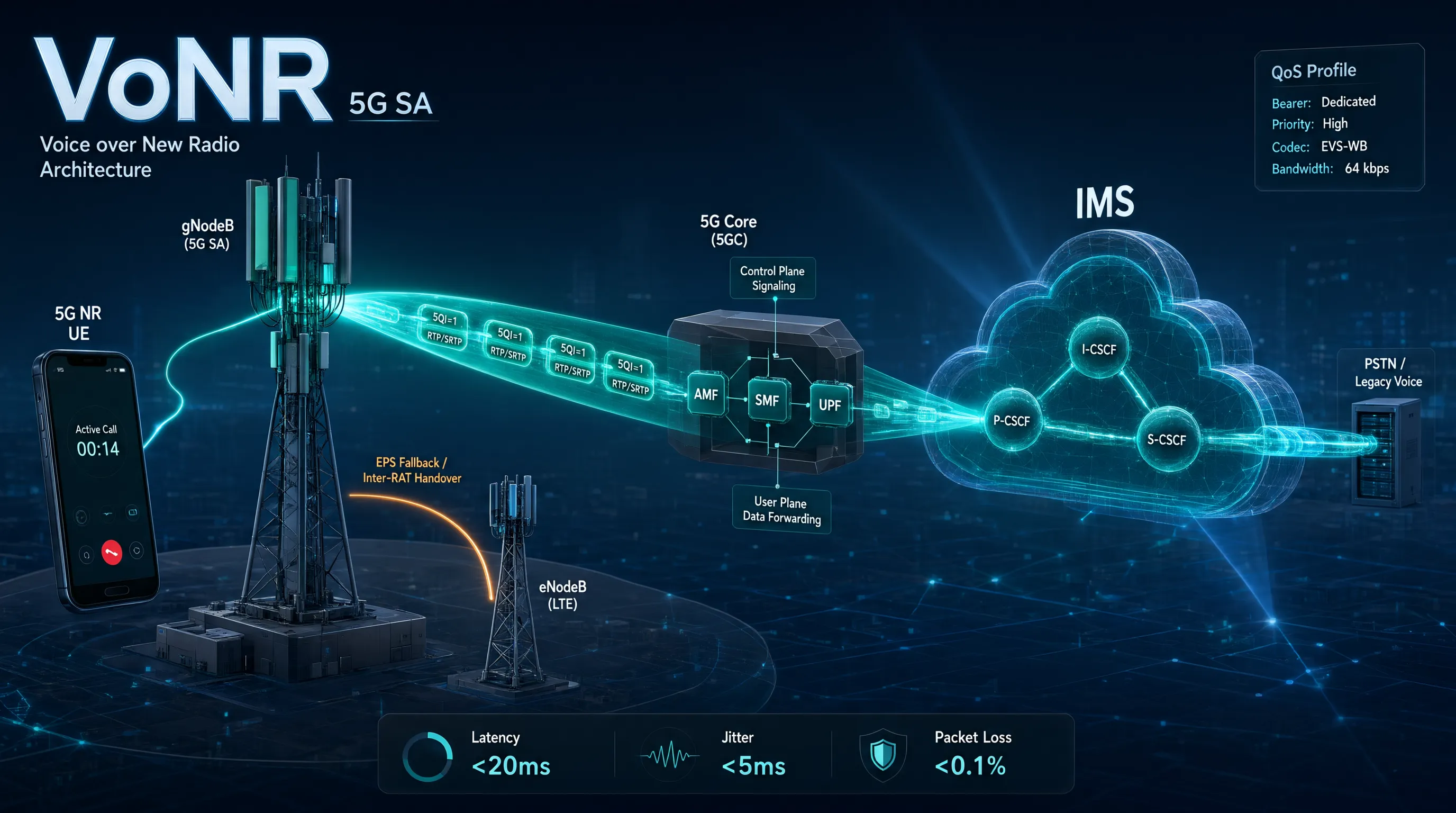
Descubre cómo VoNR en 5G SA convierte la calidad de voz en un tema de RAN: cobertura UL, movilidad a LTE, scheduling, EPS Fallback y KPIs clave.
Read More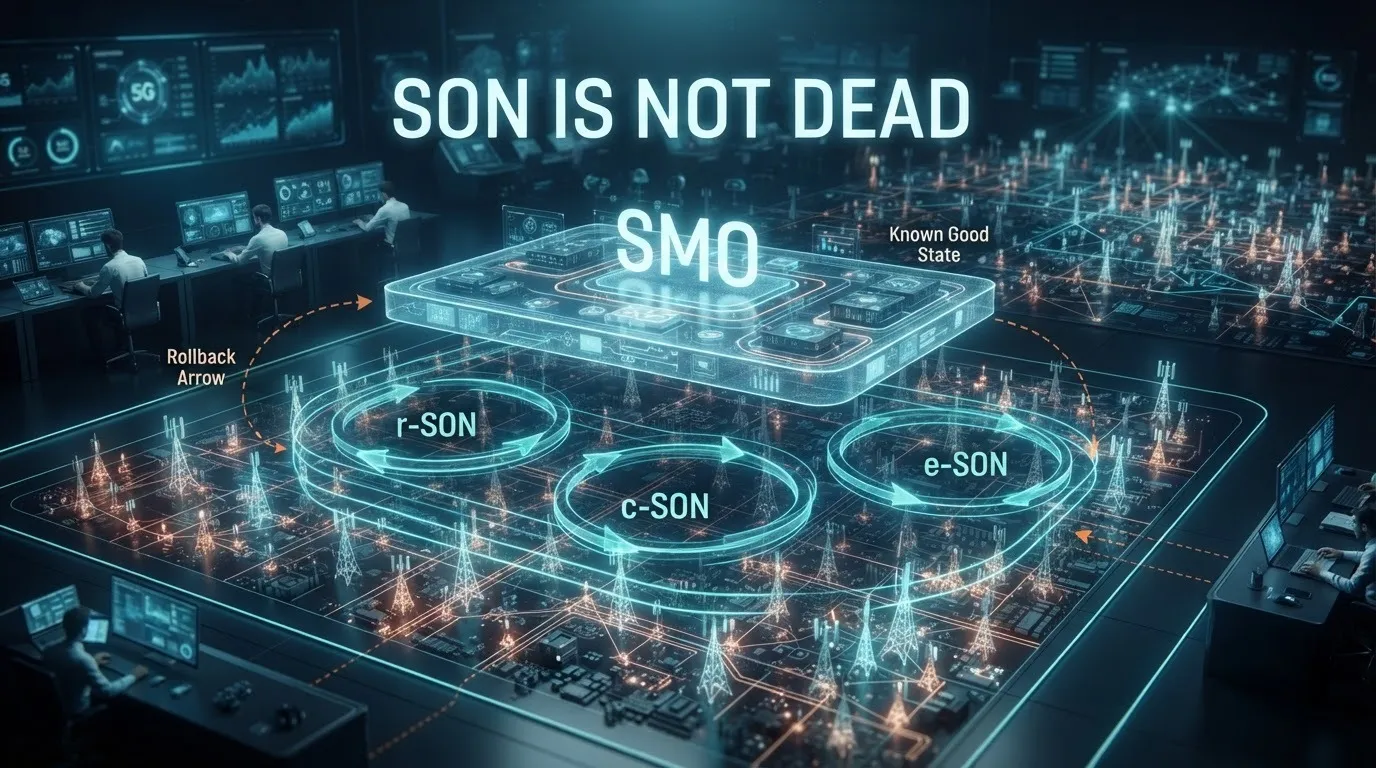
Explore why SON still matters and how SMO guardrails, policies, conflict detection and rollback make closed loop automation safe in O-RAN networks.
Read More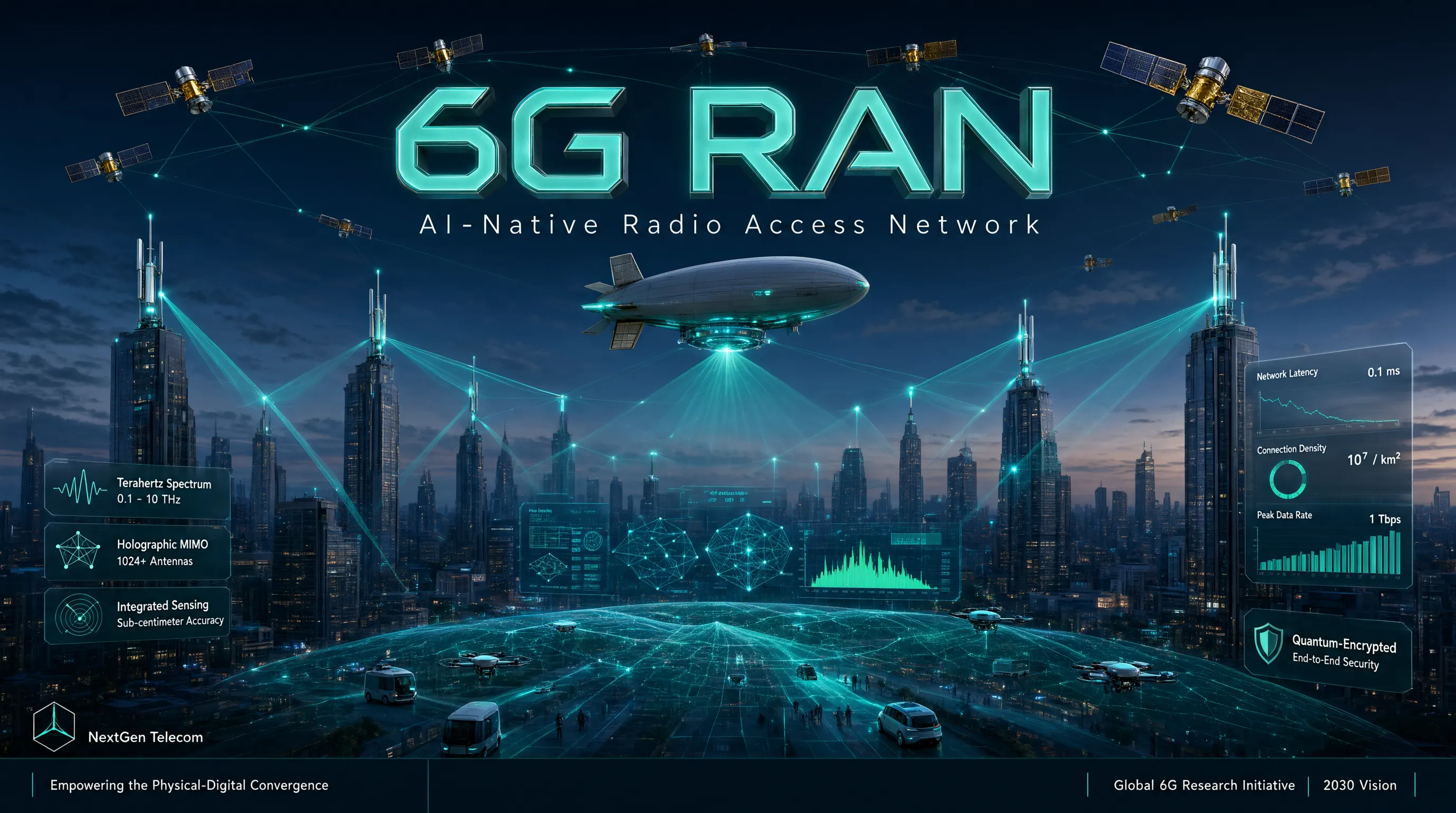
Learn the 6G design principles RAN engineers should study today, from AI native design and sensing to upper mid band spectrum and energy efficiency.
Read More
Descubre los criterios de diseño RF que definen una red privada 5G industrial: multitrayecto, SINR, TDD y espectro para latencia y confiabilidad.
Read More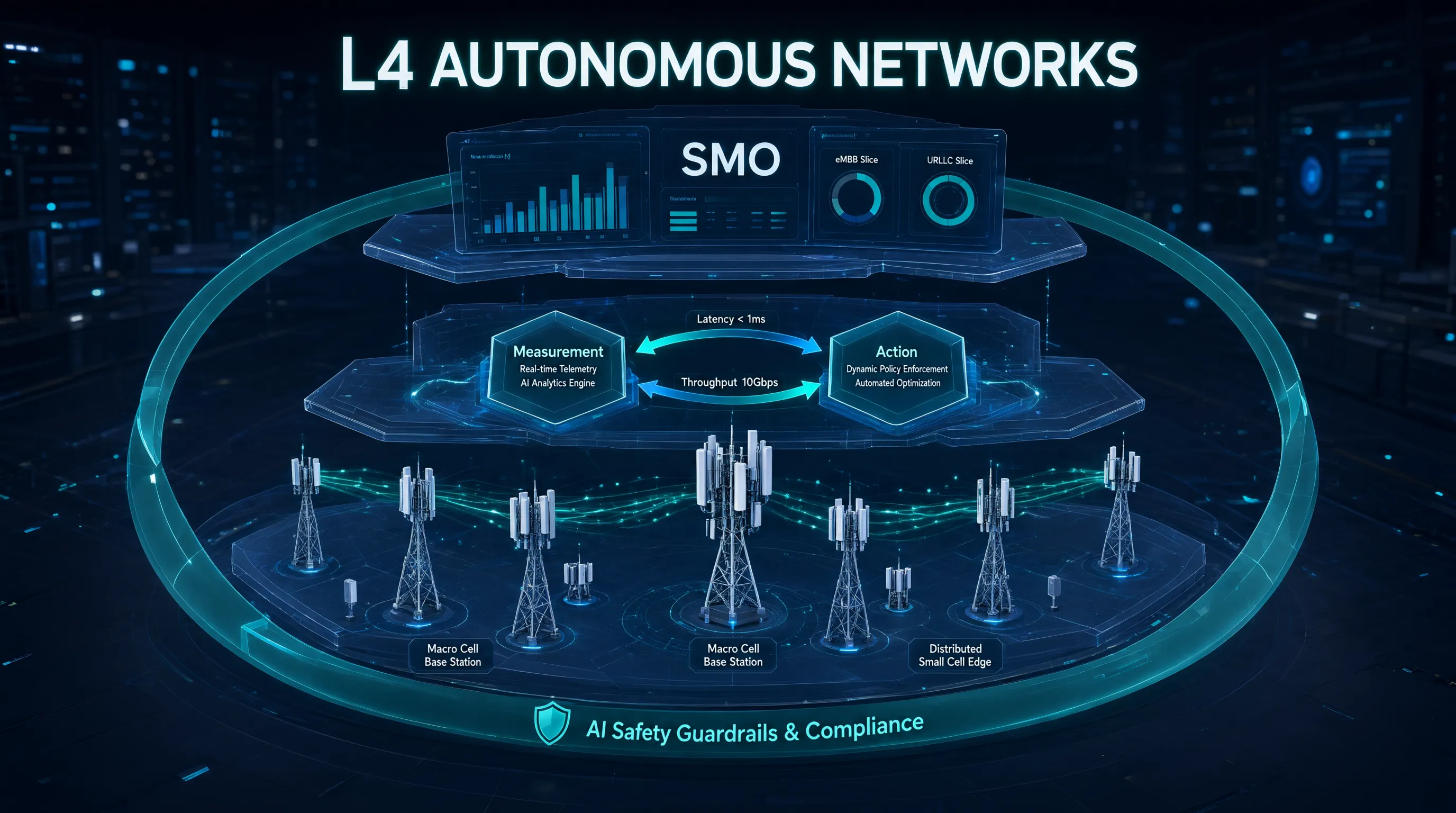
Understand what L4 Autonomous Networks require beyond automation: intent, guardrails, explainability and data discipline across RAN, SON and SMO.
Read More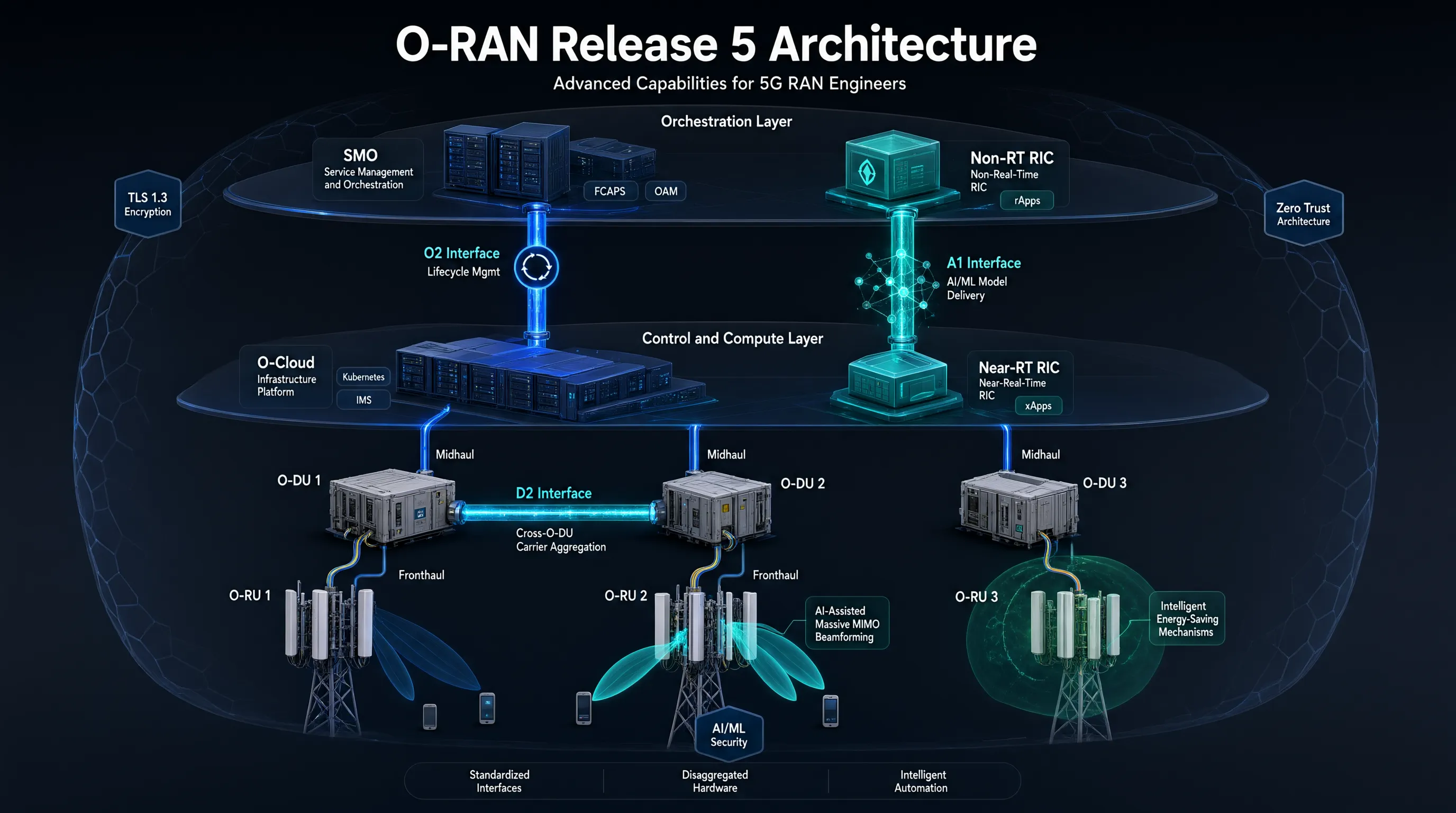
Explore O-RAN Release 5 advances in AI/ML, Massive MIMO, D2, O-Cloud, energy efficiency and intelligent RAN operations.
Read More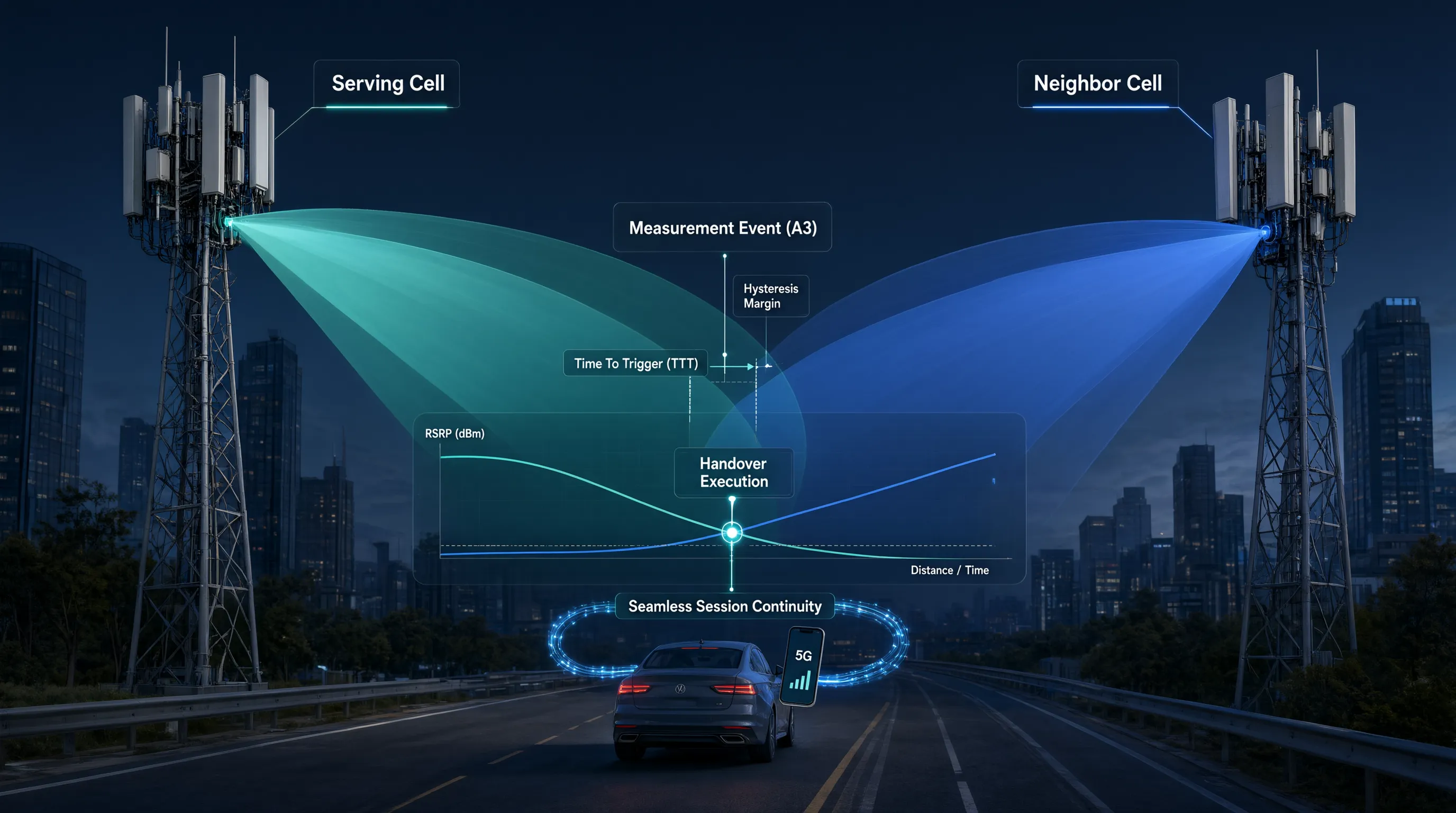
Descubre cómo el handover mantiene una conexión móvil usando mediciones RF, vecinos, hysteresis, offsets y Time To Trigger.
Read More
Understand how 5G cell edge conditions expose the interaction between SINR, interference, mobility, uplink and capacity.
Read More
Explore Digital Twin RAN as a safe validation layer for AI, automation, optimization and autonomous network decisions.
Read More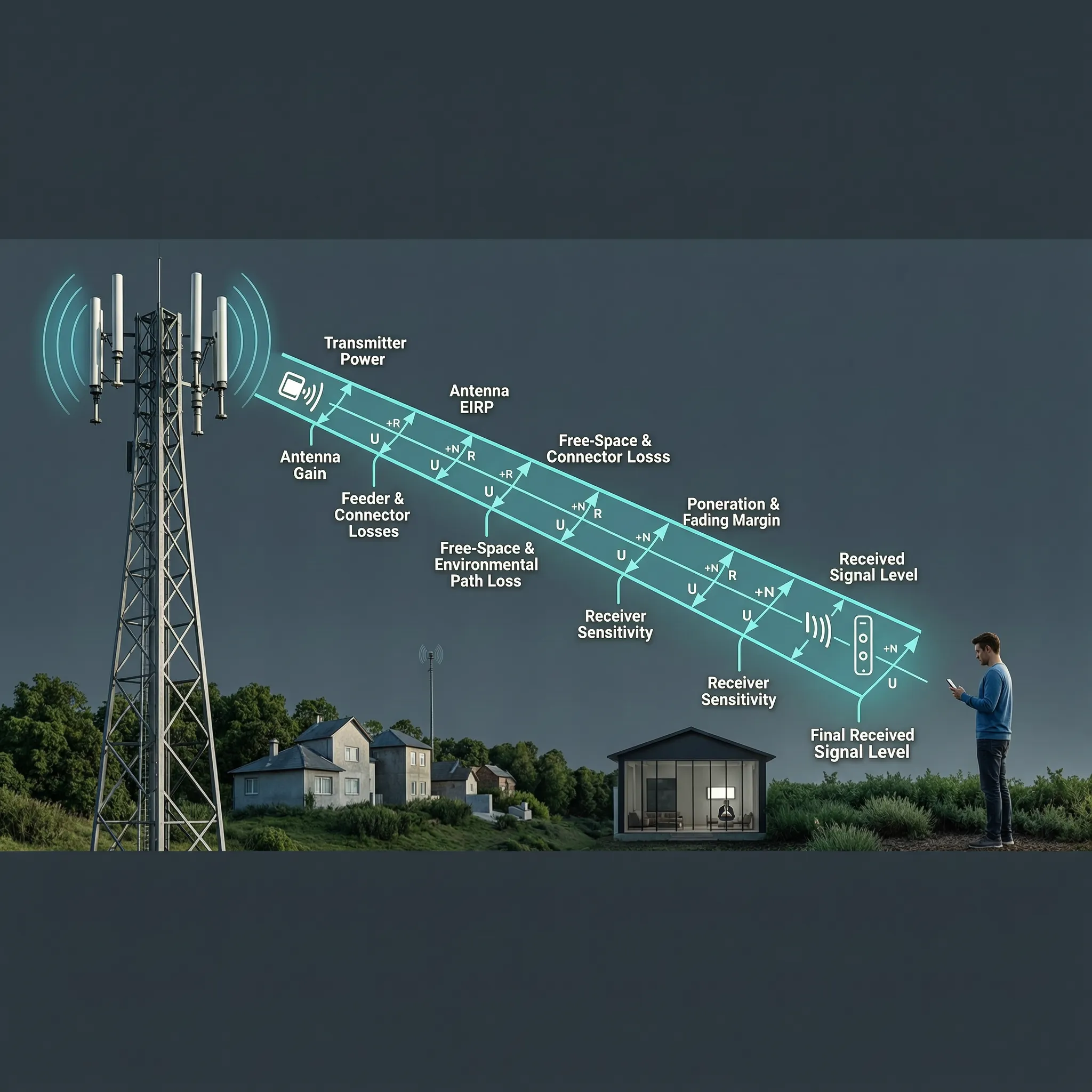
Domina el Link Budget para estimar cobertura, pérdidas, ganancias y márgenes antes de desplegar una red LTE o 5G.
Read More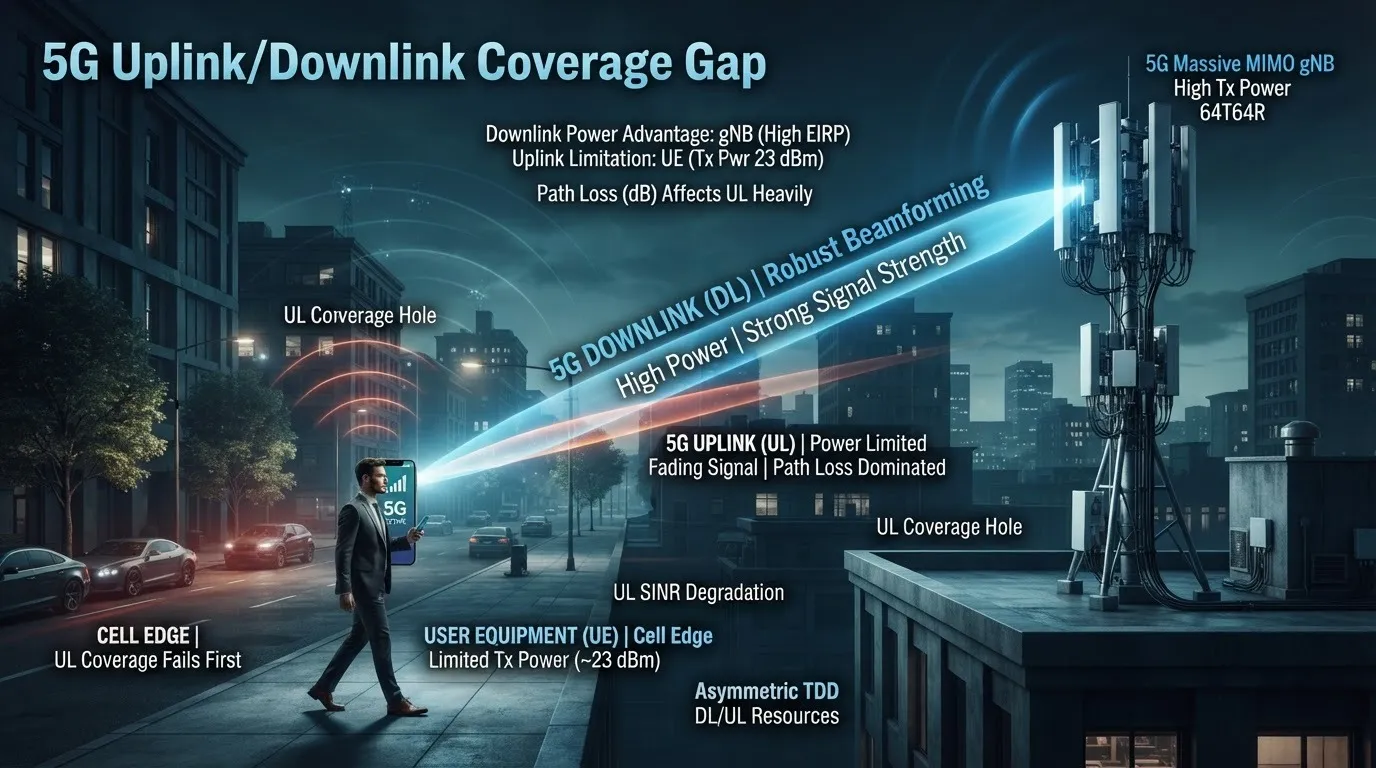
Understand 5G uplink limitations through UE power, link budget, TDD asymmetry, path loss, and cell-edge RF behavior.
Read More
Discover why the future of RAN optimization depends less on collecting more KPIs and more on understanding the operational context behind every metric.
Read More
Descubre por qué no todas las decisiones en una red móvil deben automatizarse y cómo encontrar el equilibrio entre IA y experiencia de ingeniería.
Read More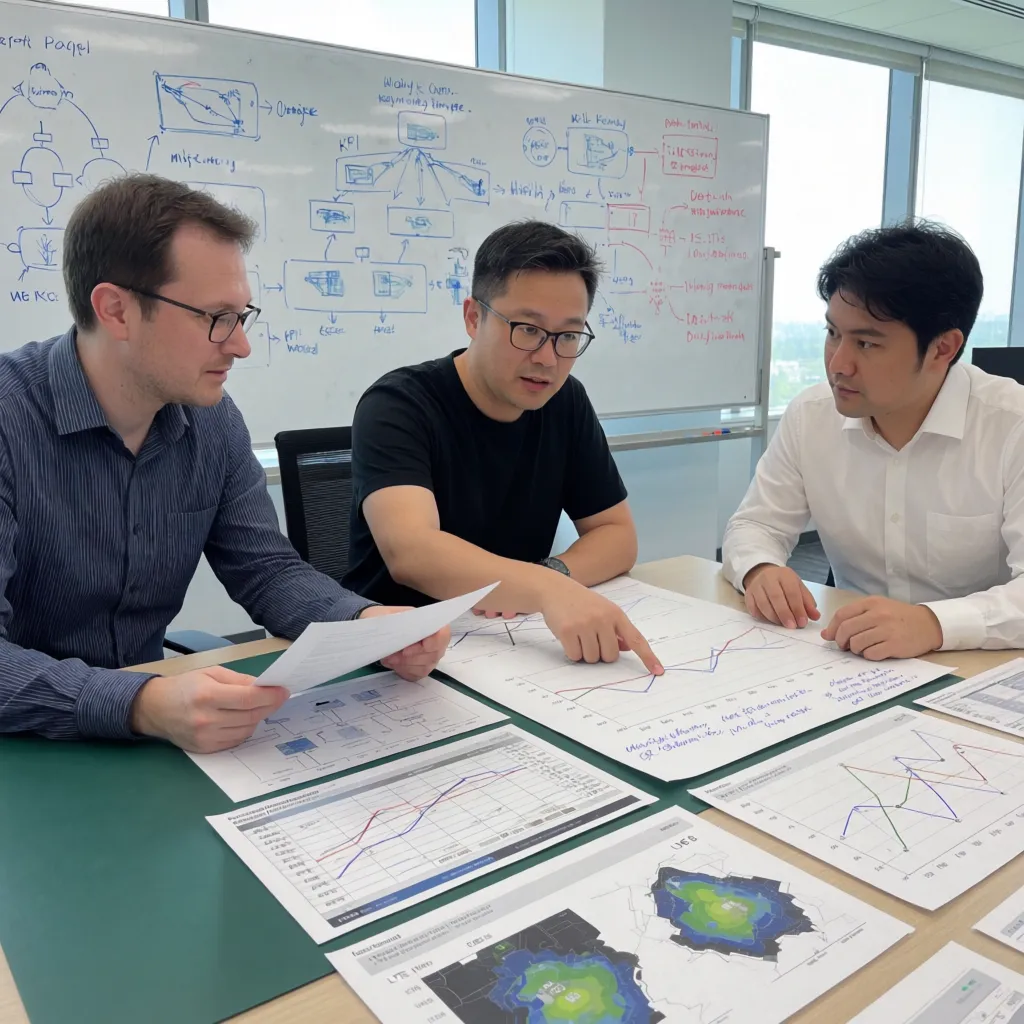
Learn why parameter tuning can unintentionally degrade network performance and why understanding system-wide behavior matters more than changing individual settings.
Read More
Discover why technical expertise alone isn't enough and what truly distinguishes a trusted RAN consultant from a highly skilled engineer.
Read More
Descubre por qué los errores más costosos en optimización RF no suelen ser técnicos, sino decisiones que ignoran el impacto sobre el resto de la red.
Read More
Explore why the biggest challenge of Cloud RAN may not be deployment, but operating increasingly virtualized and software-driven mobile networks.
Read More
Discover why network KPIs tell only part of the story and why understanding customer experience is essential for effective RAN optimization.
Read More
Discover why poor neighbor planning silently degrades mobility, user experience, and network efficiency, and why ANR remains critical in modern RAN optimization.
Read More
Discover why AI alone cannot optimize mobile networks and why decades of RF engineering expertise remain essential for intelligent automation.
Read More
Descubre por qué el mayor desafío en proyectos multivendor no es la interoperabilidad, sino lograr que tecnologías con filosofías distintas funcionen como una sola red.
Read More
Learn a structured approach to determine whether a network issue originates in the RAN or the Core by correlating user experience, KPIs, and system behavior.
Read More
Explore why rApps are far more than software applications and how they transform engineering expertise into scalable network automation.
Read More
Descubre por qué el primer KPI que reviso ante una queja de usuarios no es la cobertura, sino el que mejor refleja la experiencia real del cliente.
Read More
Discover why network congestion is often caused by inefficient resource management rather than a lack of spectrum, and how optimization can unlock hidden capacity.
Read More
Explore when AI should make autonomous decisions in RAN and why balancing automation with engineering expertise is key to intelligent networks.
Read More
Descubre cómo la evolución de RF Optimization, pasando por cSON, llevó al diseño de soluciones de automatización e inteligencia para redes móviles.
Read More
Discover why experienced RAN engineers often ignore coverage KPIs first and focus on the metrics that reveal the true root cause of network performance issues.
Read More
Explore why long-term O-RAN success depends more on operational excellence than on deployment and integration
Read More
Analiza una celda congestionada desde la causa raíz antes de decidir ampliar capacidad en una red móvil.
Read More
Learn why experienced RF engineers often prioritize SINR over RSRP when diagnosing real-world network performance.
Read More
Descubre por qué el verdadero valor de un consultor RAN no está solo en optimizar KPIs, sino en comprender problemas complejos y guiar mejores decisiones técnicas.
Read More
Explore why AI-RAN will transform the role of RF engineers rather than eliminate the need for engineering judgment
Read More
Descubre por qué algunos problemas de RAN requieren mejor ingeniería y no necesariamente más infraestructura.
Read More
Explore why achieving autonomous networks requires far more than deploying an SMO platform.
Read More
Discover three engineering lessons from optimizing one of the largest mobile networks in the United States.
Read More
Discover why experienced RAN engineers prioritize context over throughput when troubleshooting complex network performance issues
Read More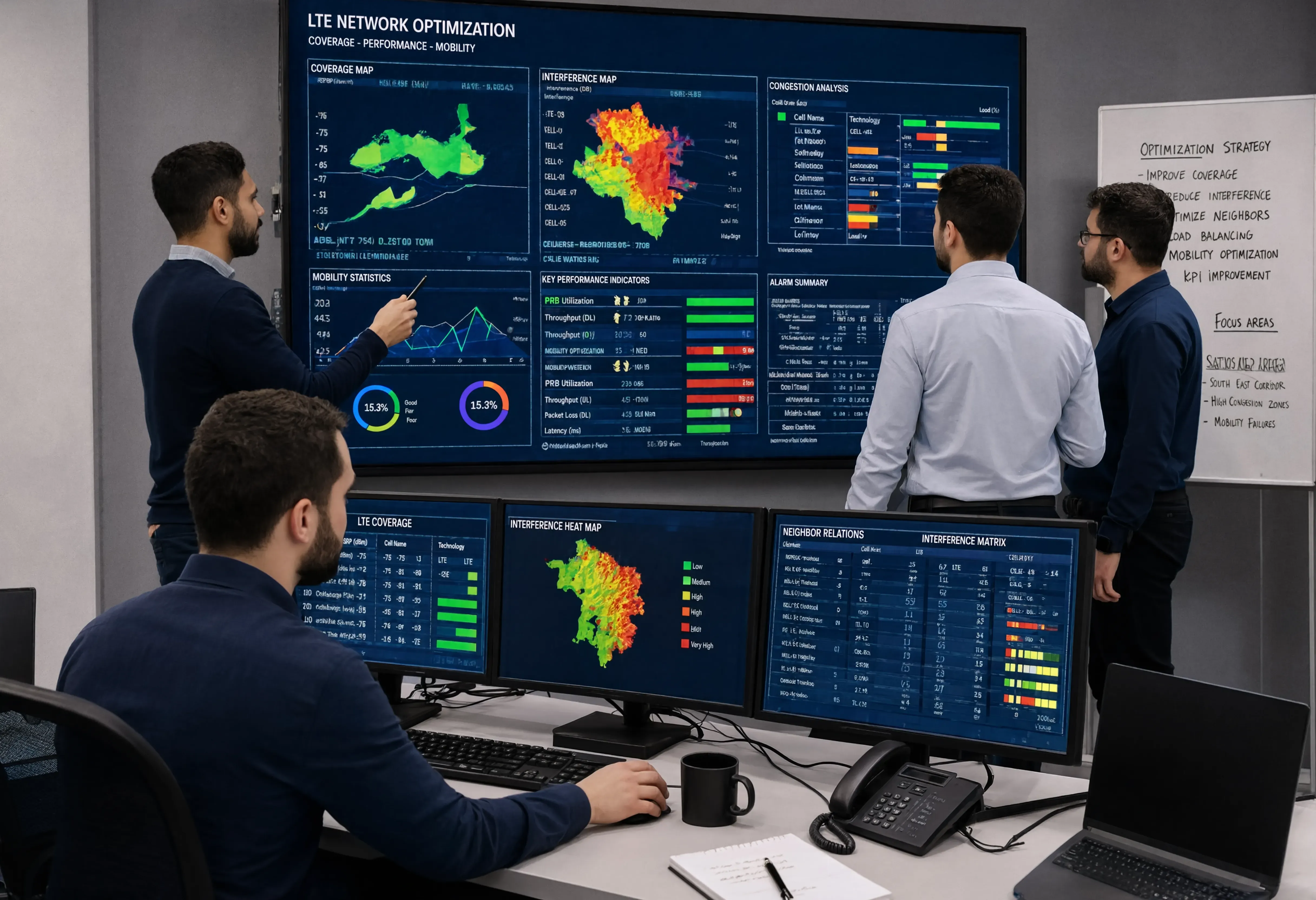
Descubre los errores más frecuentes en la optimización LTE y cómo un mejor diagnóstico acelera la solución de problemas en RAN.
Read More
Explore why future telecom networks must optimize customer experience and business outcomes, not only technical KPIs
Read More
Explore how SON, SMO and AI are transforming network optimization from KPI management to customer experience improvement.
Read More
Discover how poor QoE silently impacts customer retention, operational costs, and revenue growth in telecom networks.
Read More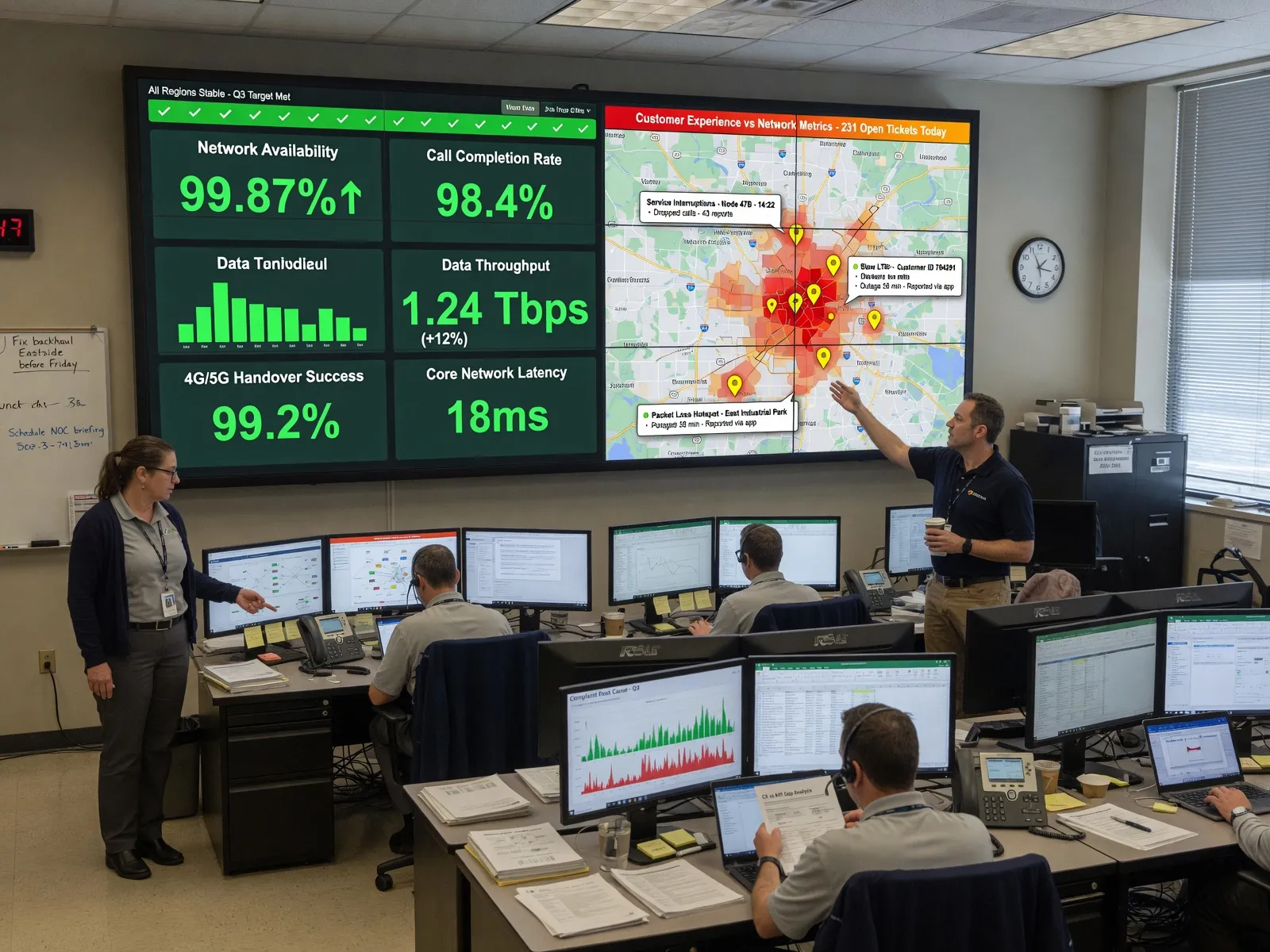
Discover why healthy network KPIs can mask poor customer experience and lead to flawed optimization decisions.
Read More
Explores how AI, SMO, and intelligent automation are enabling energy-aware RAN optimization by dynamically balancing network performance and power consumption.
Read More
Explores how AI, SMO, and intelligent automation are enabling energy-aware RAN optimization by dynamically balancing network performance and power consumption.
Read More
Explores why energy efficiency is emerging as a key telecom KPI, complementing traditional network performance metrics such as throughput, coverage, and capacity.
Read More
Explores the tradeoff between energy efficiency and network performance, highlighting how operators balance power savings with coverage, capacity, and user experience.
Read More
Explains the main sources of energy consumption in RAN, from power amplifiers and Massive MIMO radios to baseband processing and supporting infrastructure.
Read More
Energy Efficiency in RAN: Why It’s a Business Strategy, Not Just a Sustainability Initiative
Read More
Explores how AI-driven predictive optimization could transform Massive MIMO by anticipating user behavior, traffic demand, and beam management decisions before performance degrades.
Read More
Explains why Massive MIMO does not always deliver expected performance gains, highlighting the impact of SINR, traffic density, device capabilities, and beam management.
Read More
Explains why beam management is the real challenge in Massive MIMO, requiring continuous adaptation of radio resources to changing user locations and network conditions.
Read More Explains why Massive MIMO beamforming primarily improves signal quality, spectral efficiency, and capacity rather than simply extending 5G coverage.
Read More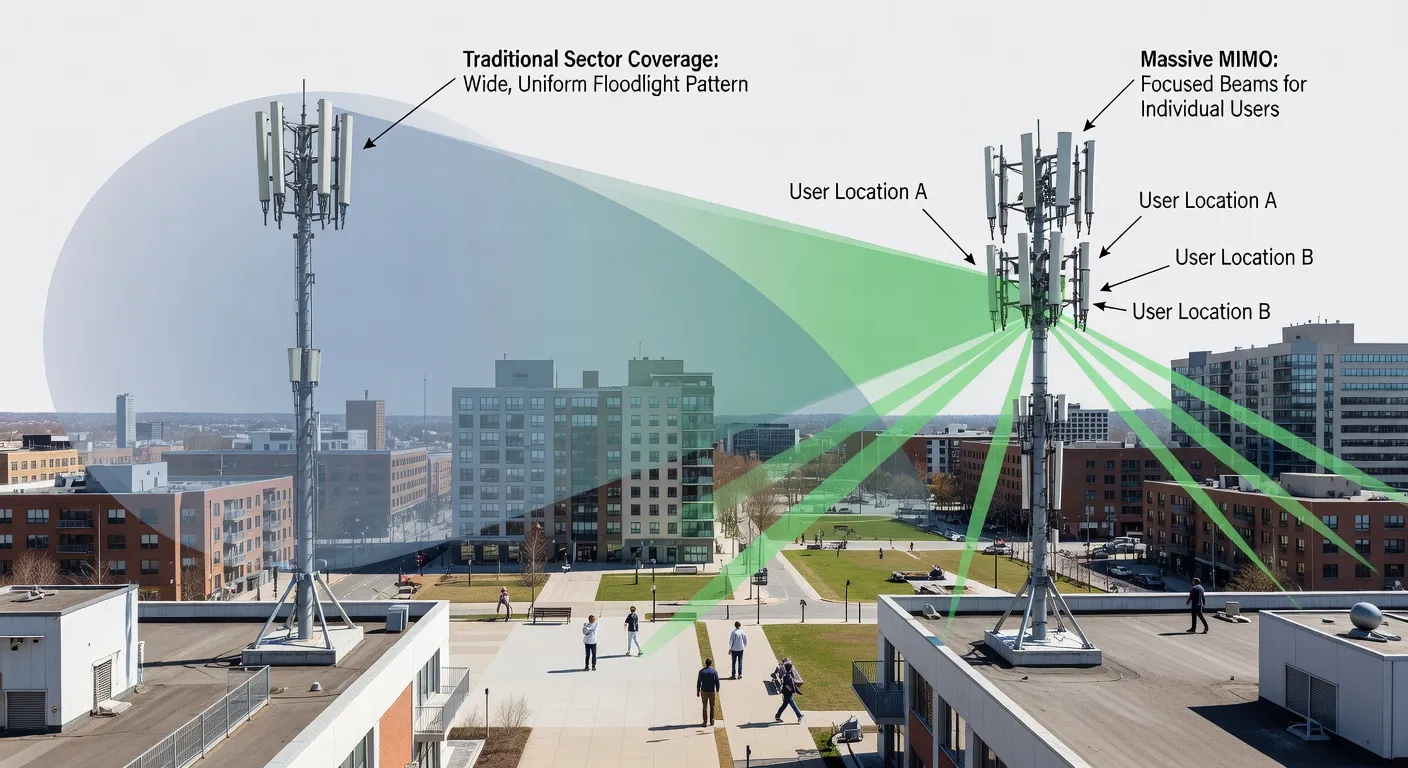
Explains how Massive MIMO transformed RF planning by replacing uniform sector coverage assumptions with dynamic beam-based radio resource allocation.
Read More
Explores how AI is transforming traditional SON by enabling more adaptive, predictive, and intelligent RAN optimization strategies
Read More
Explores the operational differences between AI-assisted and autonomous RAN, highlighting the balance between automation, human oversight, and network control.
Read More
Explains why poor telecom data quality limits the effectiveness of AI-driven RAN optimization more than the AI model itself.
Read More
Explains why AI models struggle in real RAN environments due to dynamic network conditions, inconsistent data, and operational complexity.
Read More
Where AI actually creates operational value in RAN beyond the hype -- through better decision-making, resource allocation, and root cause analysis, not through monitoring dashboards alone.
Read More
Explains how device capabilities significantly impact real 5G throughput, often limiting performance regardless of network conditions.
Read More
Explains why low network utilization does not guarantee available capacity, highlighting the gap between theoretical and usable 5G performance.
Read More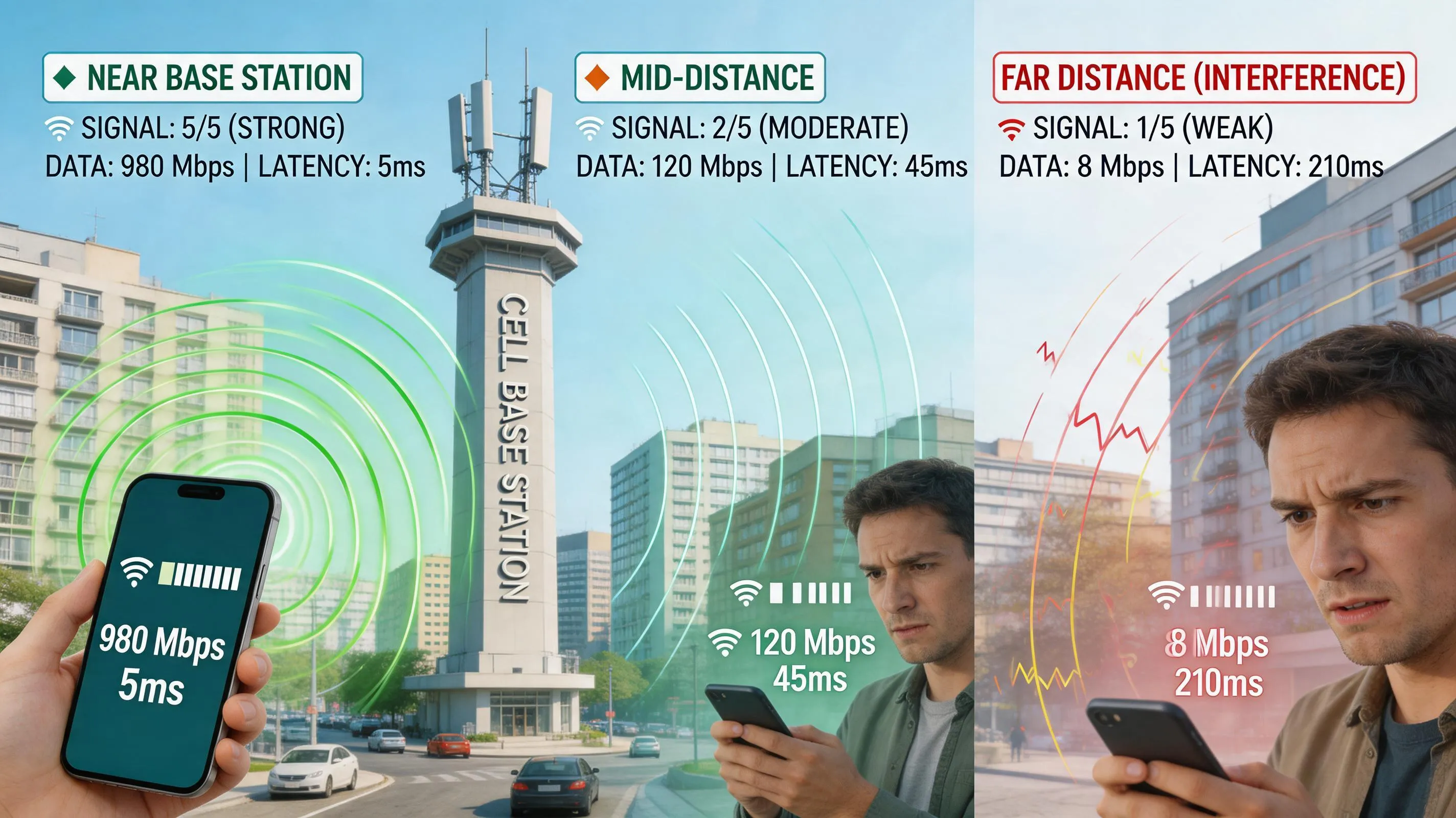
Explains why SINR has a greater impact than bandwidth on real 5G throughput by determining how efficiently spectrum can be used.
Read More
Explains how RAN scheduling decisions directly impact user throughput by dynamically allocating resources among multiple users in real time.
Read More
Explains why real-world 5G throughput differs from theoretical peak speeds due to interference, shared resources, and non-ideal radio conditions.
Read More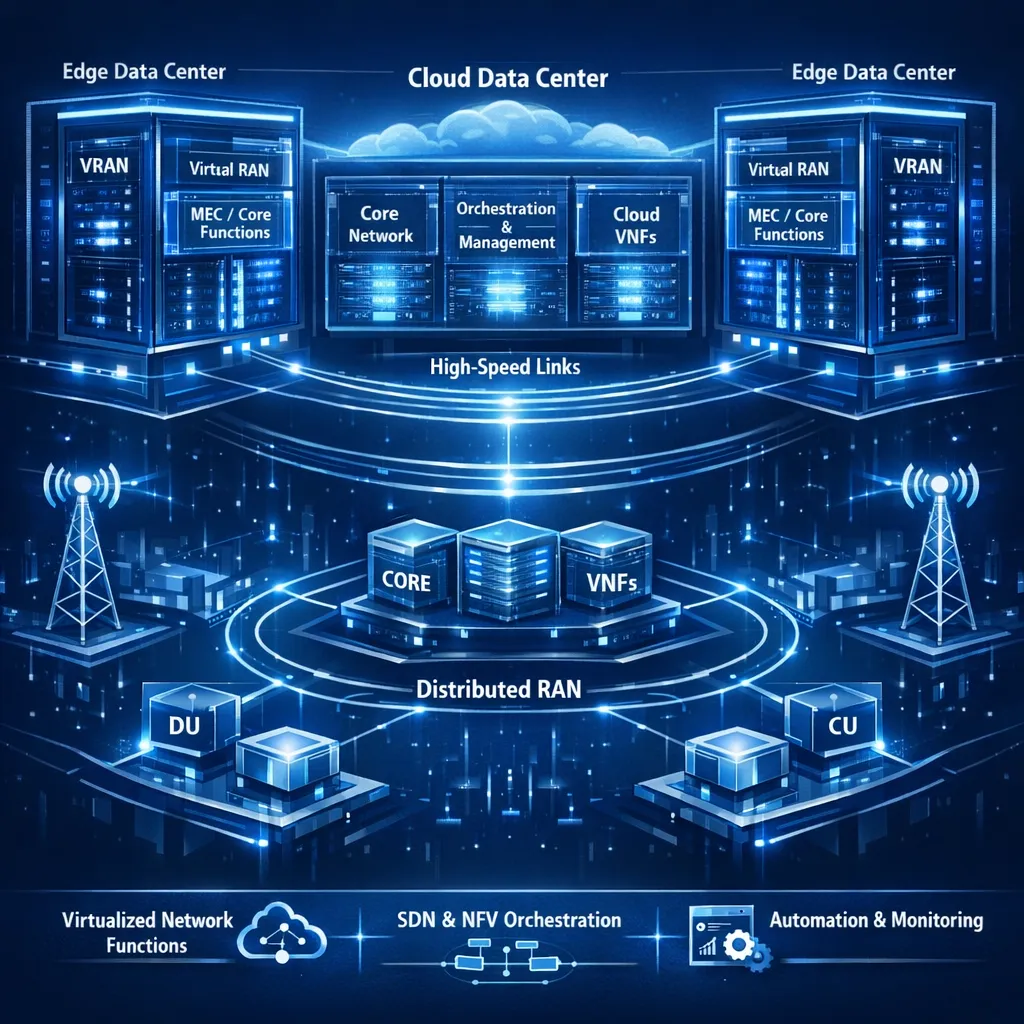
Explores how cloud-native and distributed RAN architectures transform network design while introducing new challenges in performance, latency, and operational complexity
Read More
Explores how hybrid multi-RAT networks introduce complex interworking challenges that define real RAN performance beyond individual technologies
Read More
Explores how intelligent scheduling will become a key driver of RAN performance by dynamically balancing diverse traffic demands in 5G Advanced networks
Read More
Explores whether current RAN architectures can deliver the consistent low-latency performance required for scalable XR and immersive traffic.
Read More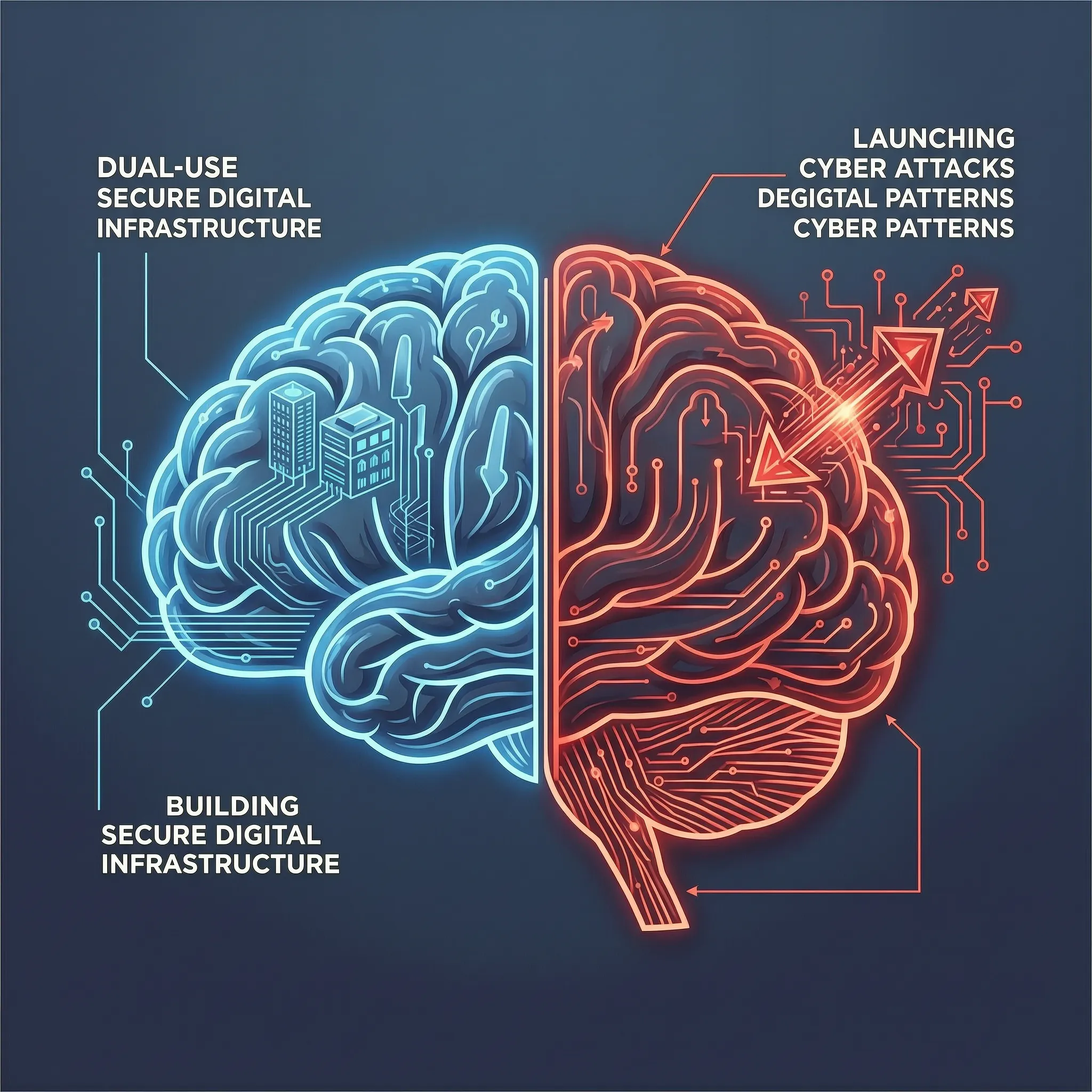
Explores how dual-use AI amplifies both innovation and cyber risk, highlighting the growing challenge of balancing technological advancement with security and control.
Read More
Explores whether full-duplex radio can truly double spectrum efficiency or if practical interference challenges will limit its real-world deployment
Read More
Explains how AI is accelerating both cyber defense and attacks, creating an emerging arms race where speed and intelligence redefine security risks.
Read More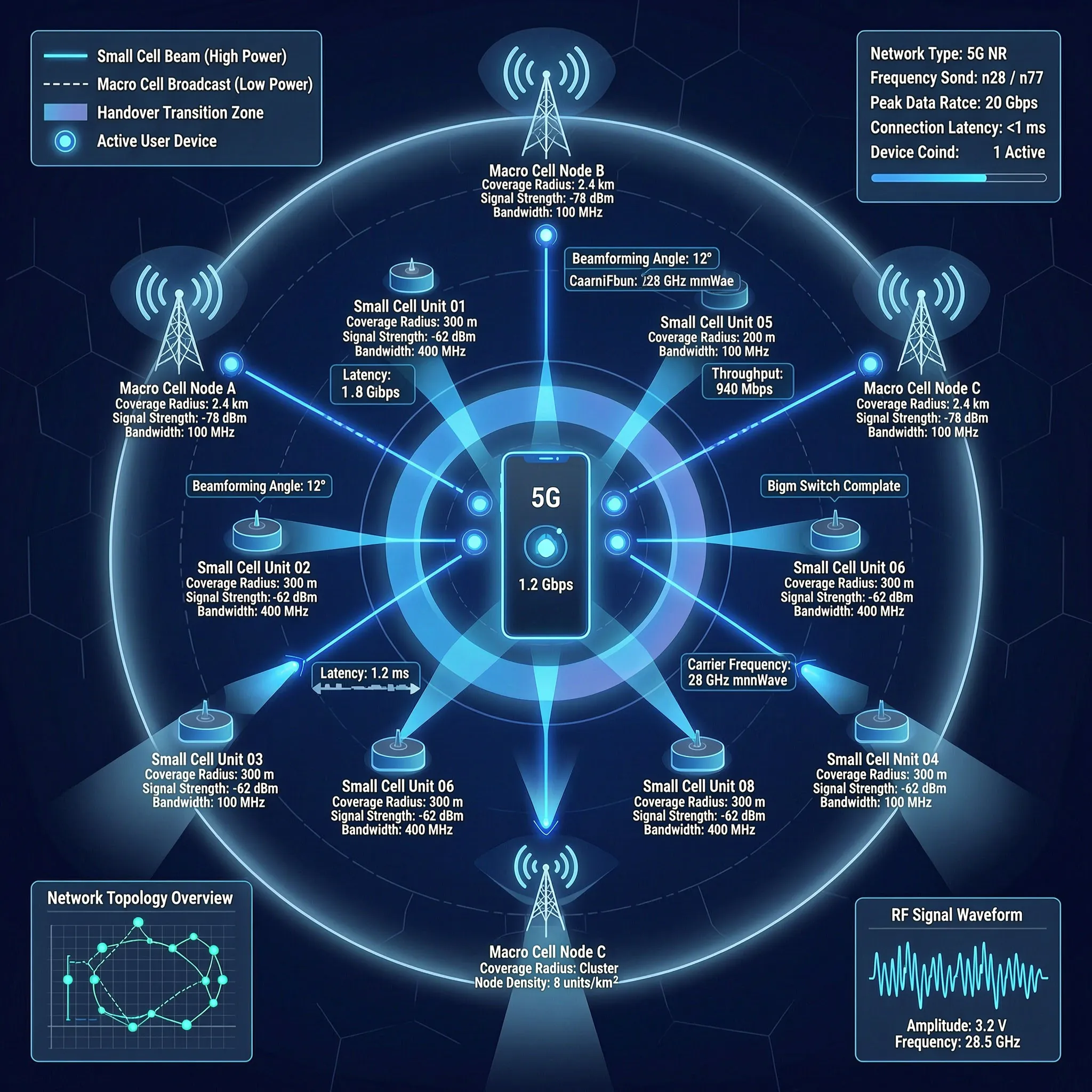
Explains why handover remains a complex challenge in 5G despite Rel-18 improvements, due to increasing network complexity and multi-layer mobility dynamics.
Read More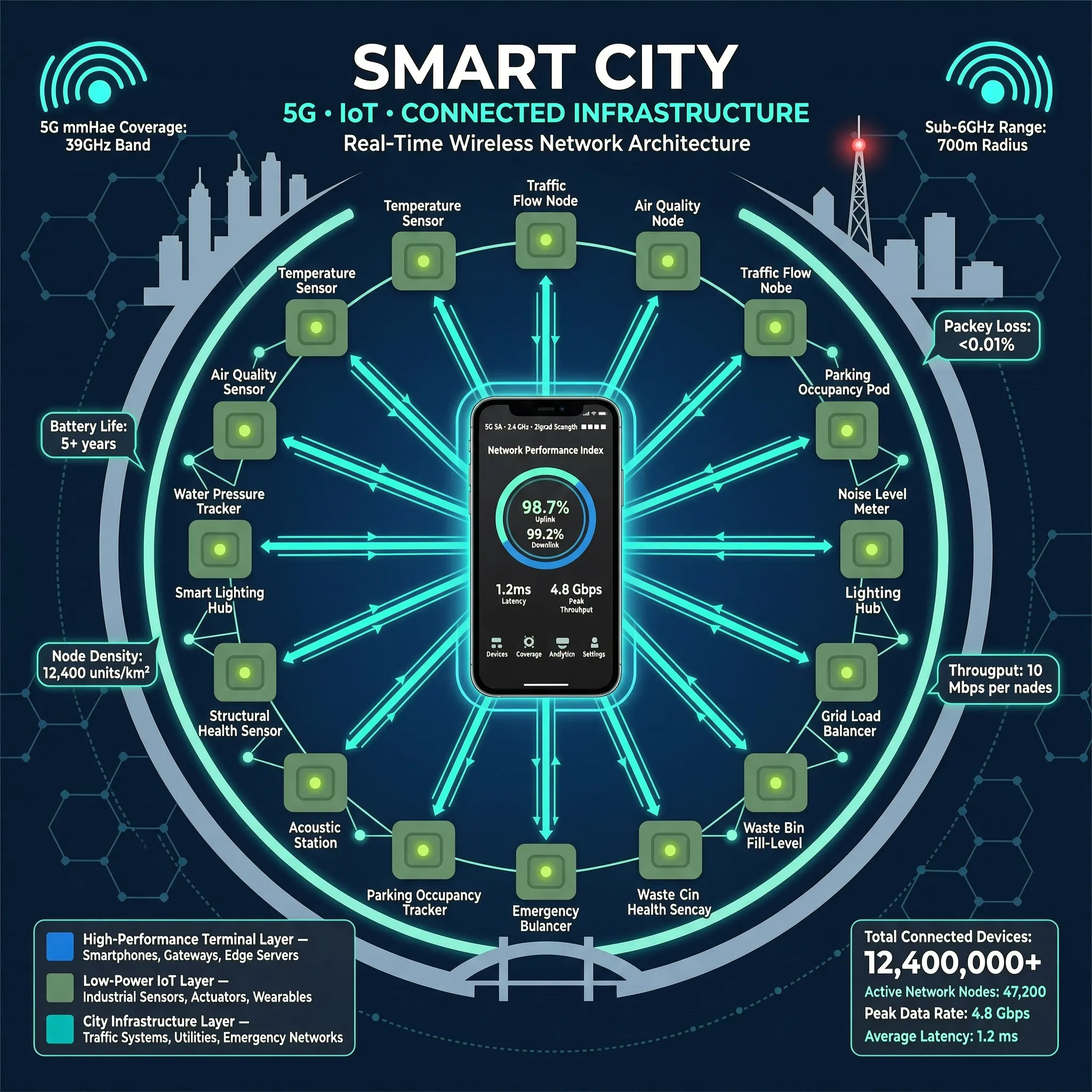
Explains how RedCap in 3GPP Rel-18 enables scalable and cost-efficient 5G adoption by aligning network performance with real device needs.
Read More
Explains how open-weight AI models like Gemma 4 are shifting power from centralized control to distributed innovation, redefining who builds and owns AI capabilities.
Read More
Explains how 3GPP Rel-18 NTN transforms RF design by introducing moving cells, Doppler effects, and dynamic coverage, redefining traditional RAN planning and optimization.
Read More
Explains how 3GPP Rel-18 shifts energy efficiency from a secondary optimization goal to a core design principle in 5G RAN. It highlights the need for intelligent, AI-driven networks that balance performance and energy consumption as a new key KPI.
Read More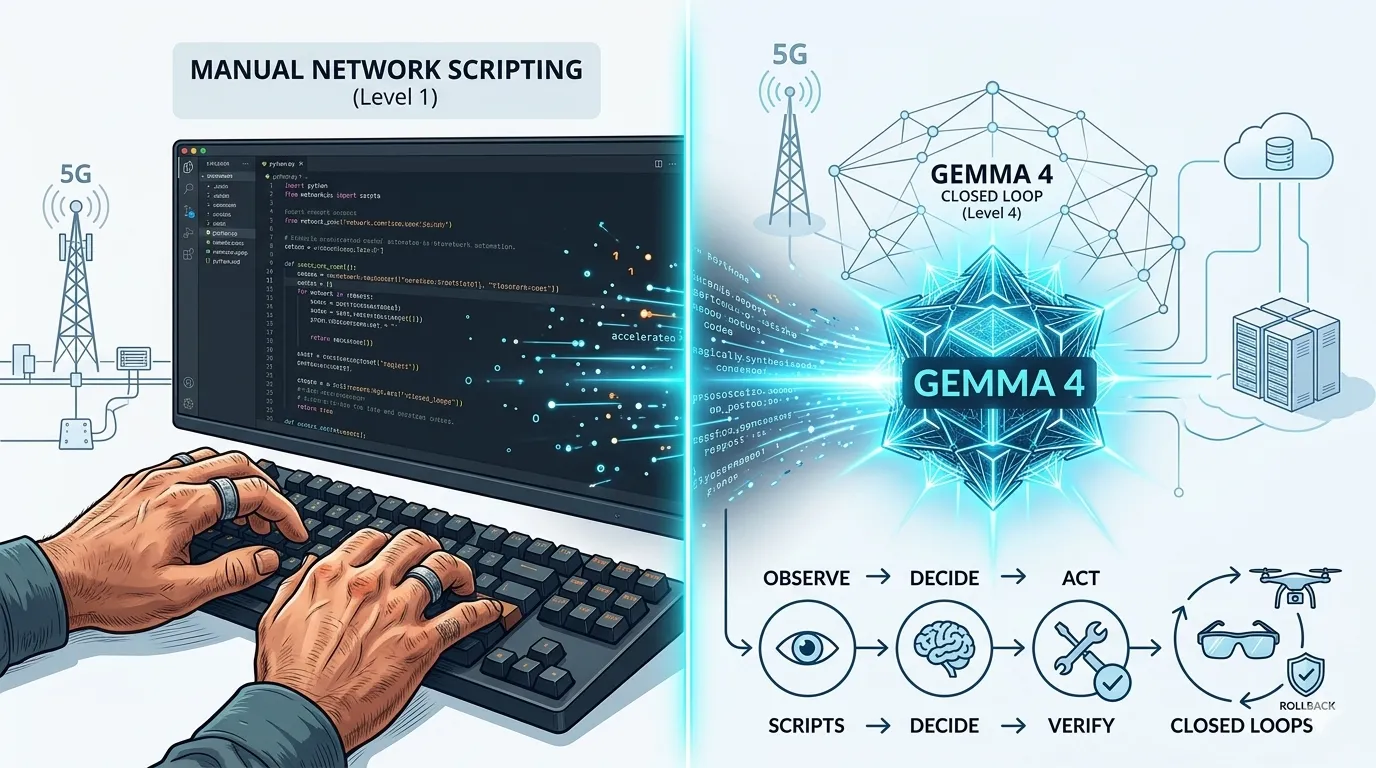
Explains practical applications of open AI models like Gemma 4, showing how they enable automation, technical support, and smarter workflows even without deep AI expertise.
Read More
Explains how 3GPP Rel-18 is driving the transition from traditional rule-based SON to AI-native RAN, where networks can learn, adapt, and make autonomous decisions. It highlights the shift from engineered optimization toward self-evolving, intelligent network behavior.
Read More
Explains how Gemma 4 signals a shift toward more accessible, adaptable AI, enabling broader innovation beyond large tech companies.
Read More
This post explores what truly defines an intelligent network, emphasizing that intelligence is not about automation or AI alone, but about making consistent, context-aware decisions aligned with real outcomes.
Read More
This post explores how Cloud RAN introduces flexibility but also shifts complexity from hardware to software, emphasizing the new operational and architectural challenges it brings.
Read More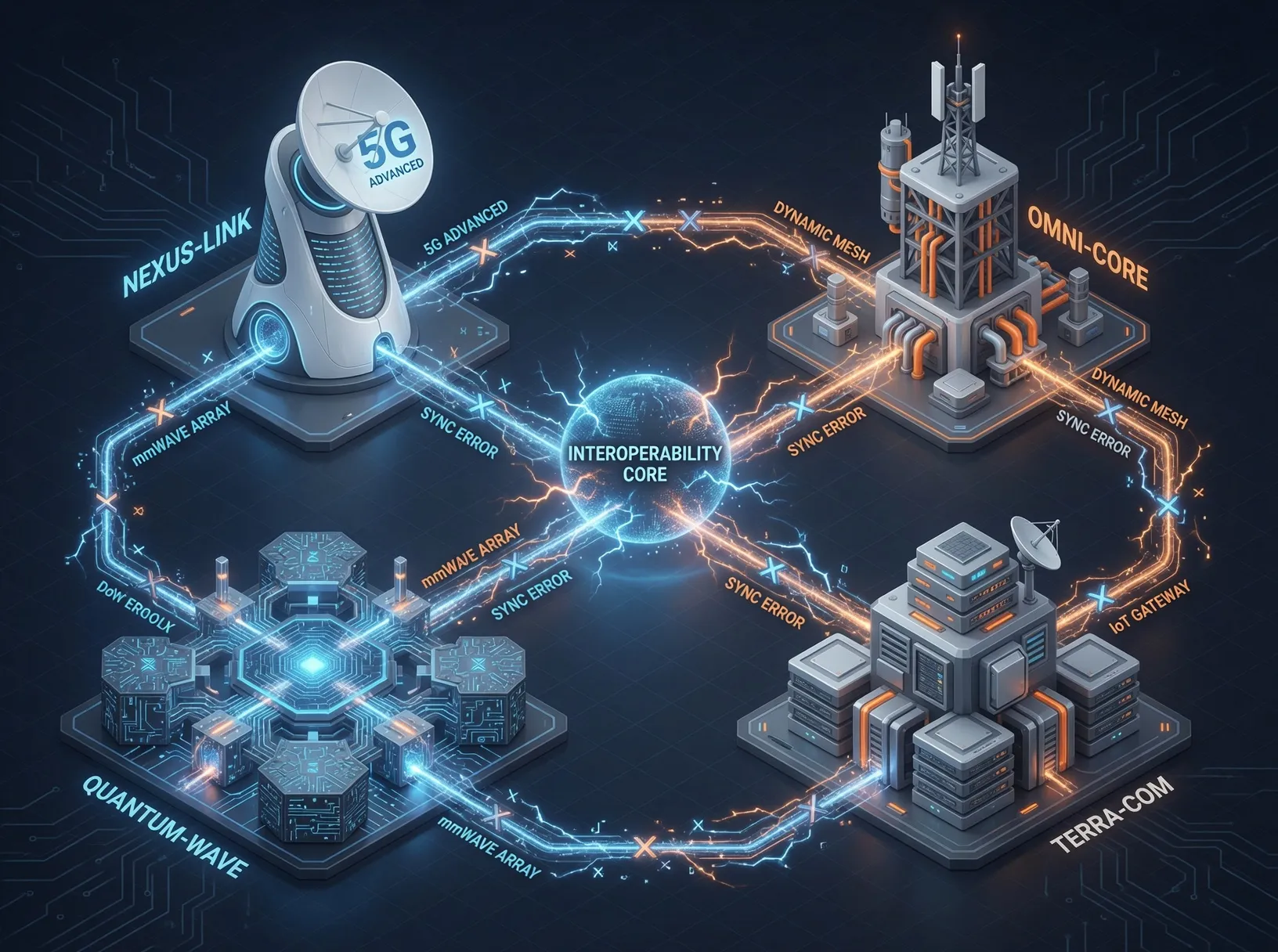
This post explains why multi-vendor RAN remains challenging despite open interfaces, highlighting how true complexity lies in behavior alignment, integration, and system-level coordination.
Read More
Why more RAN monitoring data does not equal better RAN analytics: a case for data quality, relevance, and context over sheer volume when monitoring and analyzing RAN performance.
Read More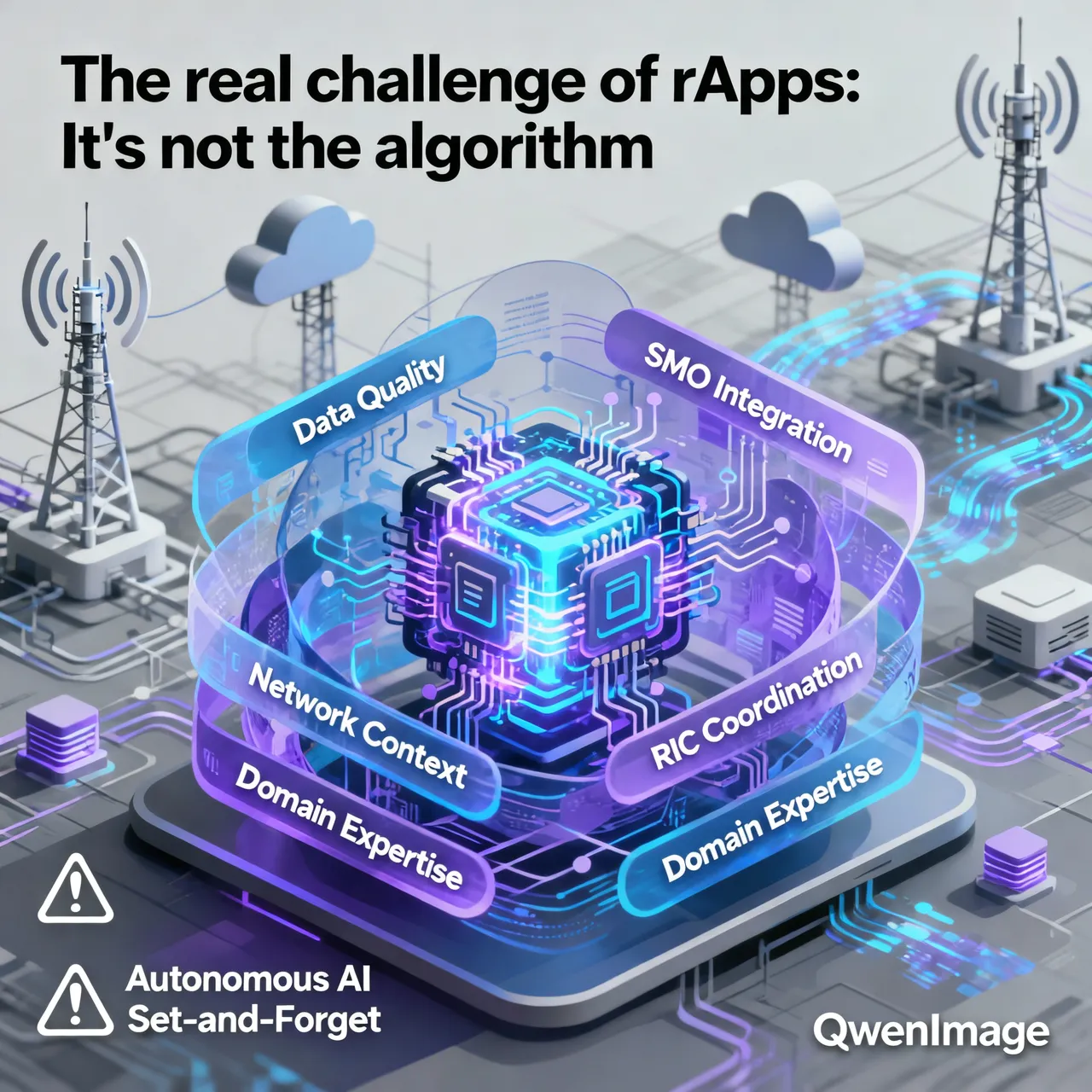
This post explains why the main challenge of rApps is not the algorithm itself, but the surrounding ecosystem, including data quality, integration, and coordination across the network.
Read More
This post explains why SMO is not just an evolution of OSS, but a fundamental shift toward orchestrating intelligence and decision-making in modern RAN architectures.
Read More
This post explores whether AI in RAN is a true transformation or an evolution of SON, highlighting how AI enhances automation but still depends on strong engineering fundamentals.
Read More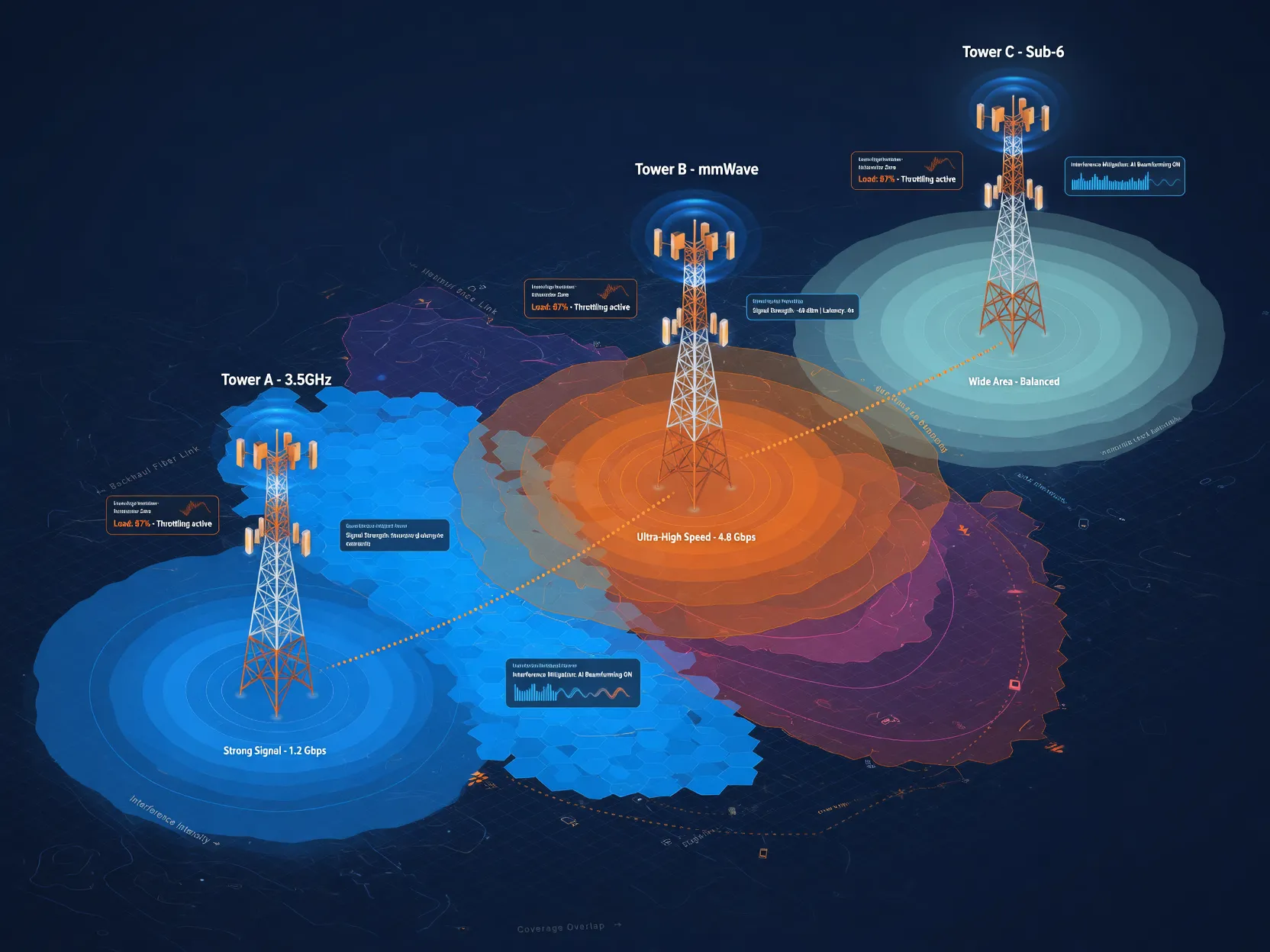
This post explains how CICO is not just about interference control, but about managing continuous trade-offs between capacity, coverage, and interference in a dynamic RAN environment.
Read More
This post highlights how poor PCI management creates hidden performance issues across mobility, interference, and load balancing, making it a critical but often underestimated layer in RAN optimization.
Read More
This post explains why Automatic Neighbor Relations (ANR) is not a fully autonomous solution and highlights how improper configuration and lack of supervision can negatively impact mobility and overall network performance.
Read More
Understanding DLB
Read More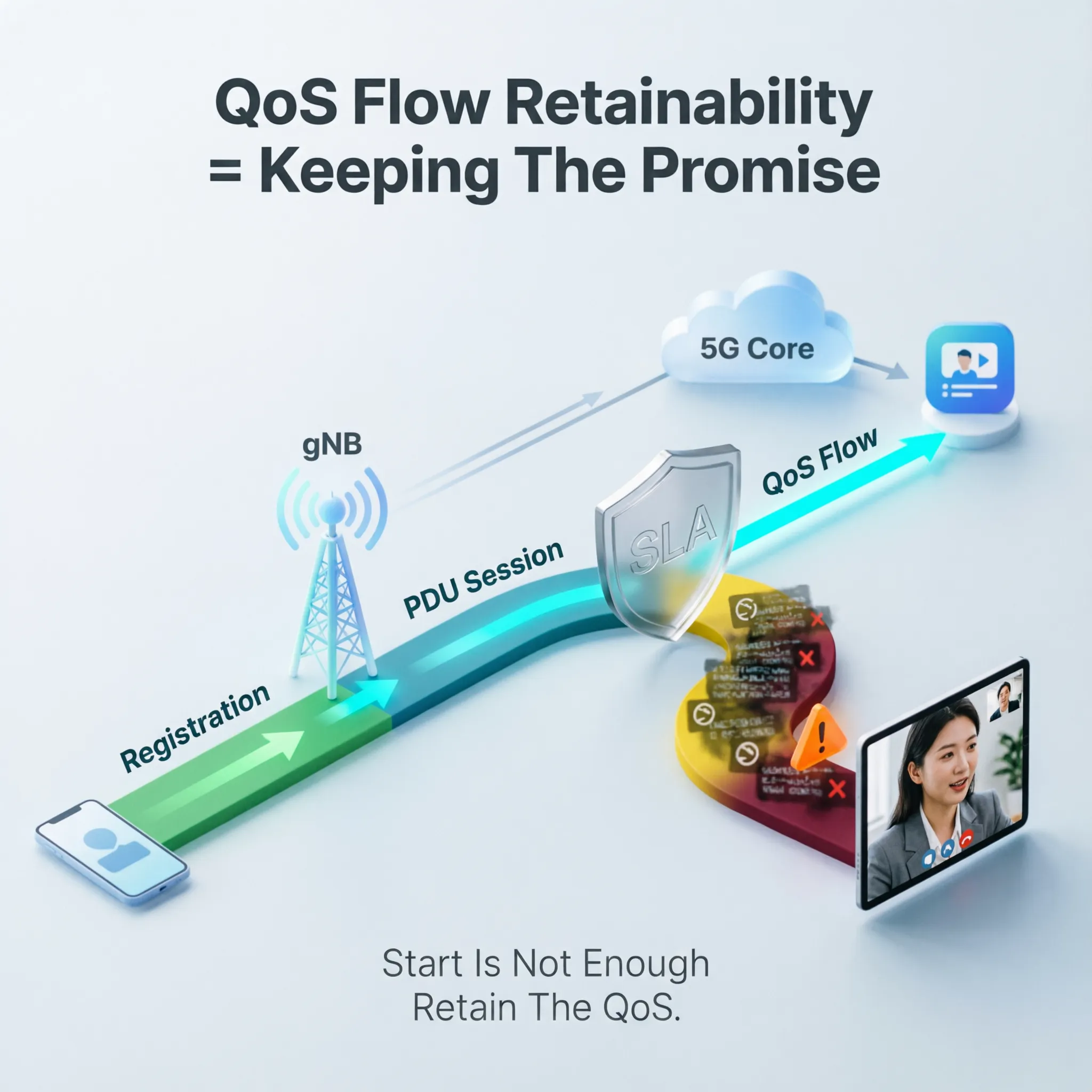
This post explains QoS Flow Retainability as an “experience KPI”: it measures whether 5G can keep the promised QoS over time (not just start a session), which is crucial for slicing and enterprise SLAs.
Read More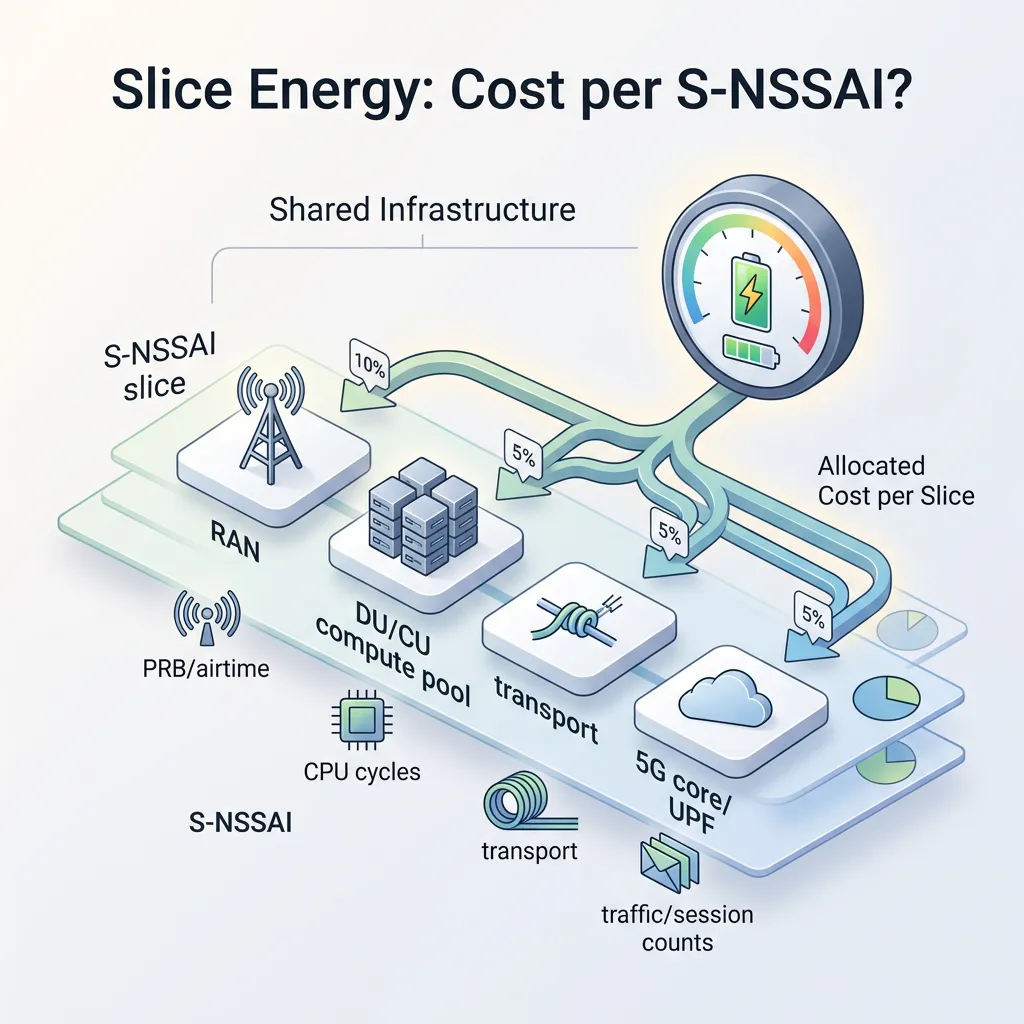
This post explores whether it’s feasible to attribute energy costs per network slice (S-NSSAI), and explains why it’s more of an allocation problem on shared infrastructure than a simple “measure watts and bill it” approach.
Read More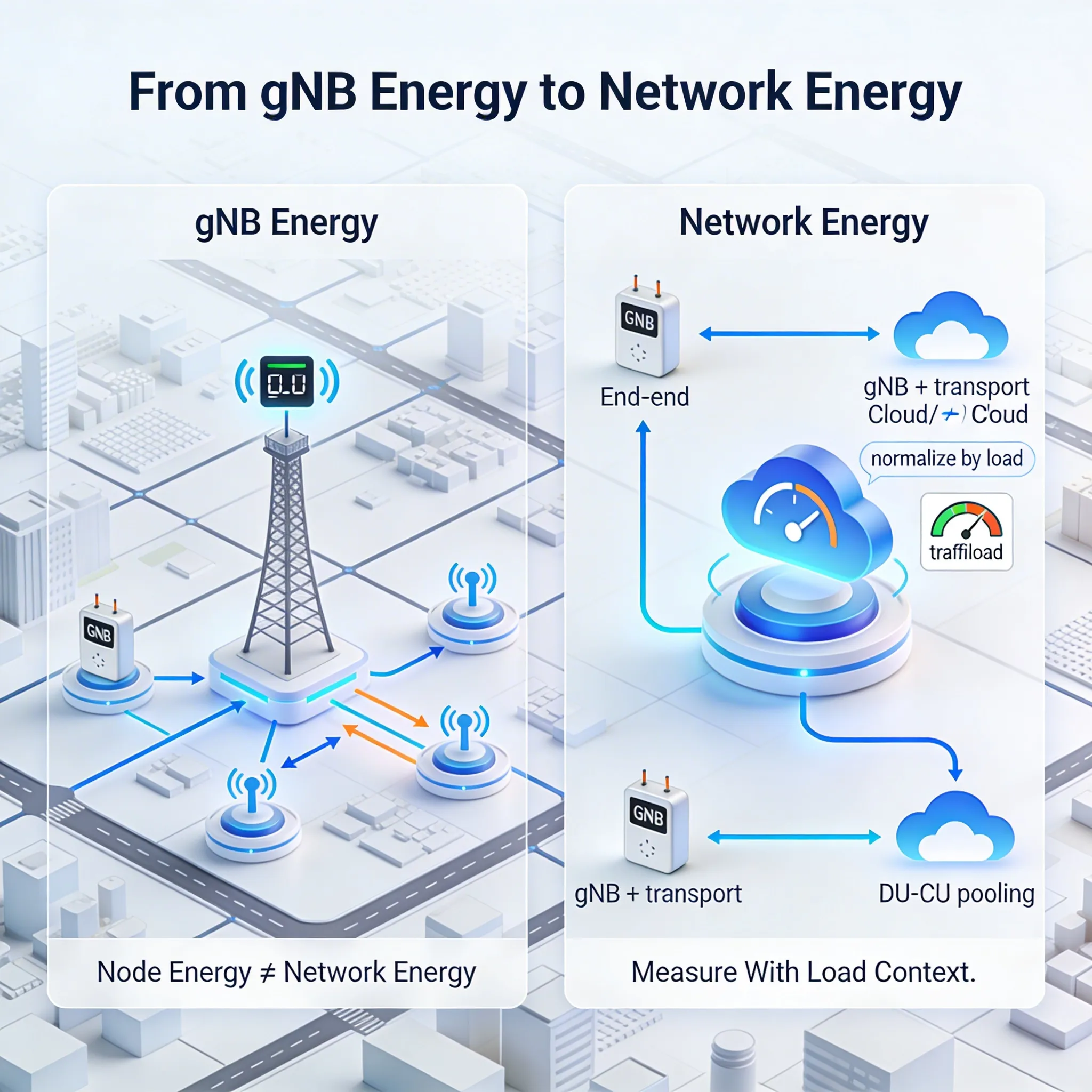
This post explains why measuring energy only at the gNB level can be misleading in 5G, and why “measuring EC the right way” means defining scope, correlating with load/service, and looking at total network energy impact—not just shifting costs around.
Read More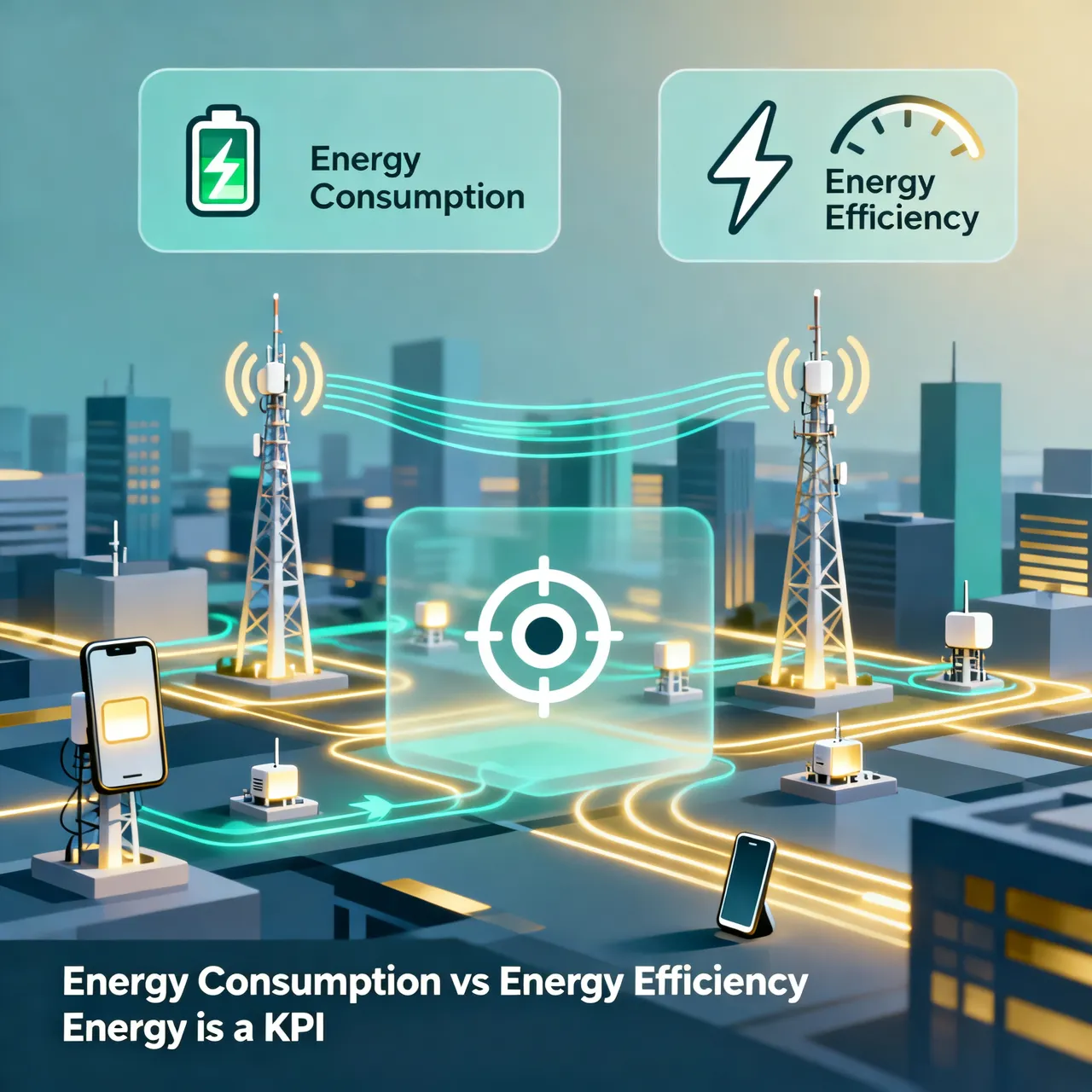
This post explains how 3GPP Rel-17 treats energy as a measurable KPI in 5G, distinguishing Energy Consumption from Energy Efficiency and why this shifts energy from “just OPEX” to an operational and competitive metric.
Read More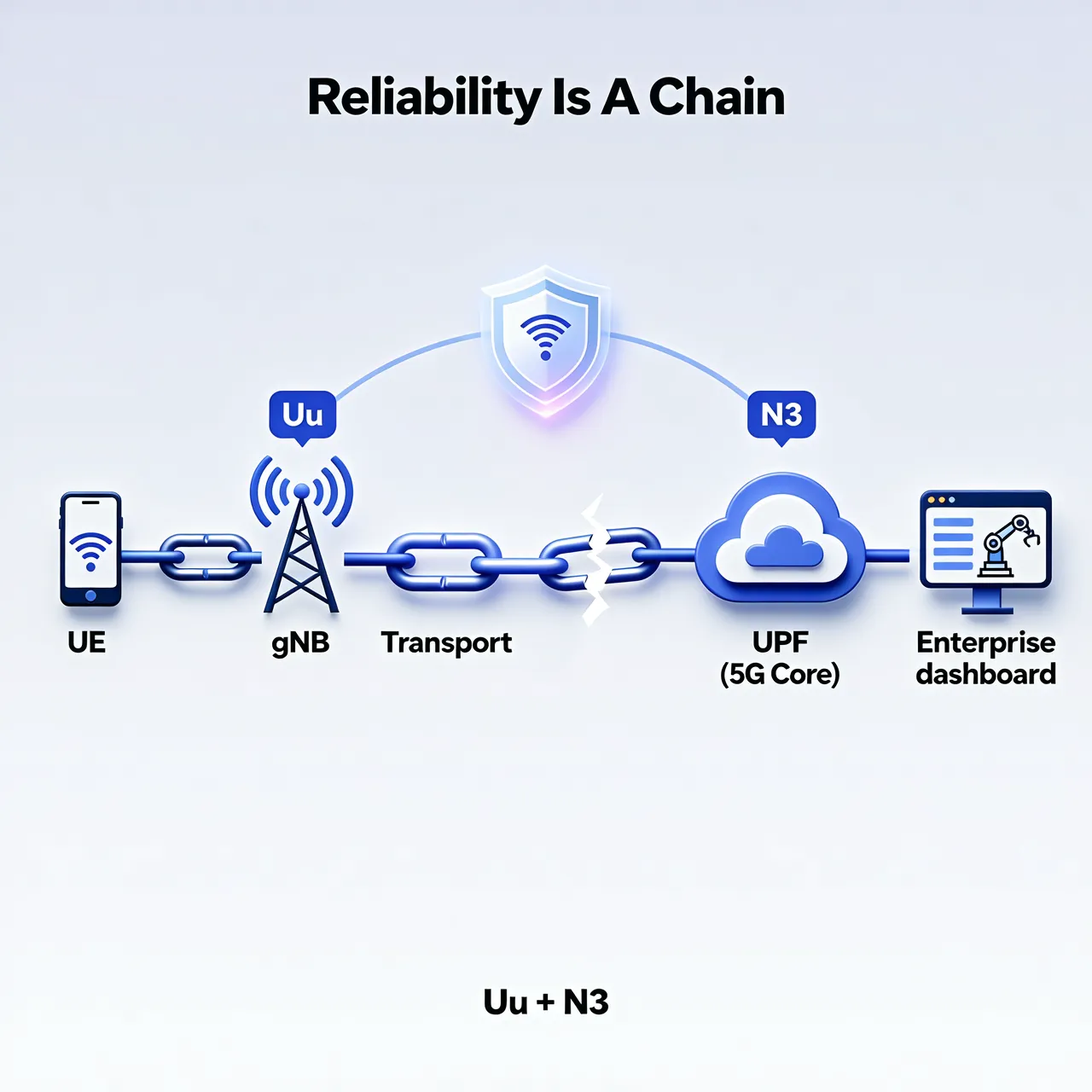
This post explains reliability for critical 5G as an end-to-end chain: Uu covers the radio hop (UE↔gNB) and N3 covers the user-plane path (gNB↔UPF), and both must be reliable for SLAs to hold.
Read More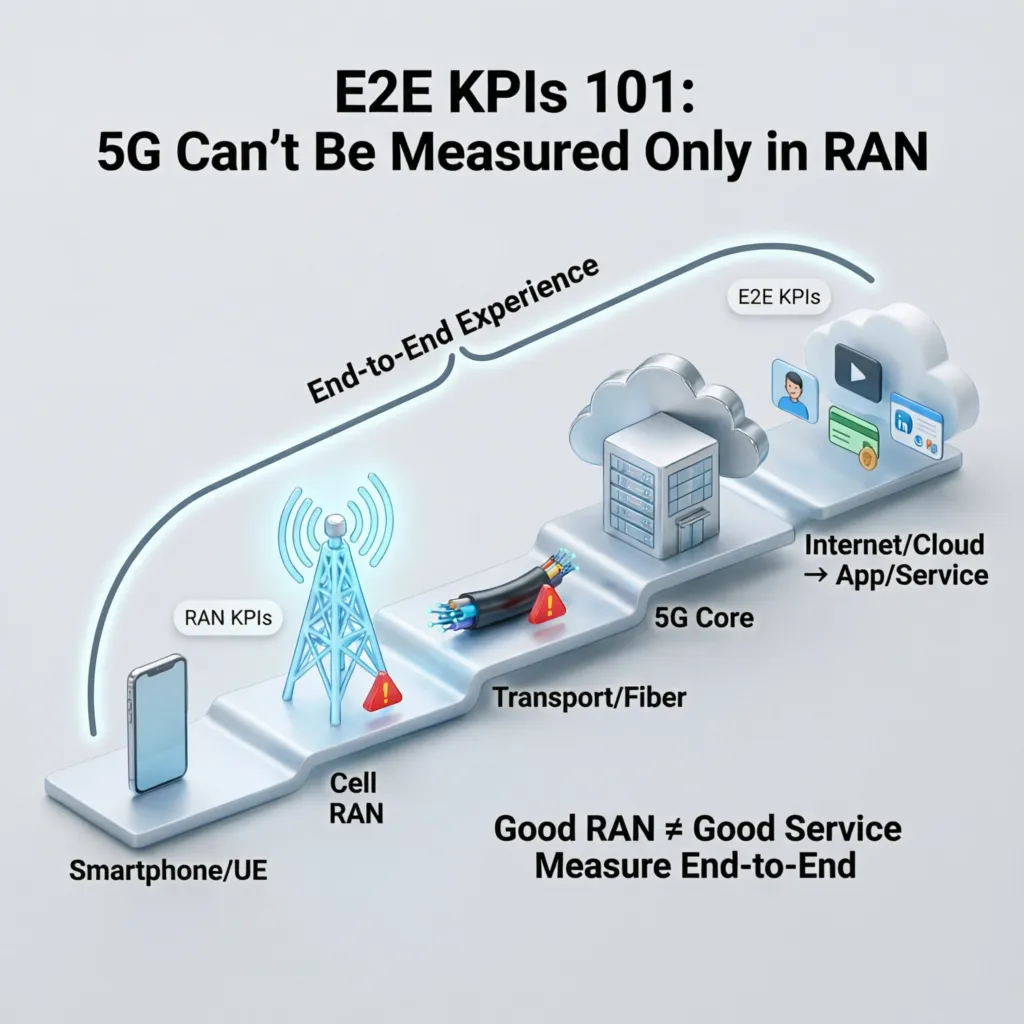
This post explains why 5G performance can’t be judged by RAN KPIs alone: users experience an end-to-end service path, so E2E KPIs are what truly reflect reliability, consistency, and SLA outcomes.
Read More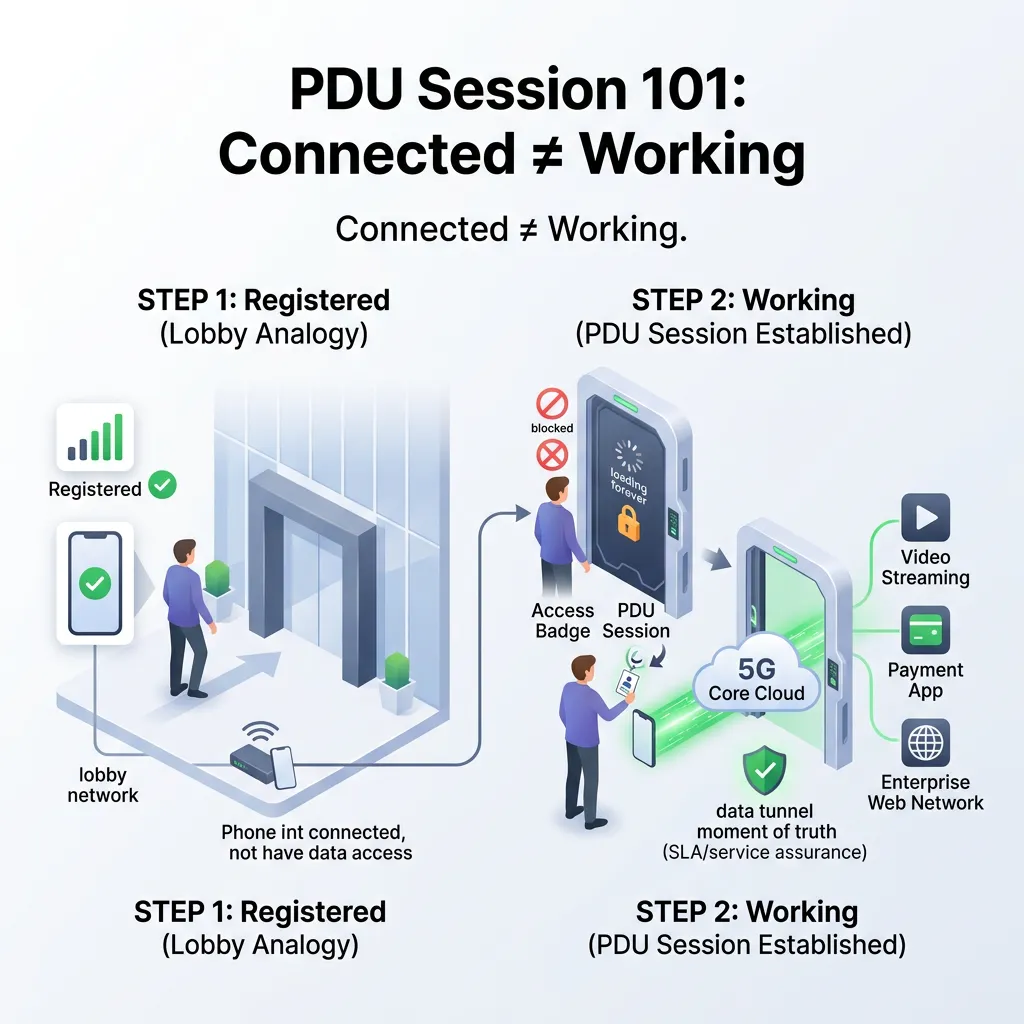
This post explains what a PDU Session is in simple terms and why a device can look “connected” (registered) while data services still don’t work if the PDU session isn’t established reliably.
Read More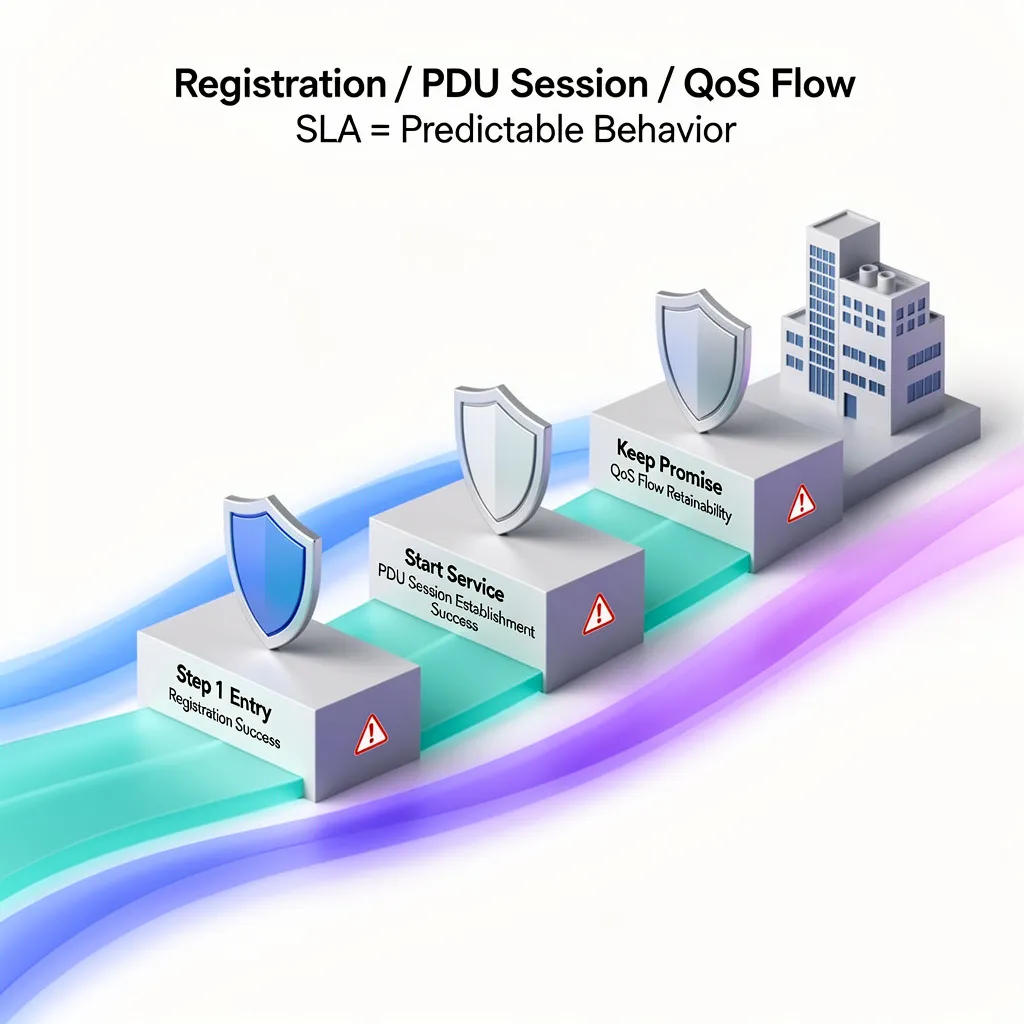
This post explains slicing SLAs in practical terms using three “make-or-break” KPIs: can devices register, can they establish the PDU session, and can the promised QoS flow remain stable over time.
Read More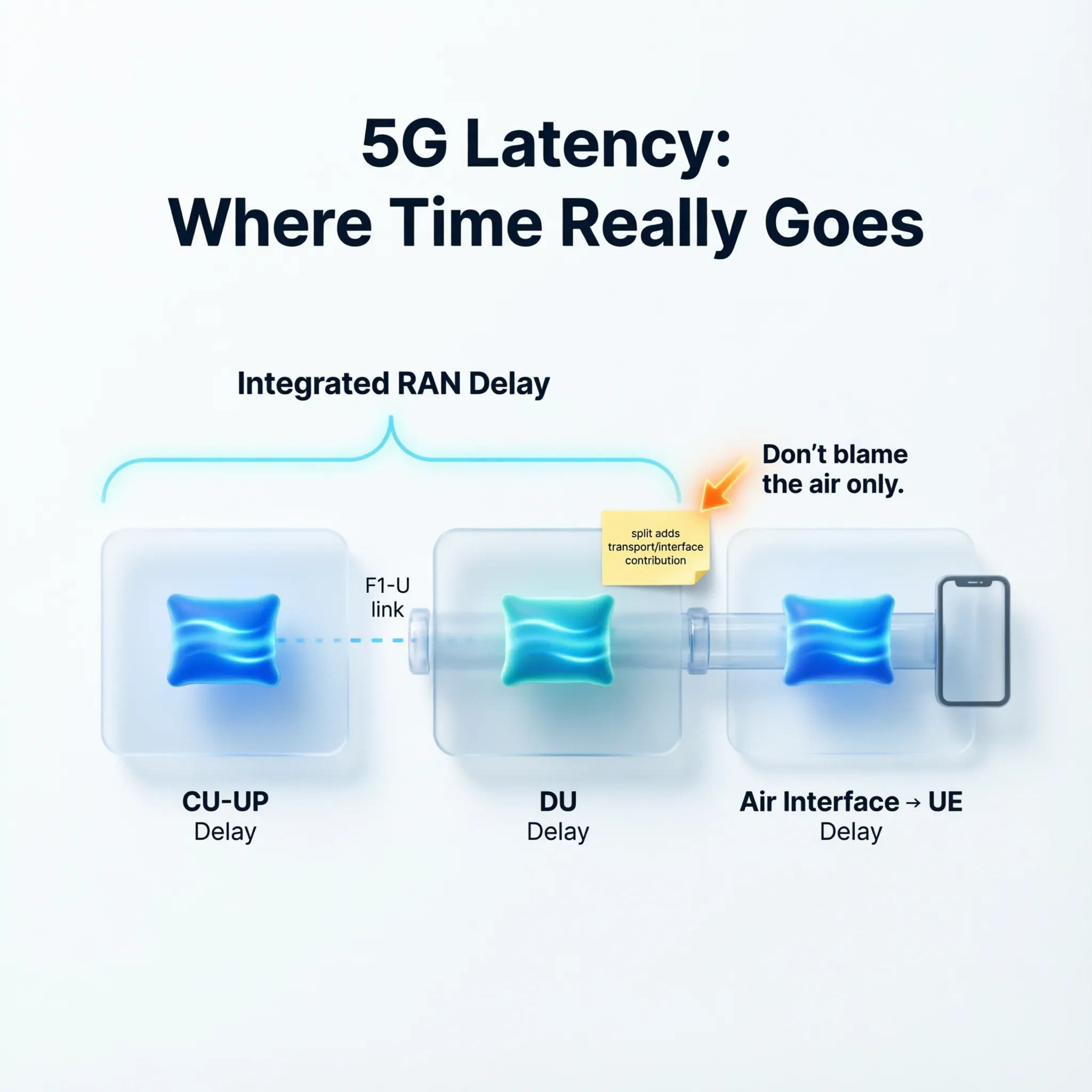
This post explains 5G “latency myths” by breaking end-to-end RAN delay into its main contributors (CU-UP vs DU vs integrated RAN), showing why blaming the air interface alone is often wrong.
Read More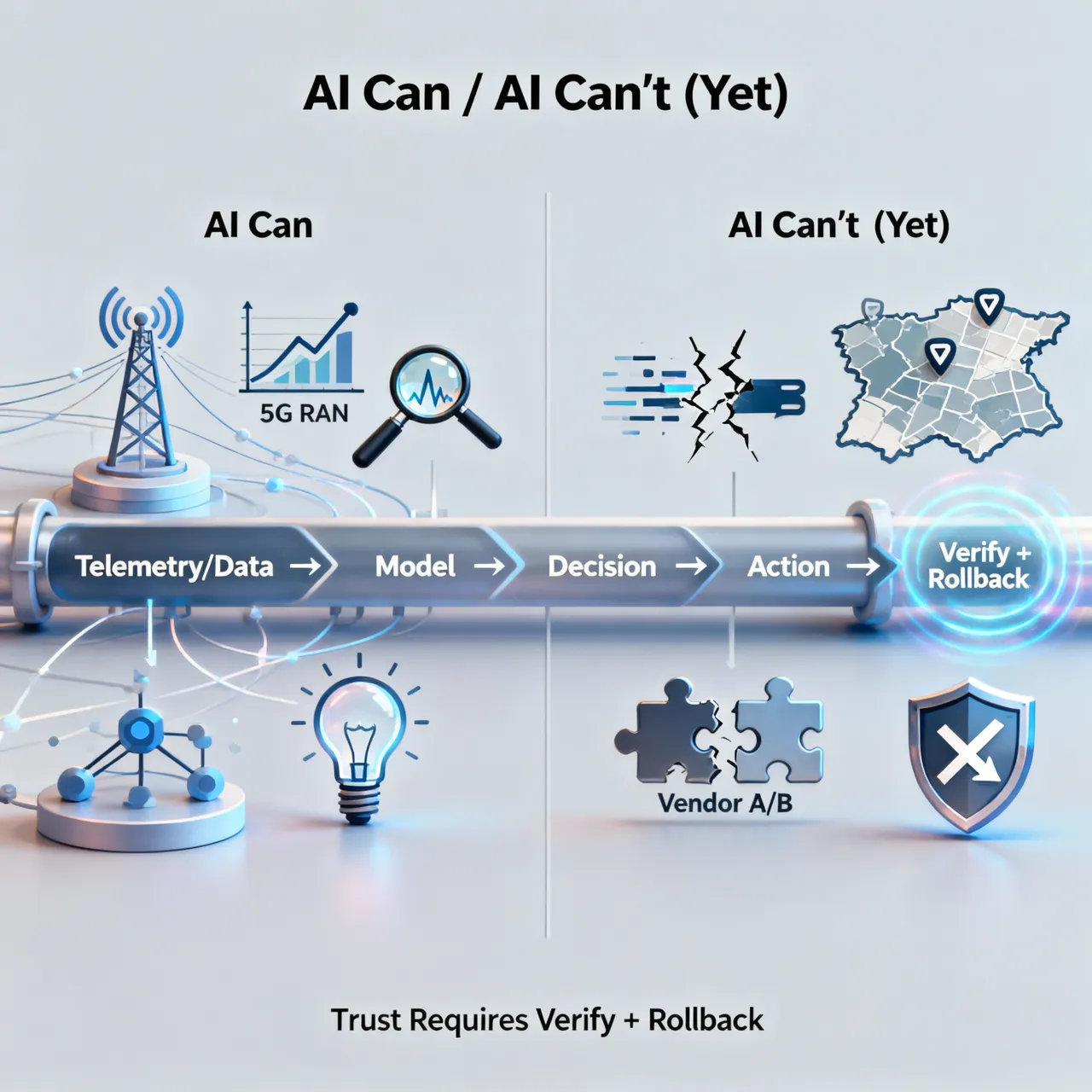
This post clarifies what AI can realistically do in RAN today (prediction, anomaly detection, smarter triage, safe recommendations) and what it still can’t do reliably without strong data, governance, and closed-loop guardrails.
Read More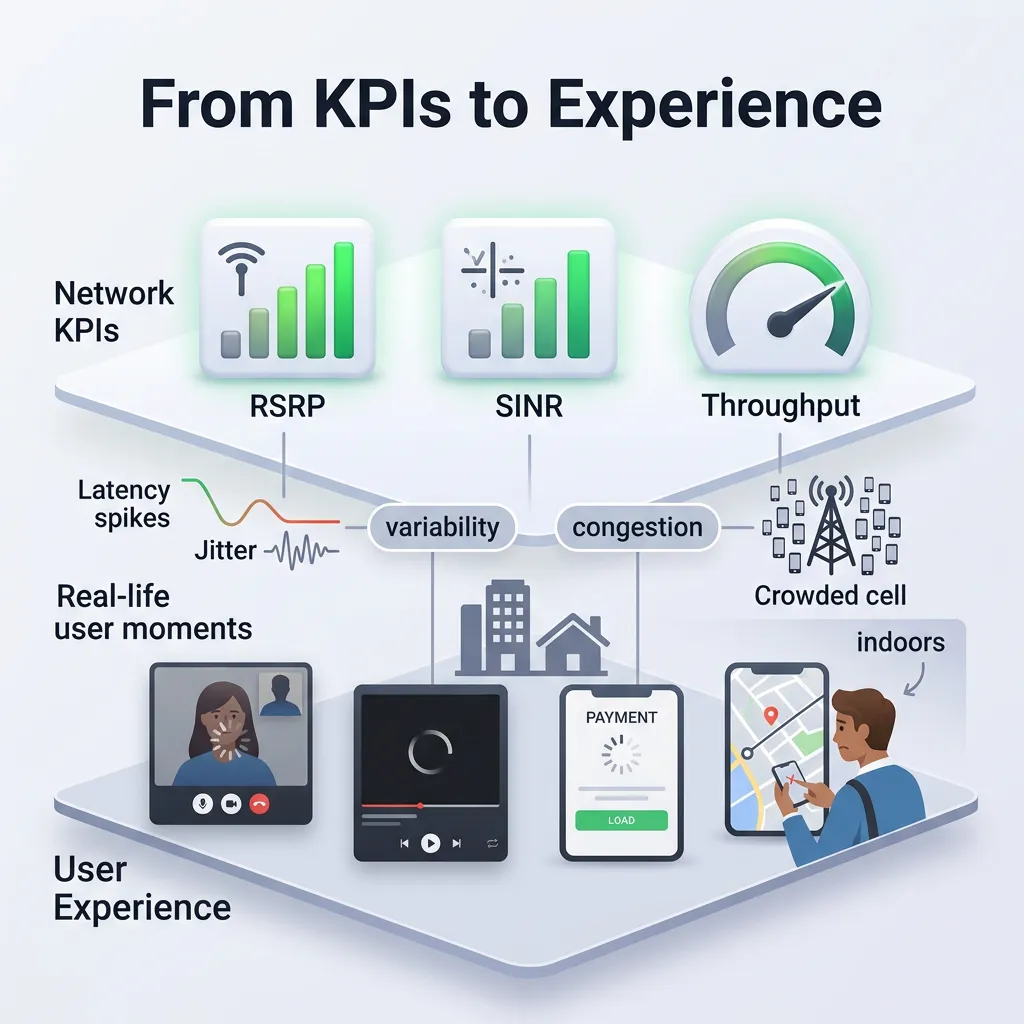
This article translates key RAN KPIs (RSRP, SINR, Throughput) into what users actually feel, and explains why “good KPIs” can still produce a bad experience due to congestion, variability, indoor conditions, and end-to-end issues.
Read More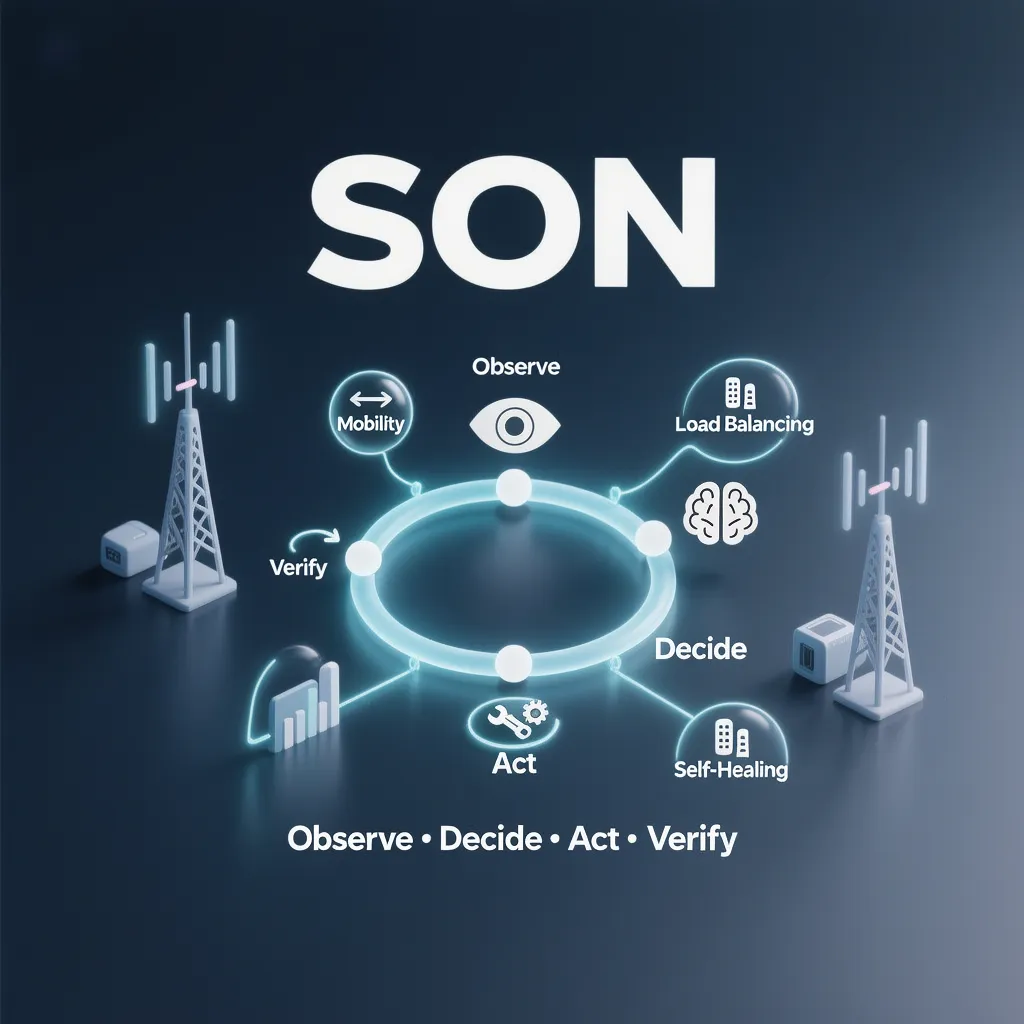
This post explains SON in simple terms as a closed-loop system (Observe → Decide → Act → Verify) that automates repetitive RAN optimizations to reduce “decision latency” and scale performance improvements safely.
Read More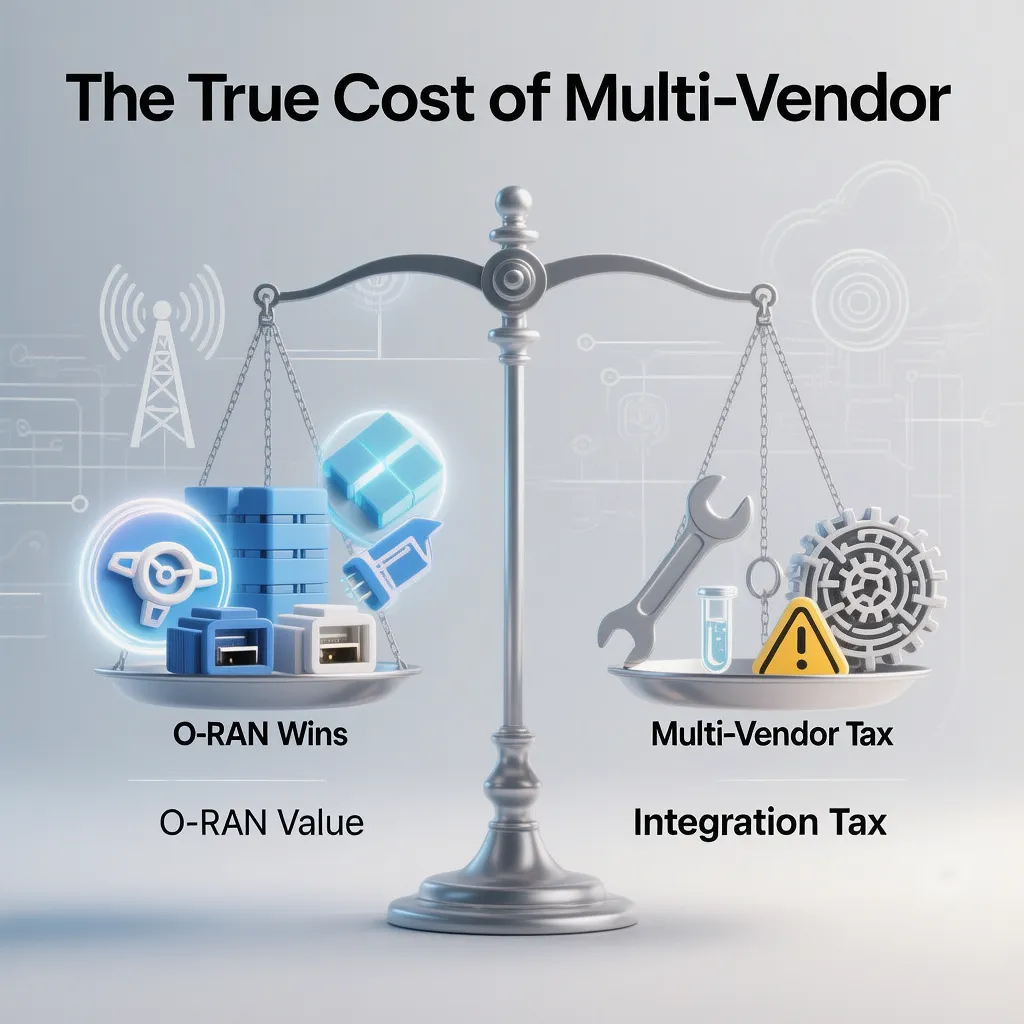
This article explains the “multi-vendor tax” behind O-RAN: where openness truly creates strategic value (control, agility, innovation) and where it can backfire due to integration, testing, accountability, and operational complexity.
Read More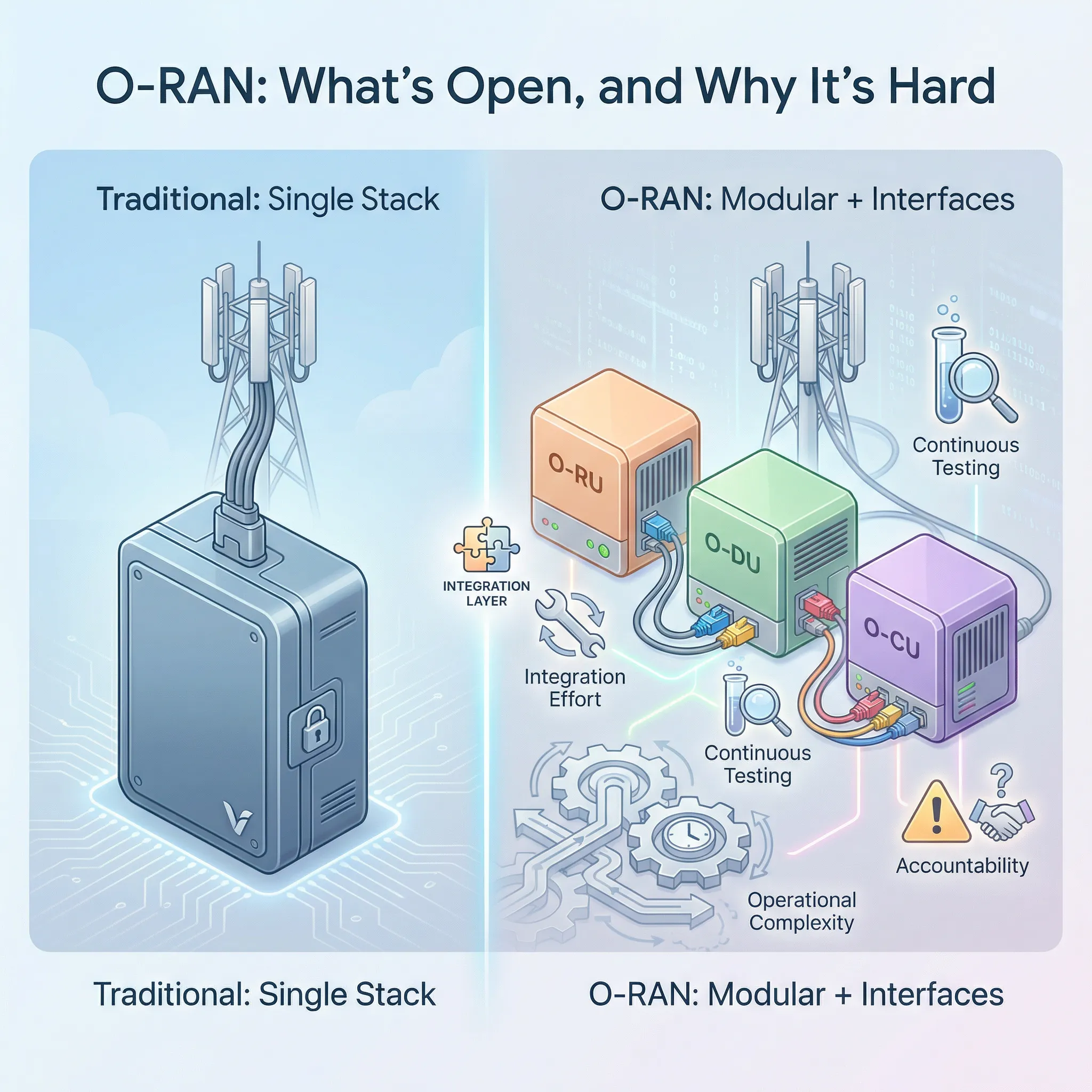
This post explains O-RAN in simple terms: what “open” really means (modular RAN with standard interfaces) and why it’s hard in practice due to integration, continuous testing, and multi-vendor operational complexity.
Read More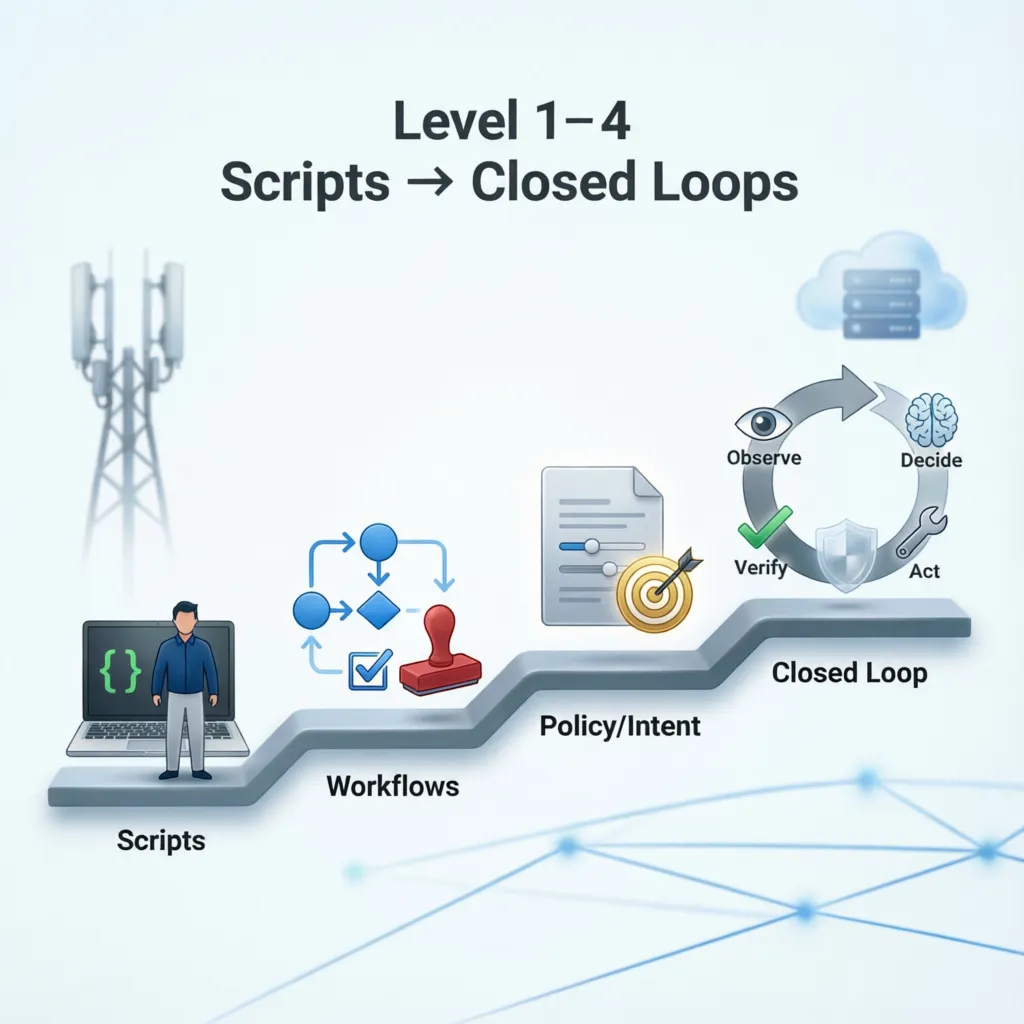
This article presents a simple 4-level model of network automation maturity, showing how teams evolve from ad-hoc scripts to governed, policy-driven closed loops that reduce “decision latency” and scale 5G operations safely.
Read More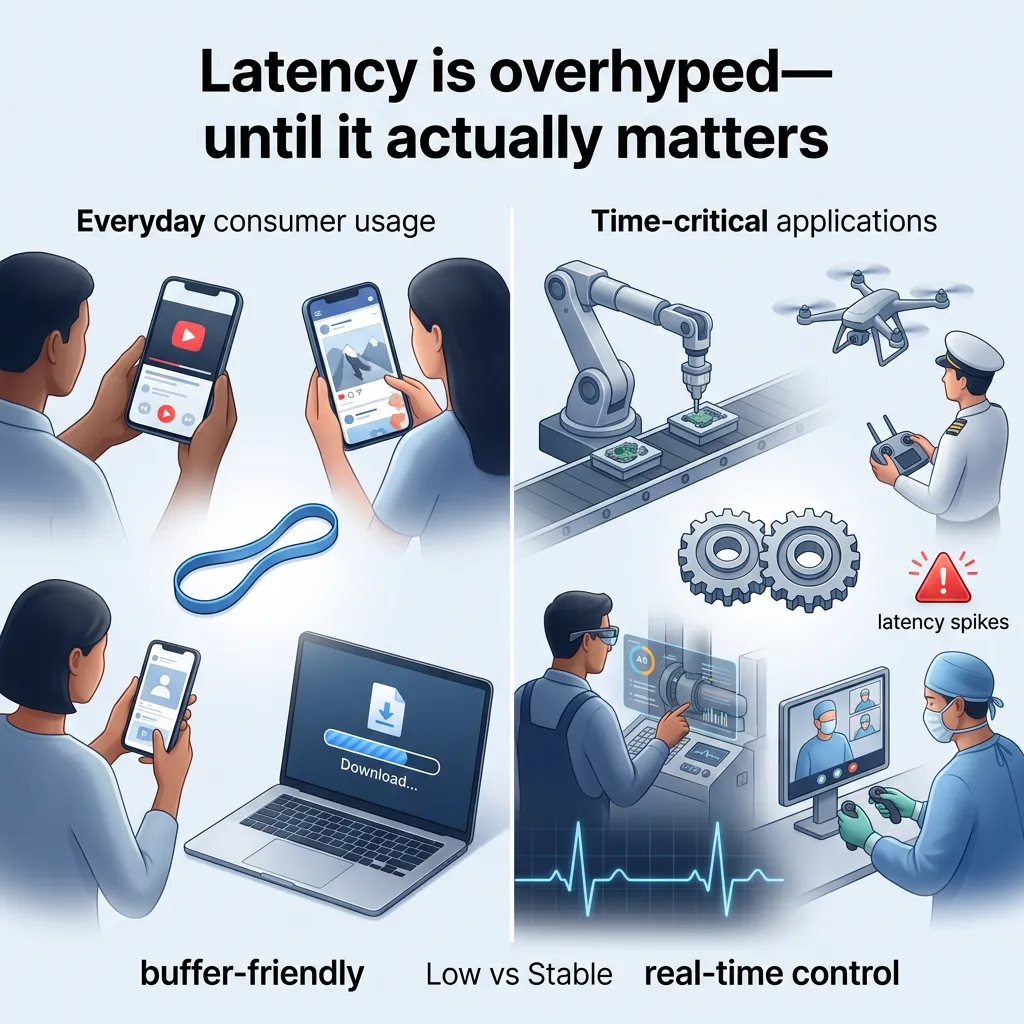
This post explains why latency is often overhyped in 5G: most consumer apps won’t feel a few milliseconds, but real-time, interactive, mission-critical use cases need low and consistent latency to be valuable.
Read More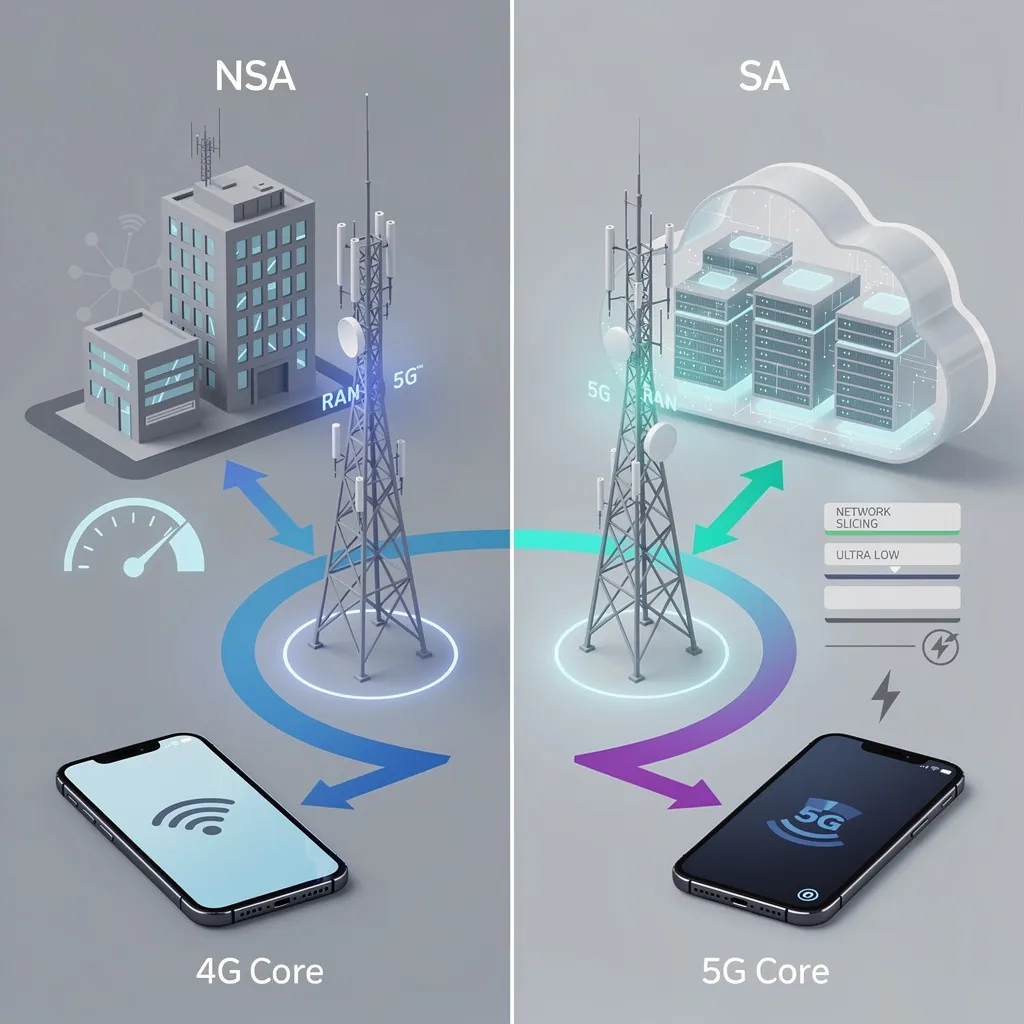
This post explains the practical difference between 5G NSA and 5G SA: NSA boosts speed on a 4G core, while SA unlocks true 5G capabilities and new monetizable services through the 5G Core.
Read More
This article explains SMO and RIC using a simple “app store for the RAN” model, where rApps/xApps turn network data into closed-loop actions to automate optimization at scale.
Read More
5G is best understood as three levers—Capacity, Latency, and Massive IoT—and its real value comes from matching the right lever to the right use case and business outcome.
Read More
In 5G, spectrum is table stakes—competitive advantage comes from execution: fast deployment, clean integration, automation, and operational discipline that turns capability into revenue.
Read More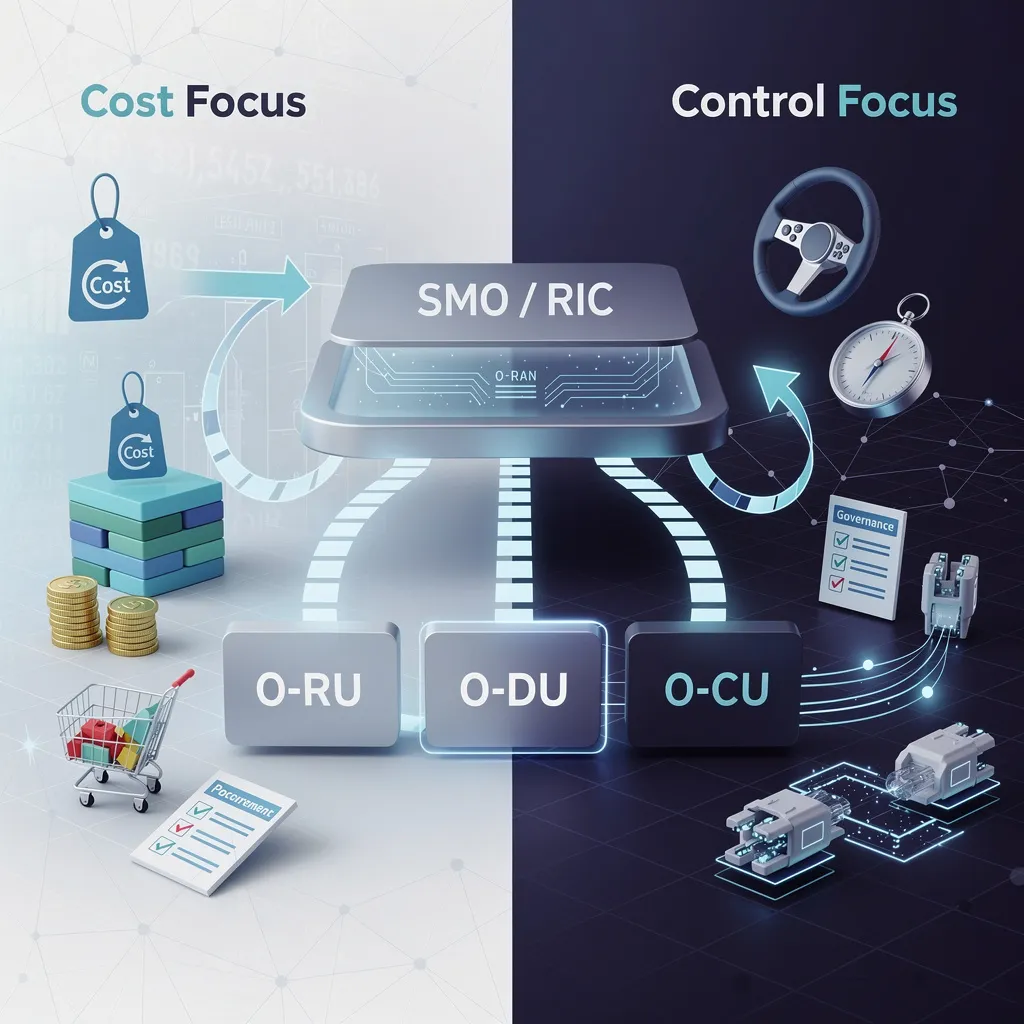
O-RAN isn’t just about lowering costs—it’s about regaining control, agility, and faster innovation through an open, well-governed operating model.
Read More
The technology evolved faster than the mindset
Read More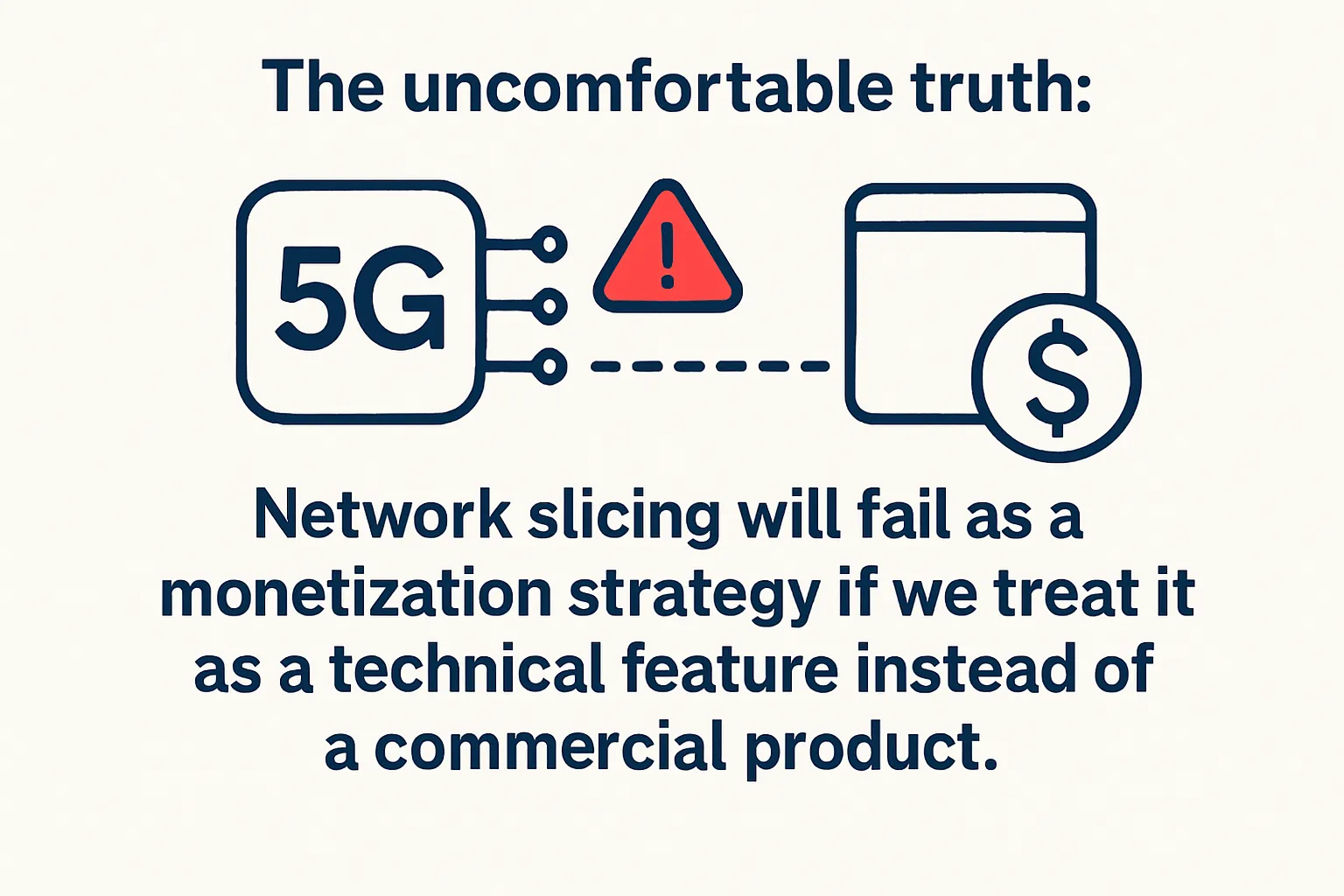
Why network slicing needs a commercial and pricing overhaul -- not just technical readiness -- to succeed as a real 5G monetization strategy in the network slicing market.
Read More
Automation enables three critical monetization levers
Read More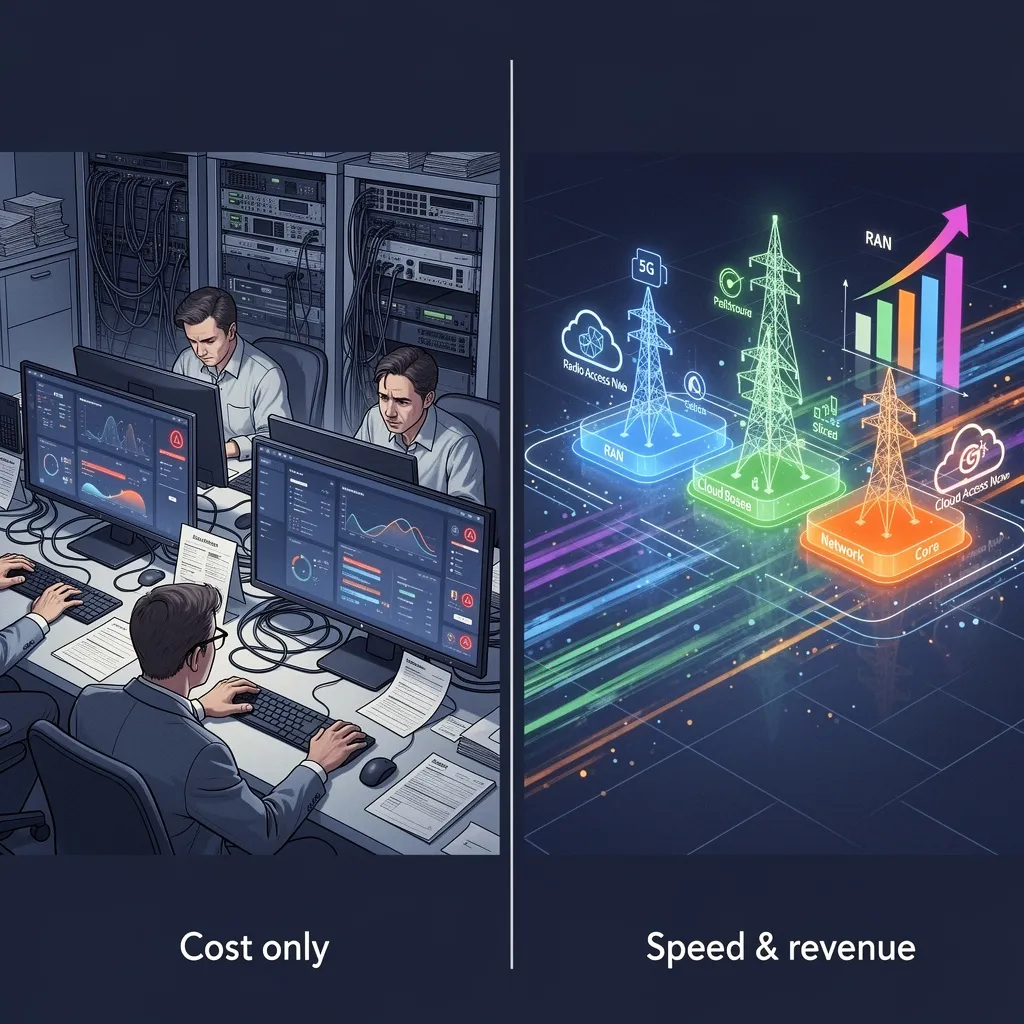
Automation enables three critical monetization levers
Read More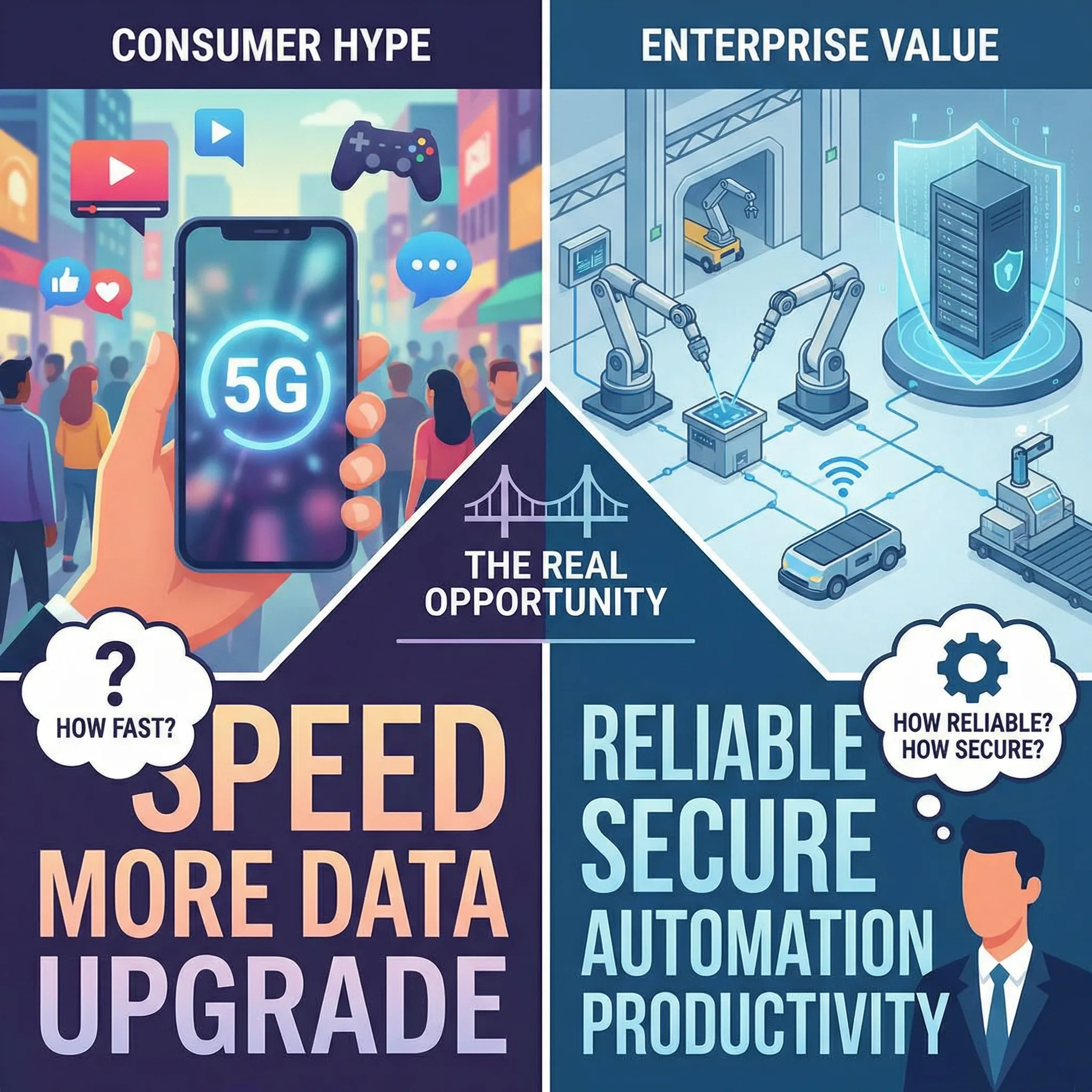
For years, we tried to justify 5G investments through mass-market upgrades. Higher speeds. Larger data bundles. Premium plans.
Read More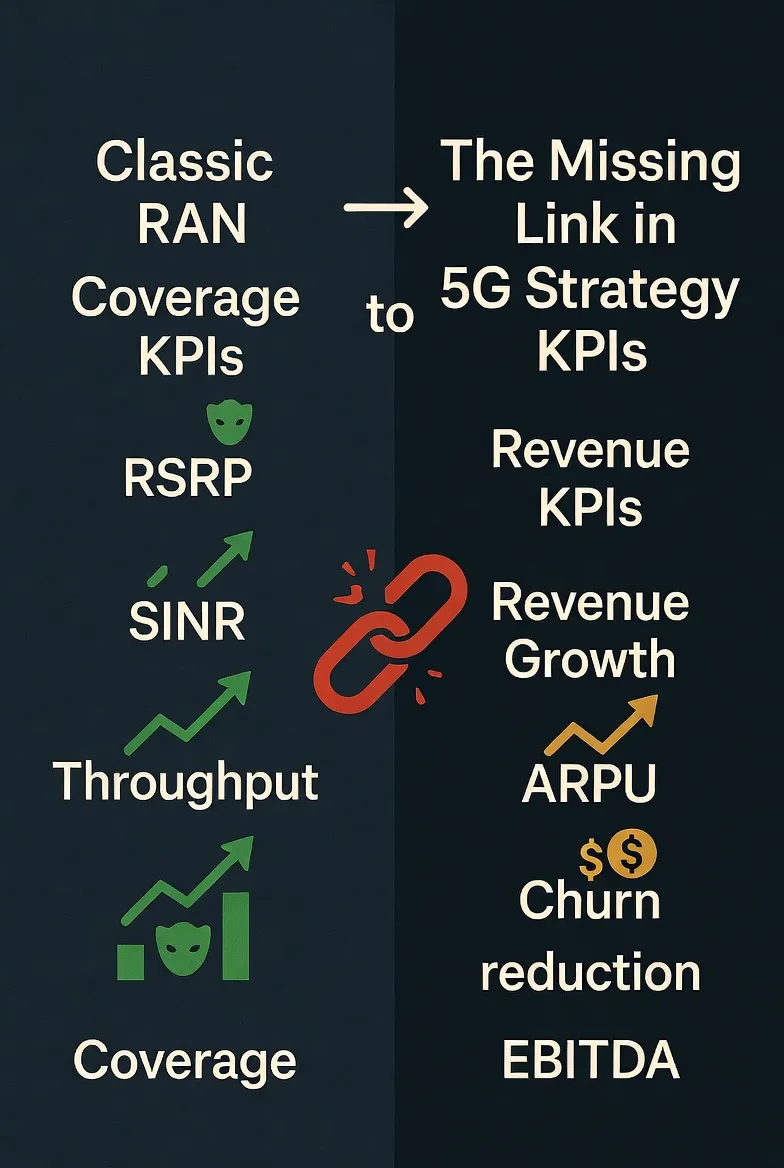
Coverage is the foundation. Revenue is the objective. Bridging them is leadership.
Read More
Let’s be honest. Most consumers don’t wake up thinking about latency, spectrum bands, or network slicing. They just want their apps to load. Their video calls to work. Their streaming not to buffer.
Read More
From a business perspective, this raises an uncomfortable question: Why hasn’t one of the largest technology investments in telecom history translated into proportional financial returns?
Read More
Why UE power saving is a silent KPI in 5G NR and how Release 17 challenges traditional SON optimization logic.
Read More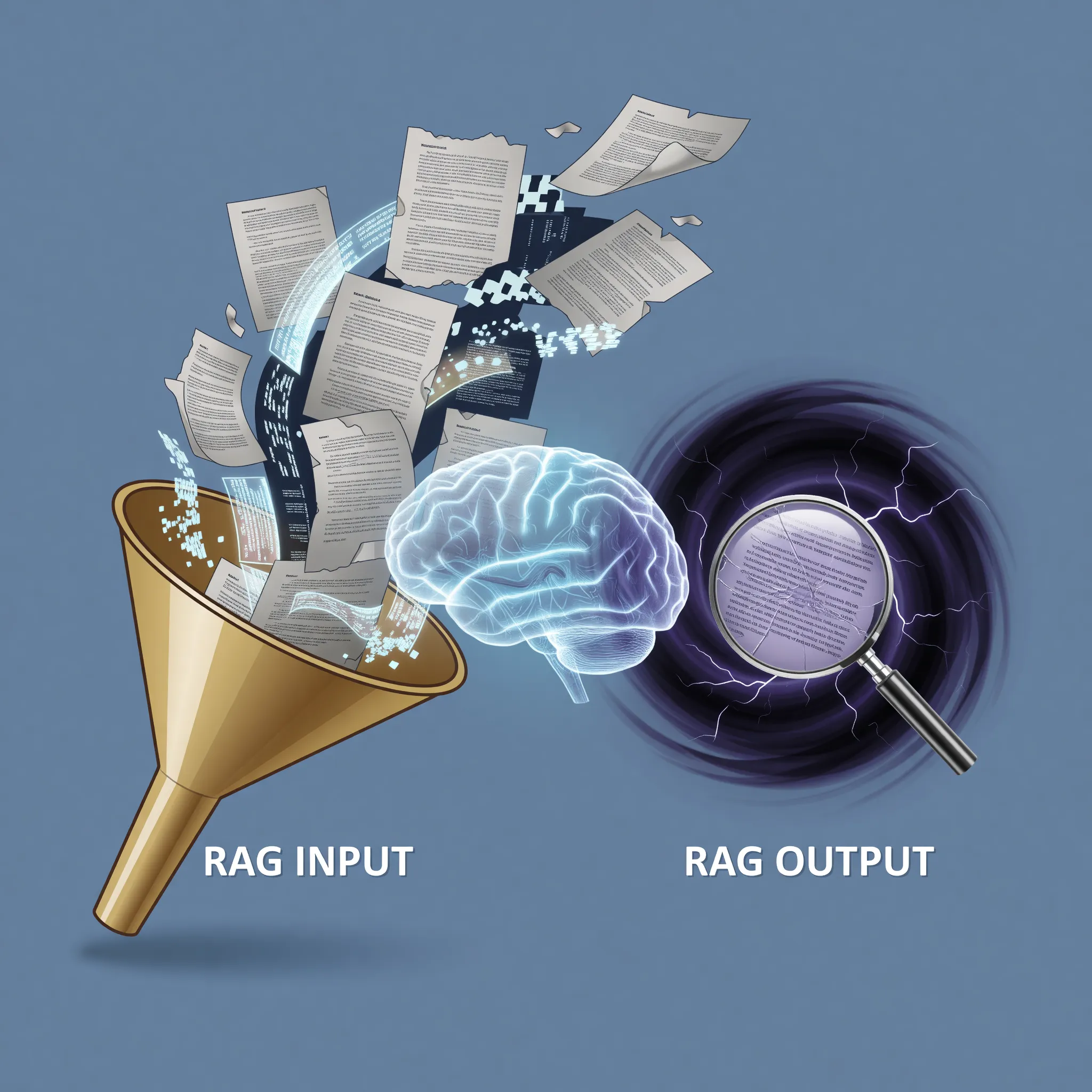
RAG transforms obvious hallucinations into subtle, data-grounded errors. Learn why validation is more critical than retrieval.
Read More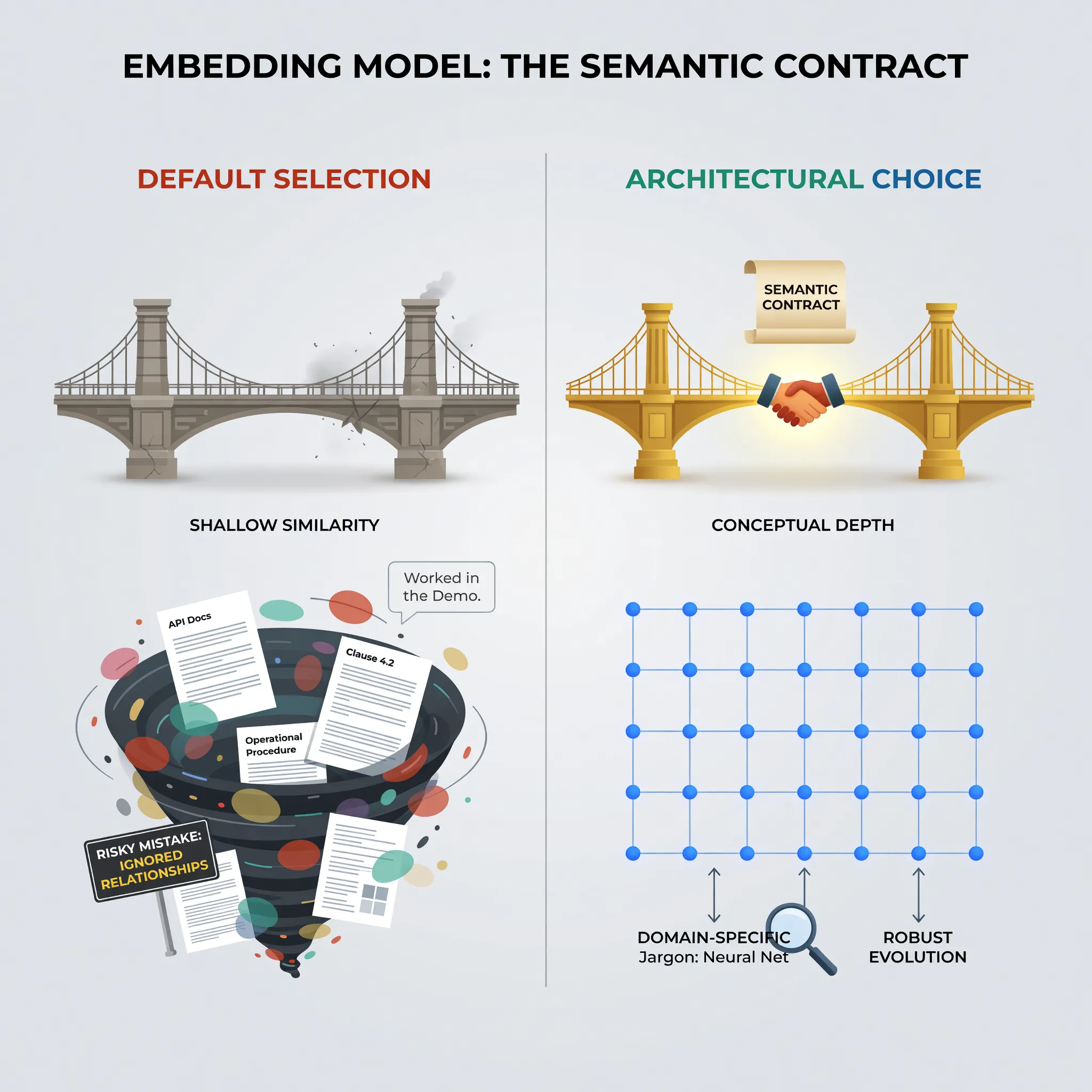
In many RAG and AI projects, the embedding model is selected almost by inertia. Whatever is popular. Whatever comes bundled. Whatever worked well enough in a demo.
Read More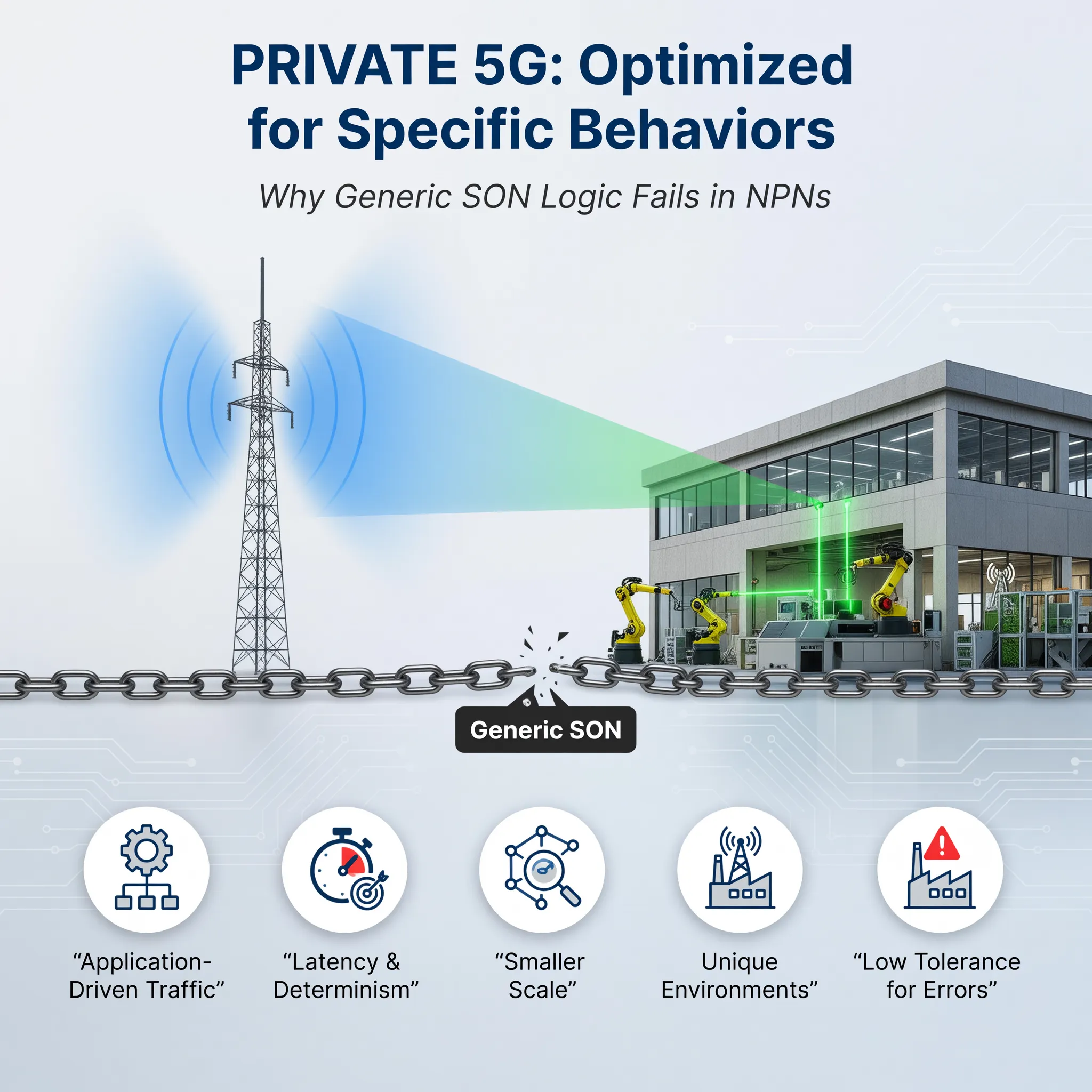
Why generic SON logic fails in Private 5G environments and how 3GPP Release 17 changes the automation landscape for NPNs.
Read More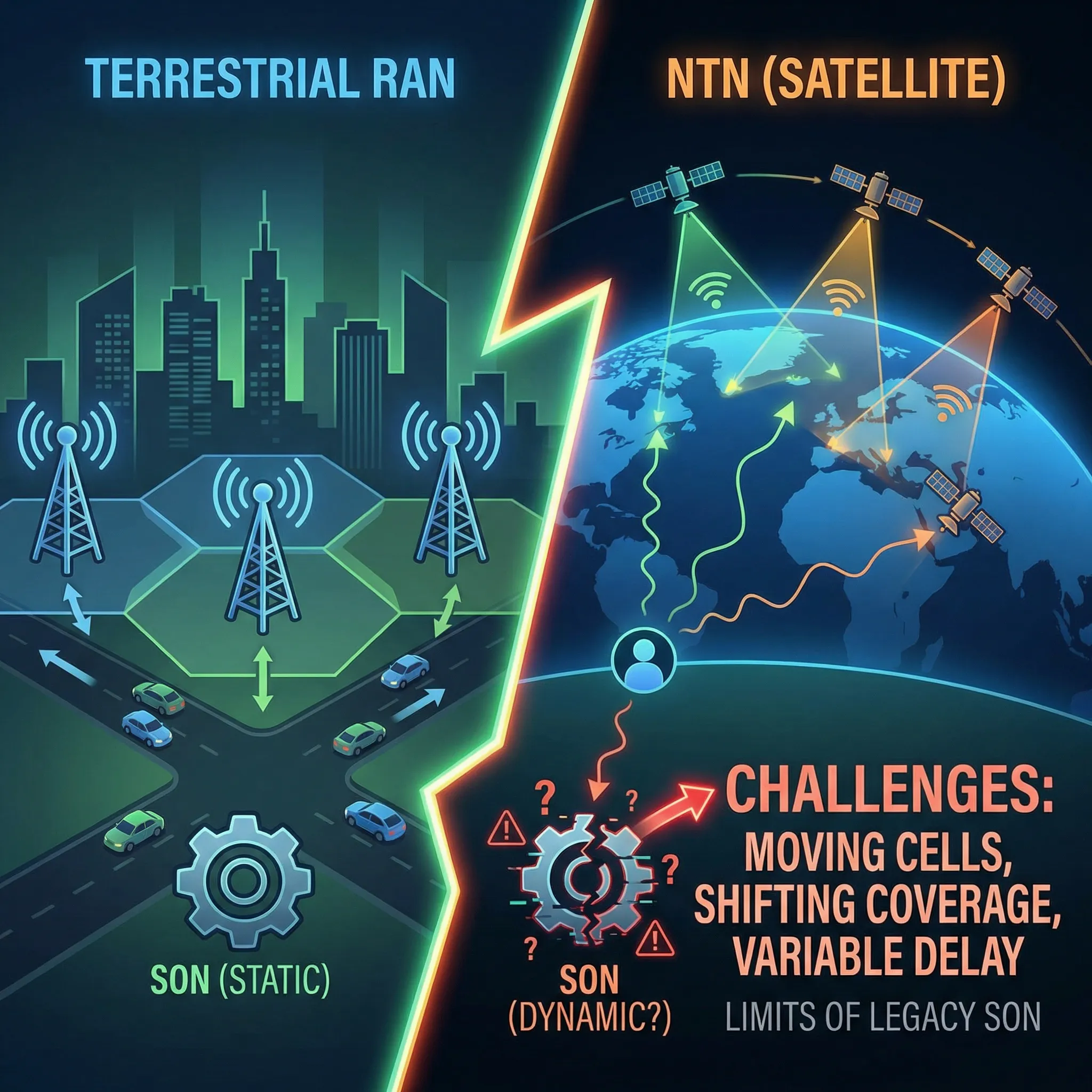
NR over Non-Terrestrial Networks (NTN) changes one of the most fundamental assumptions behind traditional SON.
Read More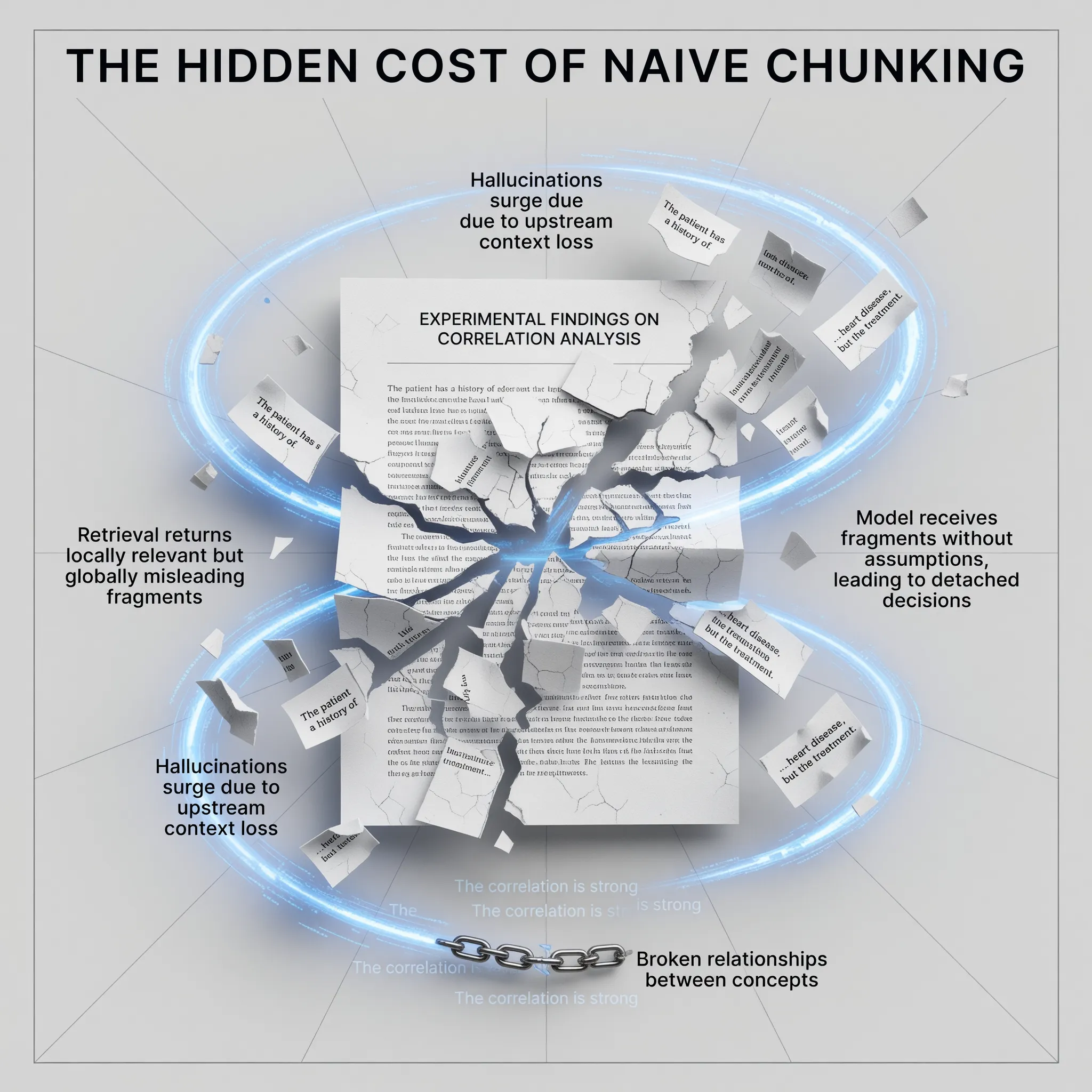
Beyond models and databases, chunking is the architectural decision where context is either preserved or destroyed in RAG systems.
Read More
Moving beyond search optimization: how embeddings define the mathematical space where AI represents reality and meaning.
Read More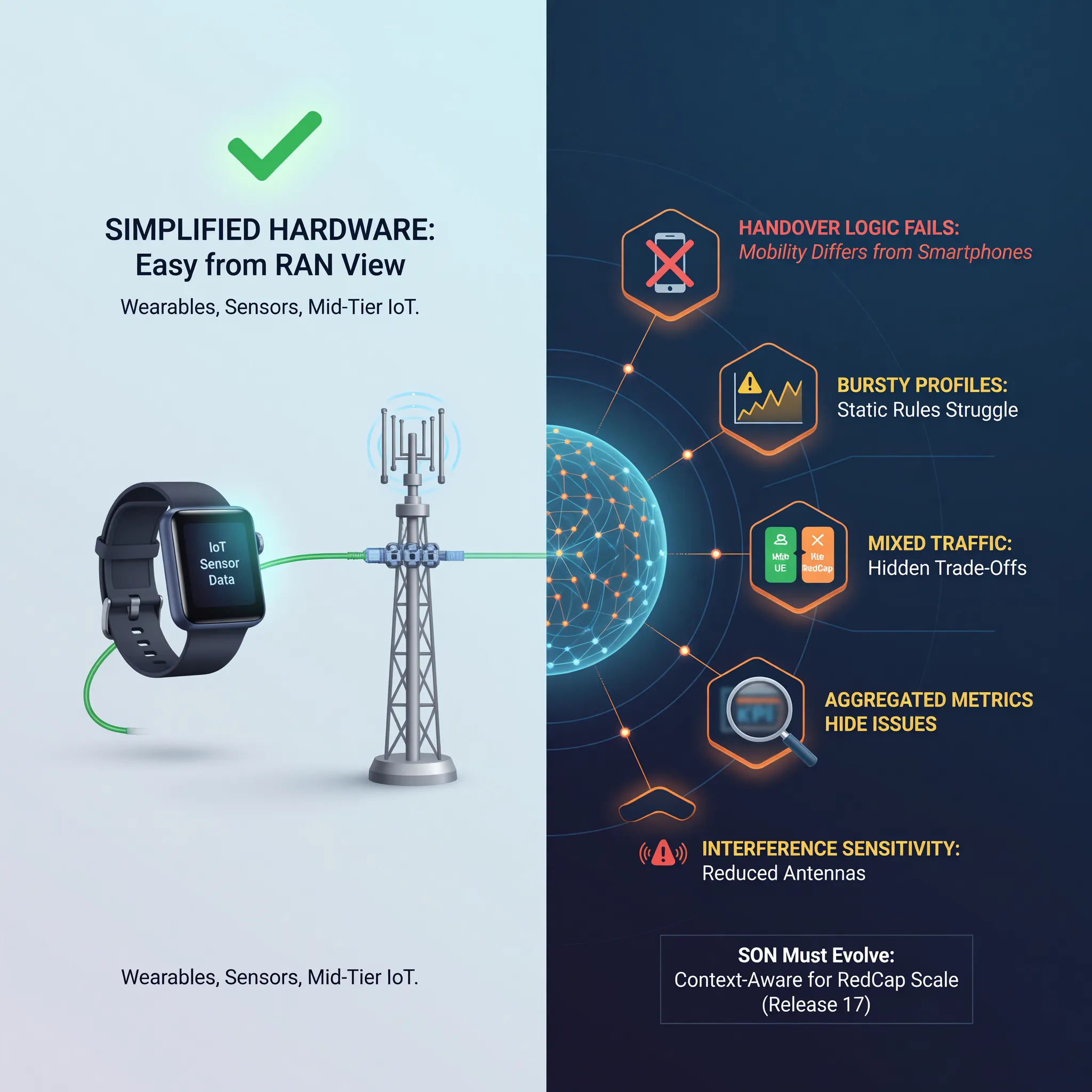
RedCap devices introduce complexity for SON. Learn why device capability is the new critical dimension for RAN optimization.
Read More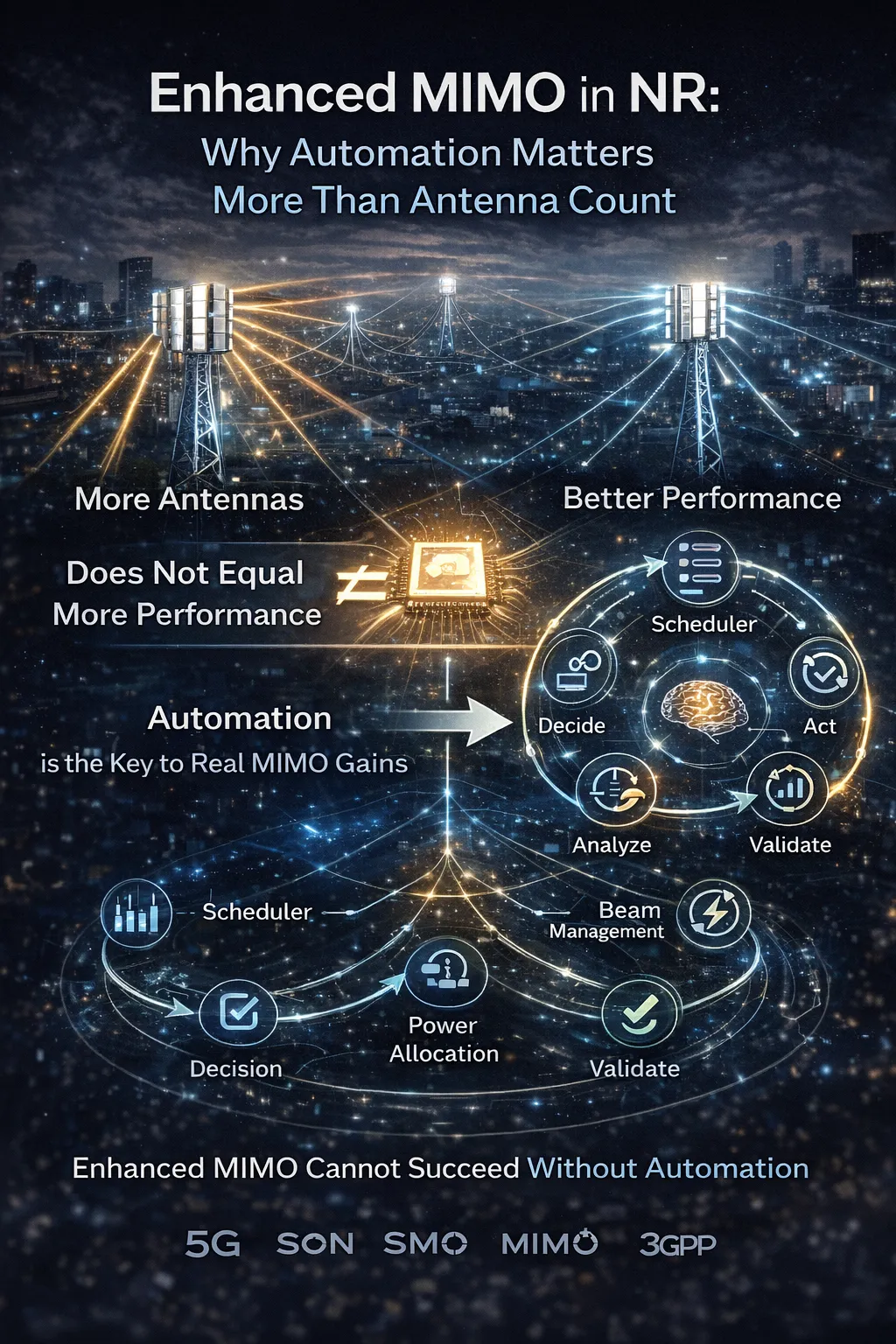
Exploring why Massive MIMO optimization requires a shift from traditional grid-based SON to beam-centric automation.
Read More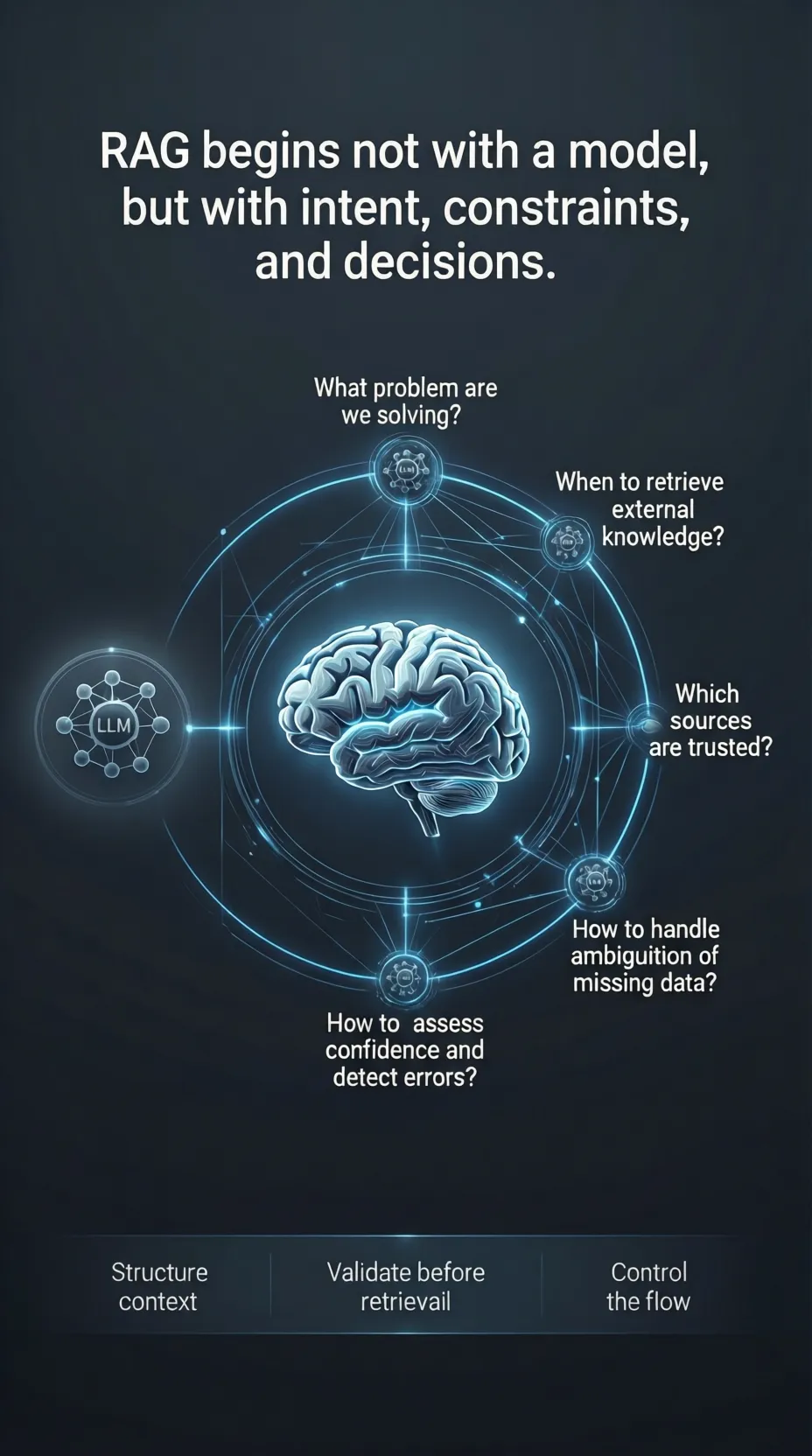
Why the success of RAG depends on system design, data orchestration, and retrieval strategy rather than just the LLM.
Read More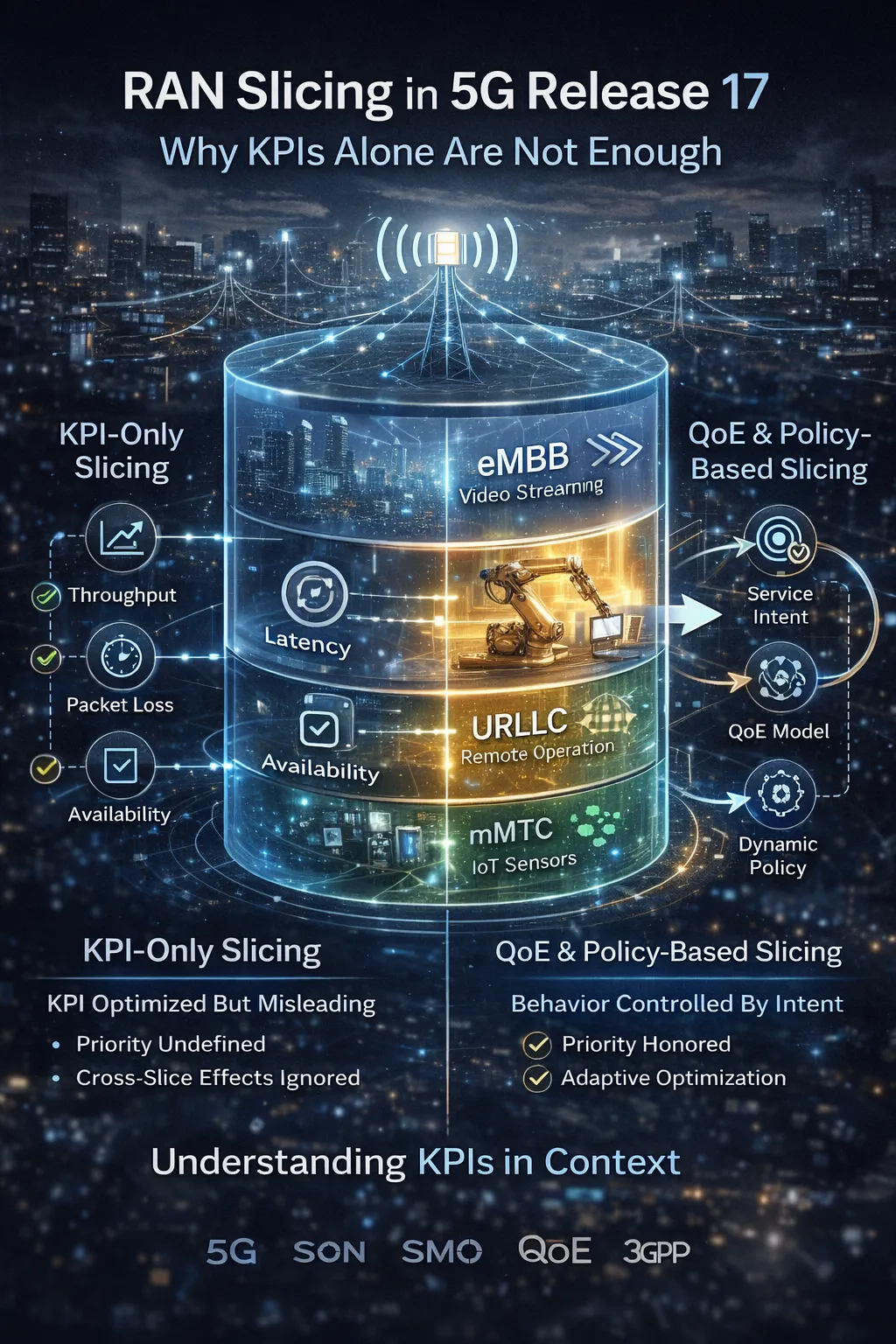
Why Network Slicing is the definitive test for SON and the necessity of real-time, cross-domain closed-loop control.
Read More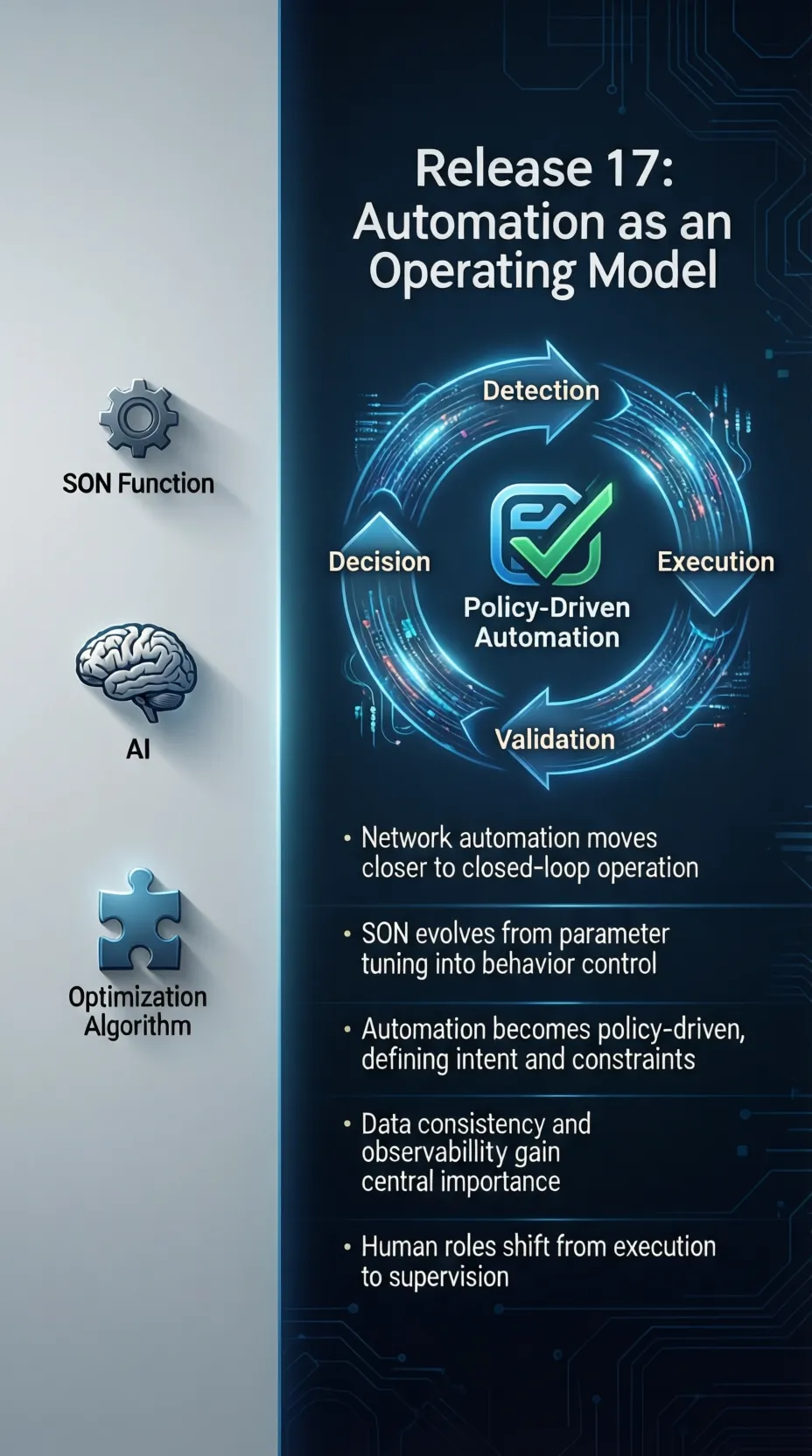
Understanding the role of the Near-Real-Time RIC in sub-second network optimization.
Read More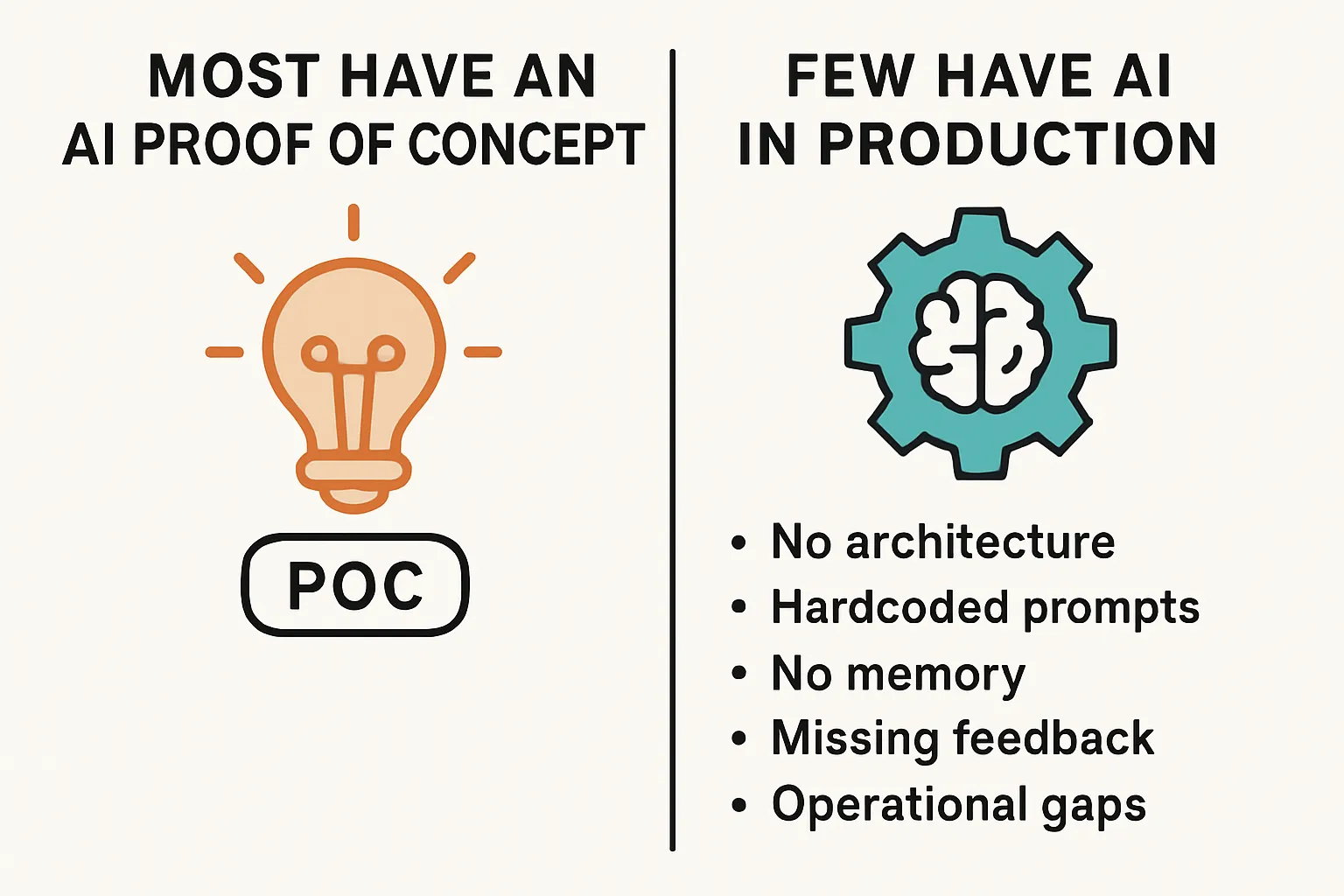
How SON is evolving to manage the critical balance between network performance and energy consumption.
Read More
Private 5G is often presented as a simple story: deploy a few sites, connect critical devices, guarantee performance, and move on.
Read More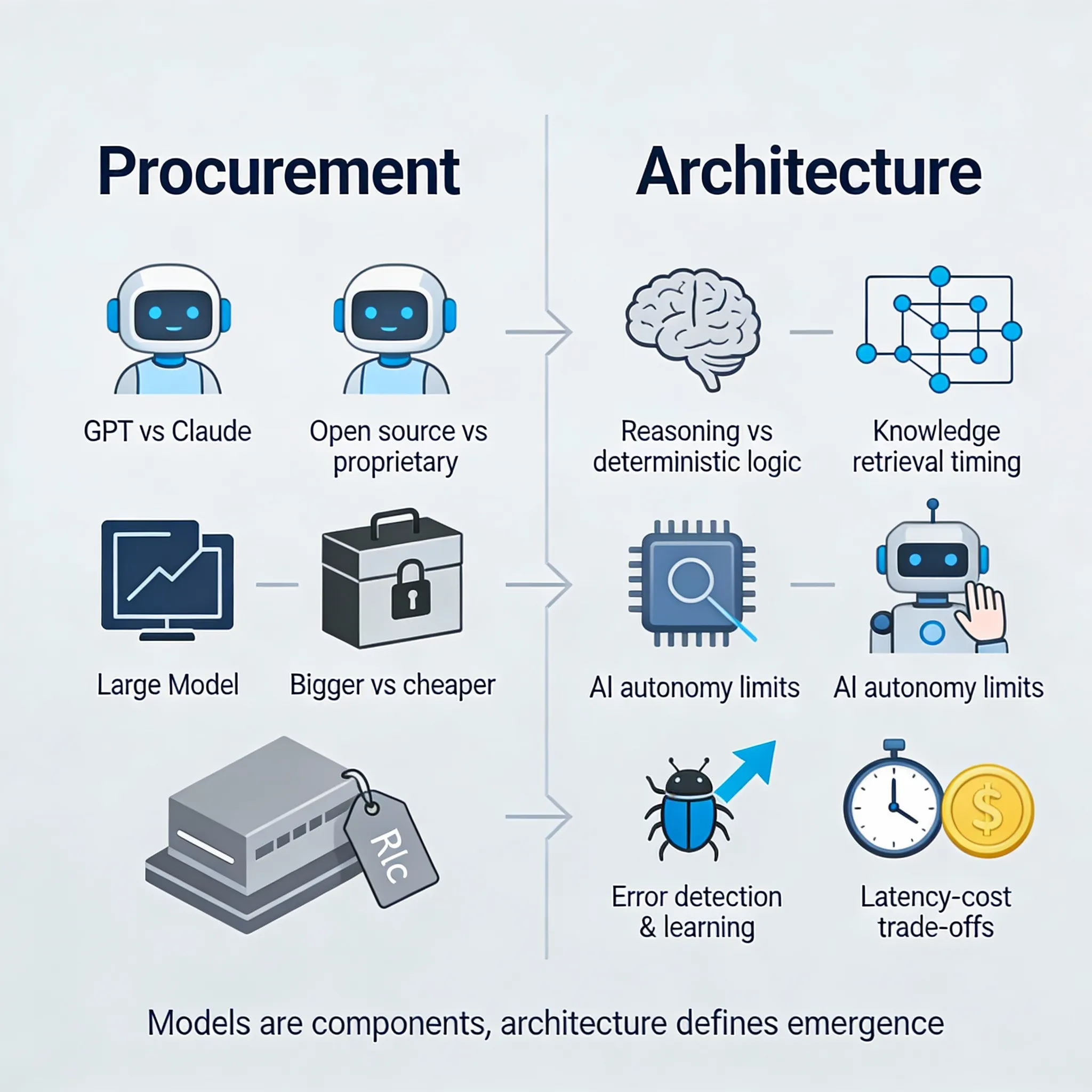
How AI and Machine Learning are transforming troubleshooting from reactive alarms to proactive root cause identification.
Read More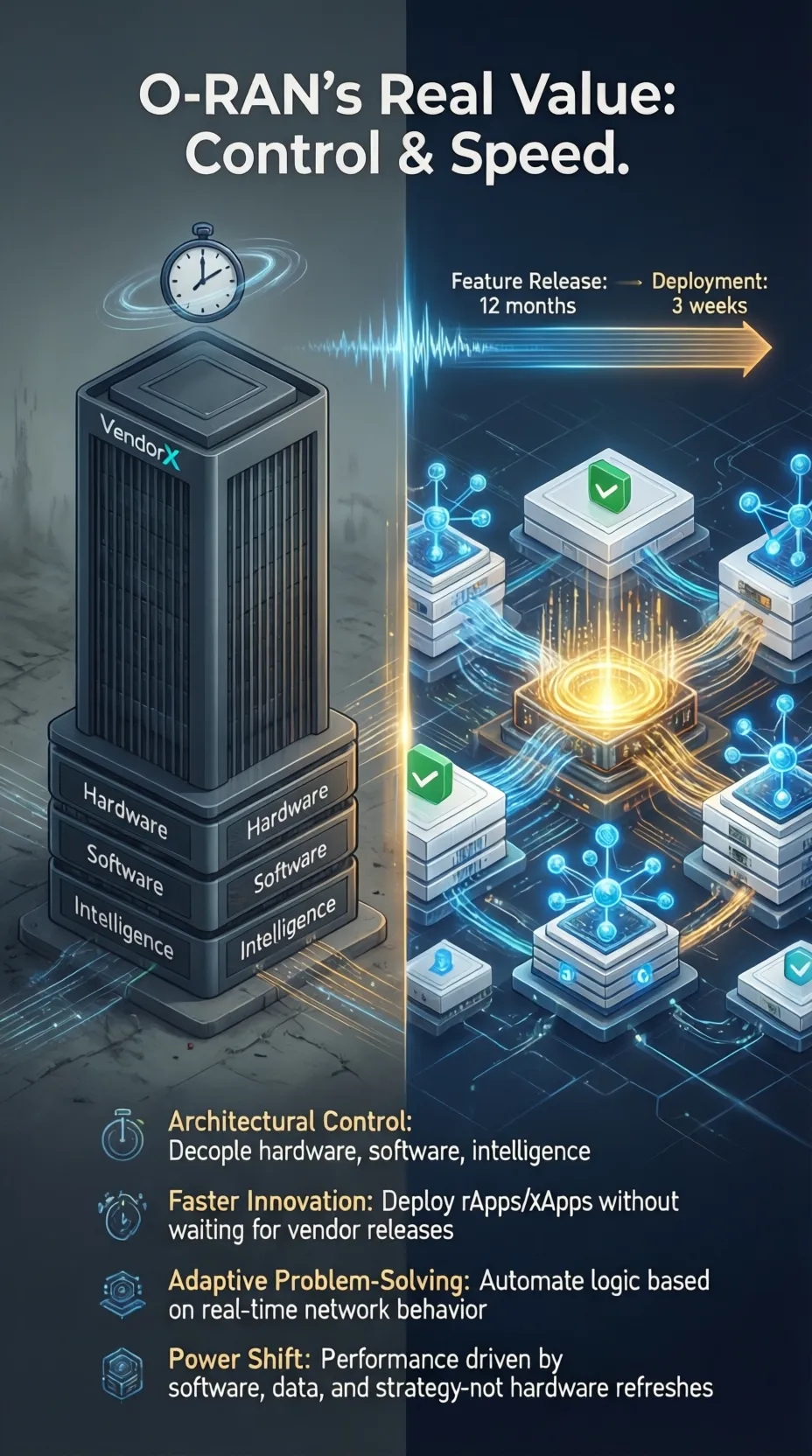
Addressing the new security frontiers of Open RAN, from interface protection to rApp/xApp governance.
Read More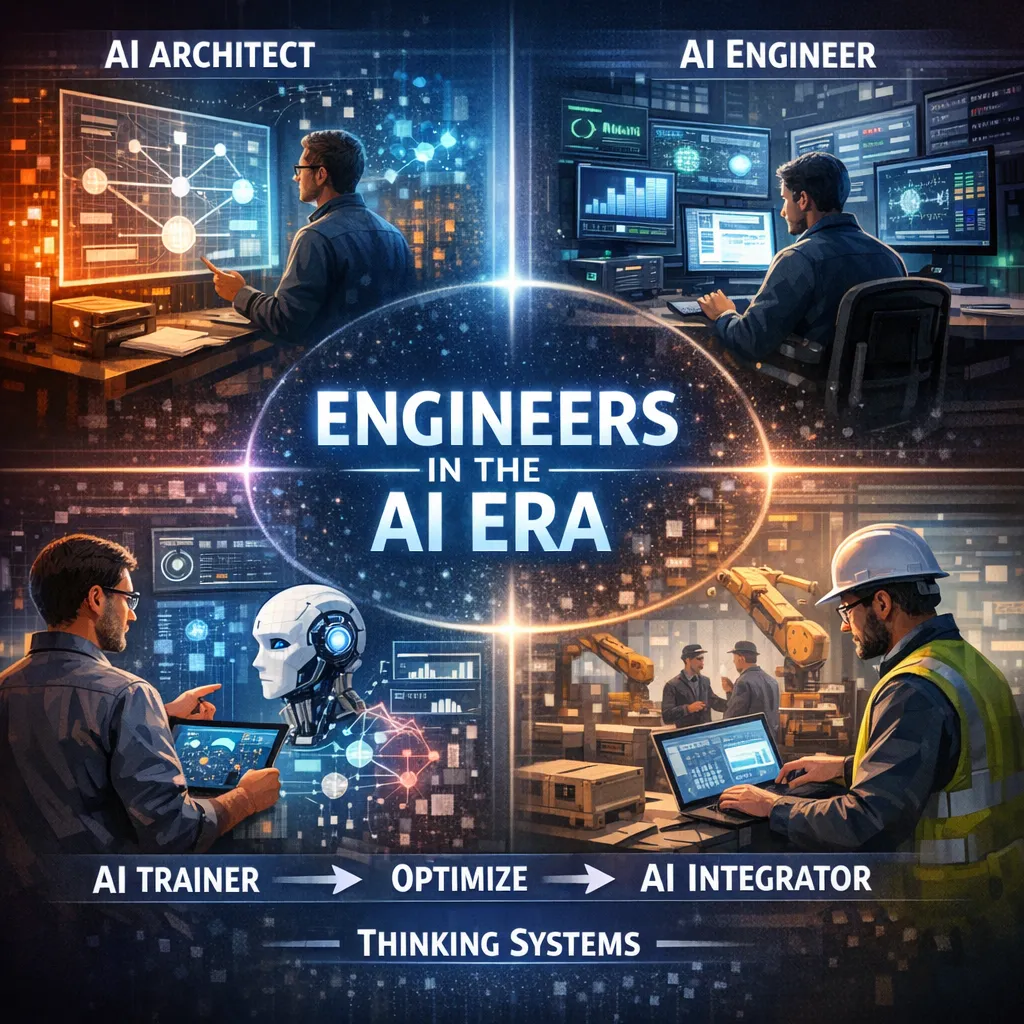
Why modern 5G networks require a shift from manual scripting to industrialized software architectures.
Read More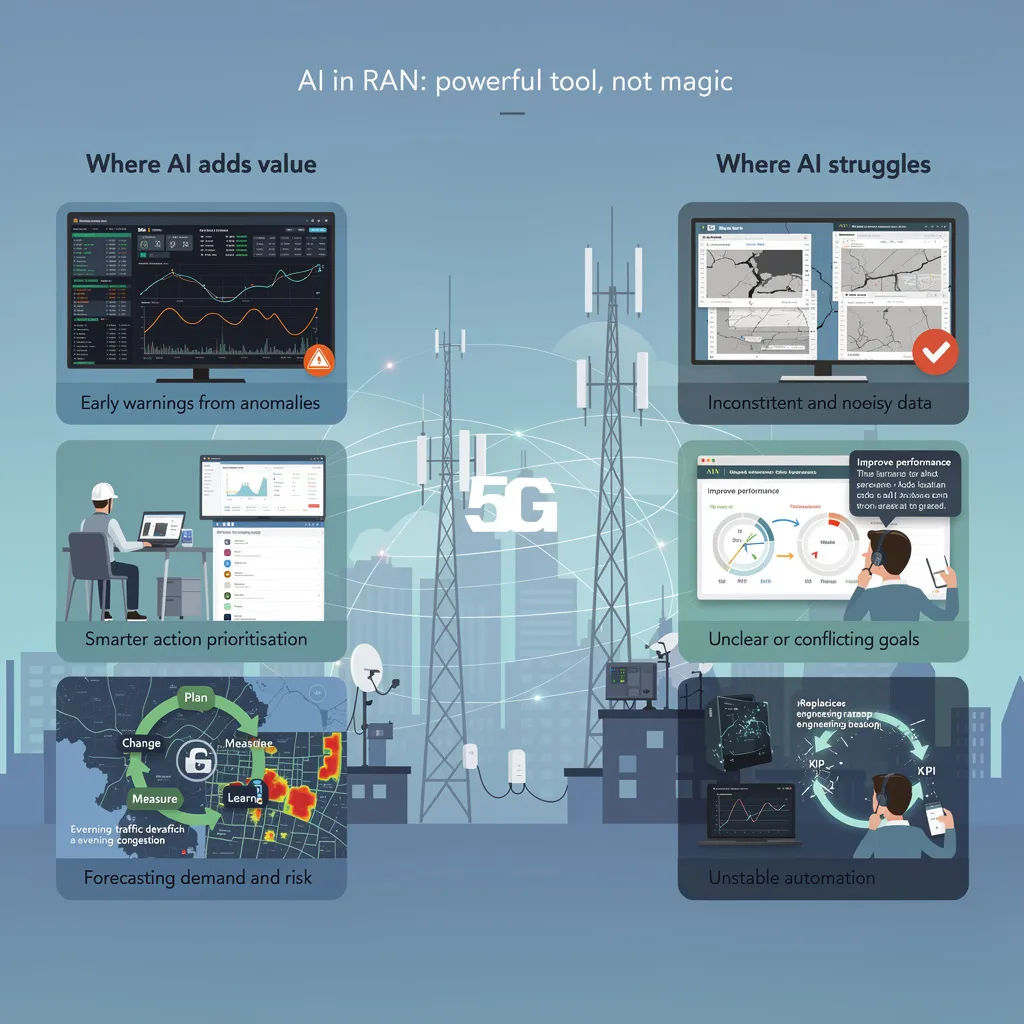
From manual configuration to intent-based networking: How SMO is changing network management.
Read More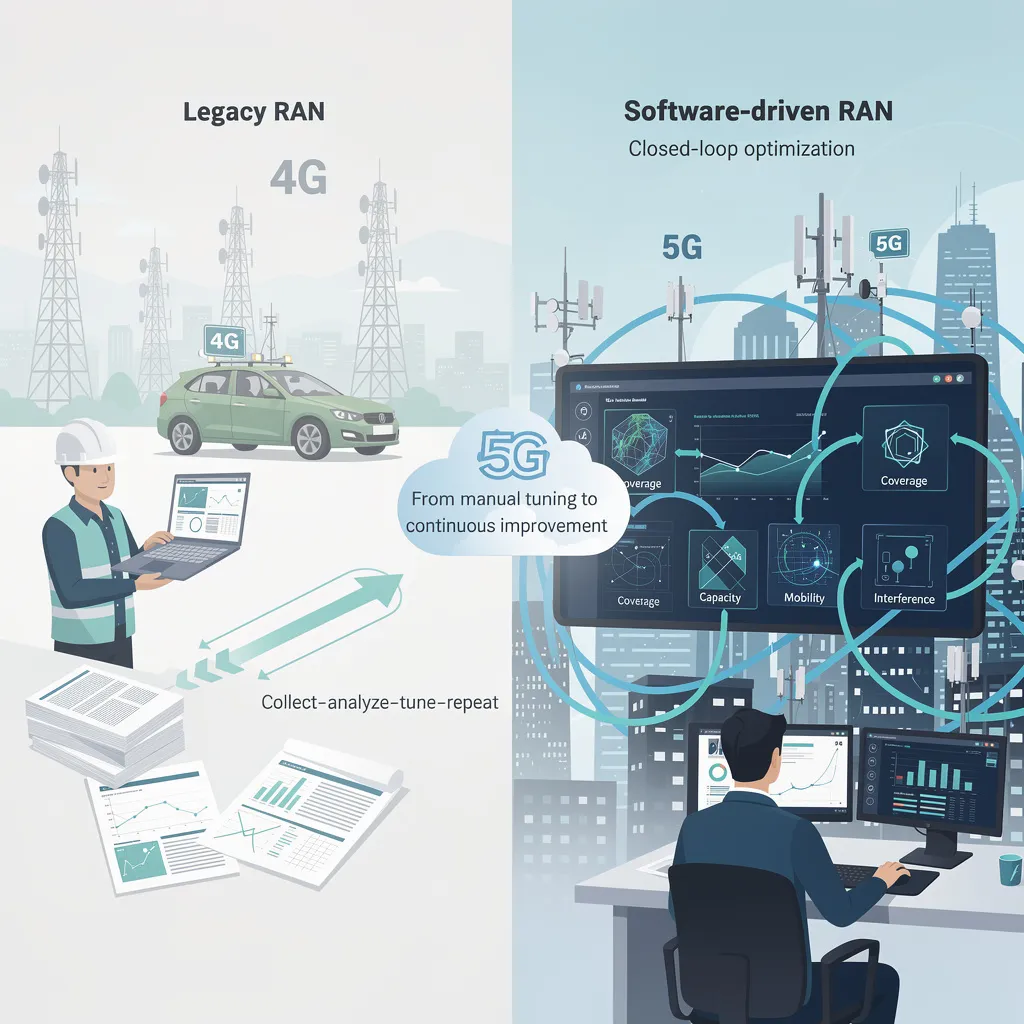
Transitioning RAN optimization from manual scripts to scalable software apps within the SMO and O-RAN ecosystem.
Read MoreWhether you're looking for collaboration on 5G/RAN projects, consulting services, or just want to connect.