WHY UPLINK OFTEN FAILS BEFORE DOWNLINK IN 5G
Understand 5G uplink limitations through UE power, link budget, TDD asymmetry, path loss, and cell-edge RF behavior.
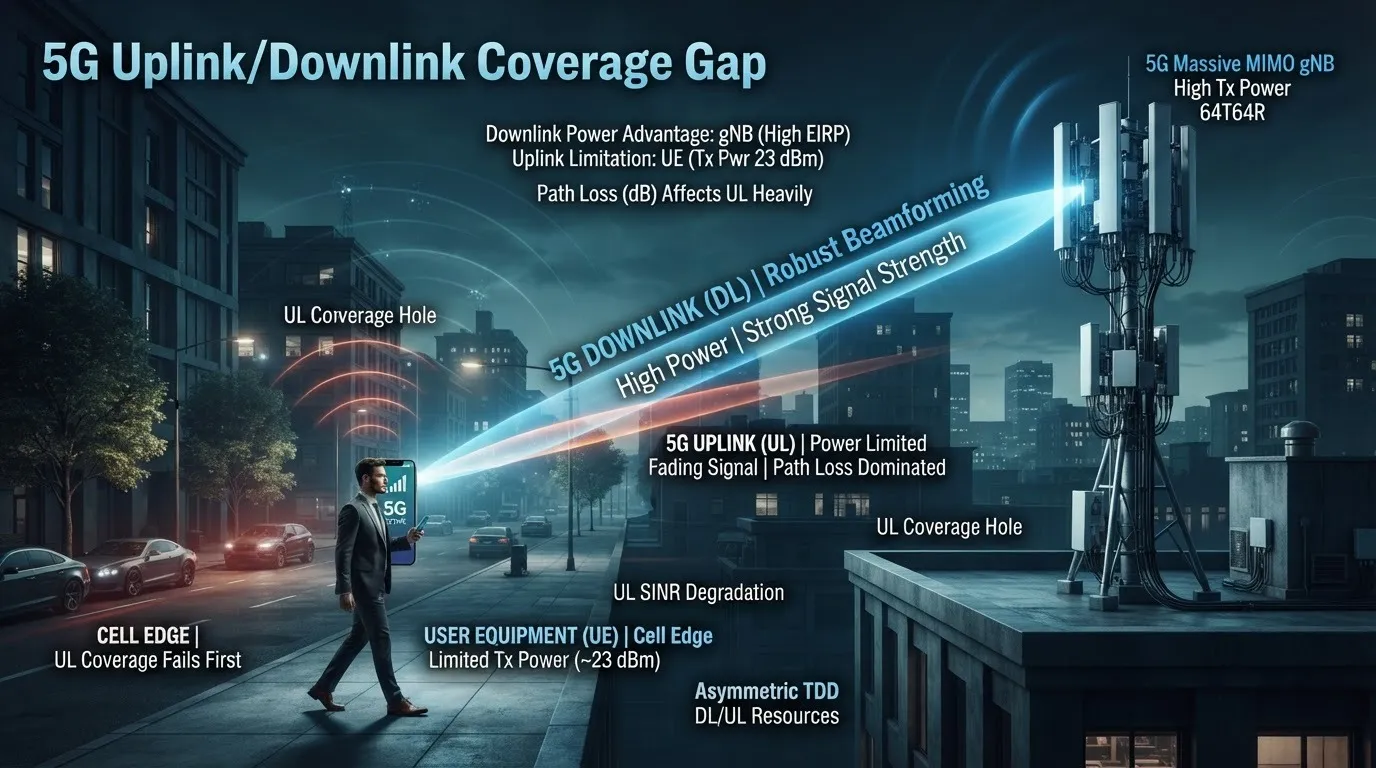
WHY UPLINK OFTEN FAILS BEFORE DOWNLINK IN 5G
One of the most important lessons in RF engineering is that coverage is not necessarily symmetrical. A user can receive a strong 5G signal and enjoy excellent download performance, while the uplink is already struggling. Why?
Because the gNB and your smartphone are playing the same RF game with very different resources. A base station can use high transmit power, large antenna arrays, beamforming, and significant antenna gain. Your smartphone has a much tougher job. It has limited transmit power, a small antenna system, battery constraints, and it may be trying to reach the site from inside a building or near the cell edge. That creates a fundamental link budget imbalance. And there is another factor: TDD.
Many mid band 5G deployments intentionally allocate more radio resources to downlink than uplink because most mobile traffic has traditionally been download heavy. So as the user moves toward the cell edge, several things start happening:
- The UE approaches its maximum transmit power while trying to compensate for increasing path loss.
- The uplink SINR deteriorates as the signal arriving at the gNB becomes weaker relative to noise and interference.
- Higher modulation and coding schemes become increasingly difficult to sustain.
- The scheduler may have fewer uplink resources available in a DL heavy TDD configuration.
This is why looking only at downlink coverage can create a false sense of network health. From an RF optimization perspective, the question should not only be: “Can the network reach the user?” We also need to ask: “Can the user reliably reach the network?”
That distinction becomes increasingly important with video uploads, cloud applications, FWA, industrial devices, XR, and other services generating more uplink traffic. Sometimes the real coverage boundary of a 5G cell is not defined by how far the gNB can transmit. It is defined by how far the UE can transmit back.
That is why a good RF engineer never looks at only one side of the link.
The downlink may look healthy while the uplink is already asking for help.
#5G #RAN #RFEngineering #RANOptimization #5GNR #Telecom