UE Power Saving Enhancements in NR: A Silent KPI That SON Must Understand
Why UE power saving is a silent KPI in 5G NR and how Release 17 challenges traditional SON optimization logic.
UE Power Saving Enhancements in NR: A Silent KPI That SON Must Understand
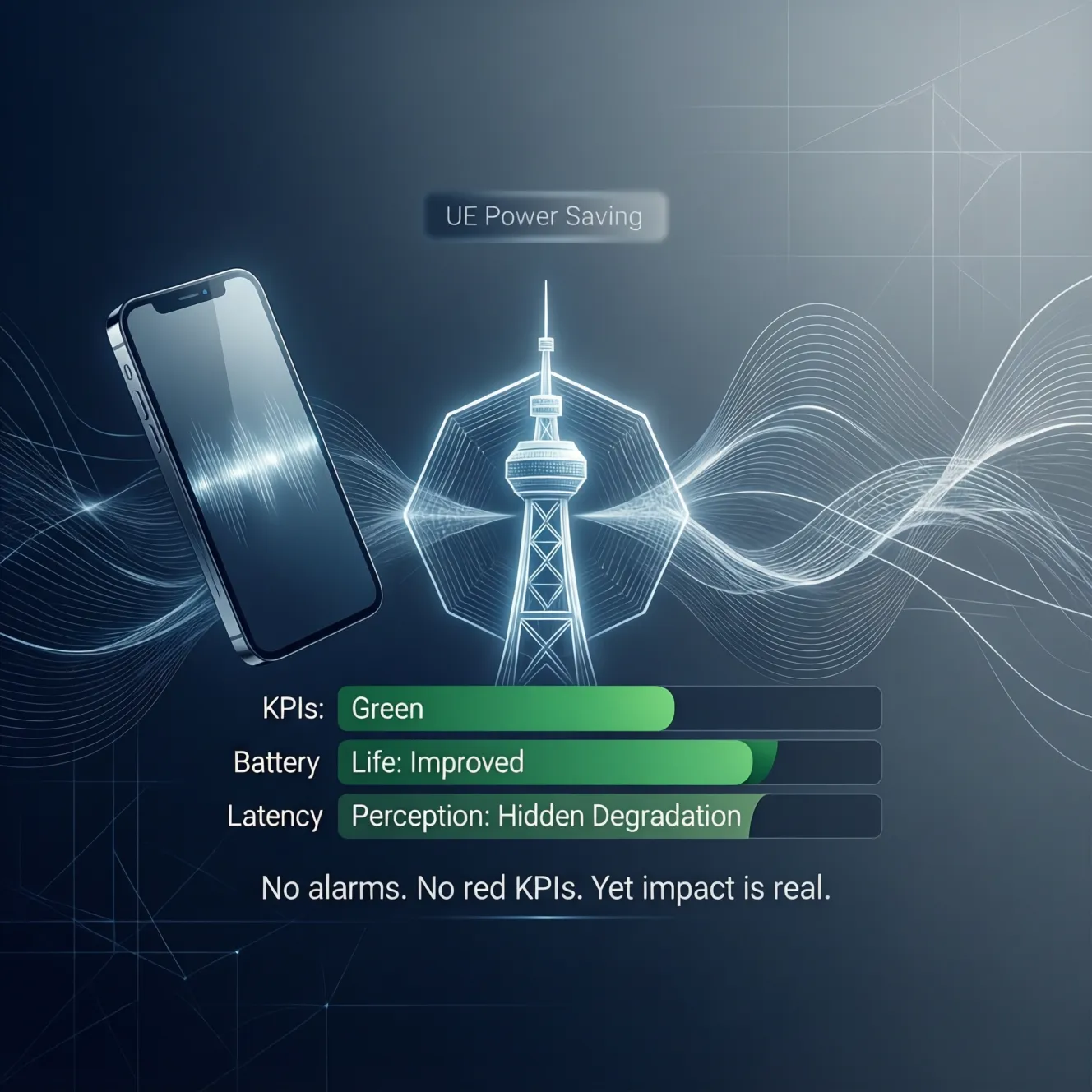
UE power saving is rarely at the center of RAN optimization discussions. There are no alarms for it. There are no obvious red KPIs. And yet, in 5G NR, power saving behavior is one of the most impactful and misunderstood dimensions of network performance.
Release 17 introduces further enhancements to UE power saving mechanisms, making devices smarter about when to listen, transmit, and sleep. From a user perspective, this is positive. From a SON perspective, it introduces a silent optimization challenge.
Here is why UE power saving matters more than it seems: • Power saving mechanisms directly affect paging response, latency perception, and session continuity, even when traditional KPIs remain green. • Aggressive power saving can improve battery life while quietly degrading user experience, especially for latency-sensitive or bursty applications. • Different UE categories react very differently to the same network configuration, making one-size-fits-all optimization strategies ineffective. • Network-side features such as DRX configuration, paging cycles, and inactivity timers interact in complex ways that are hard to capture with static rules. • KPI aggregation hides the issue, because battery-related degradation often appears as “random” user complaints rather than clear performance drops.
This is where SON must evolve. Optimizing UE power saving is not about pushing devices to sleep more. It is about balancing energy efficiency with service responsiveness, based on context, device type, and use case. That balance cannot be achieved with threshold-based logic alone.
In Release 17, power saving becomes a behavioral KPI. SON needs to understand why a device is idle, how it wakes up, and what the service expects when it does. Ignoring UE power saving does not break the network. It slowly erodes perceived quality. And in modern networks, perceived quality is often more important than raw throughput.
#5G #NR #Release17 #UEPowerSaving #SON #RANOptimization #NetworkAutomation #QoE #TelecomEngineering