The True Cost Of Multi-Vendor: Where O-RAN Wins, And Where It Doesn’t
This article explains the “multi-vendor tax” behind O-RAN: where openness truly creates strategic value (control, agility, innovation) and where it can backfire due to integration, testing, accountability, and operational complexity.
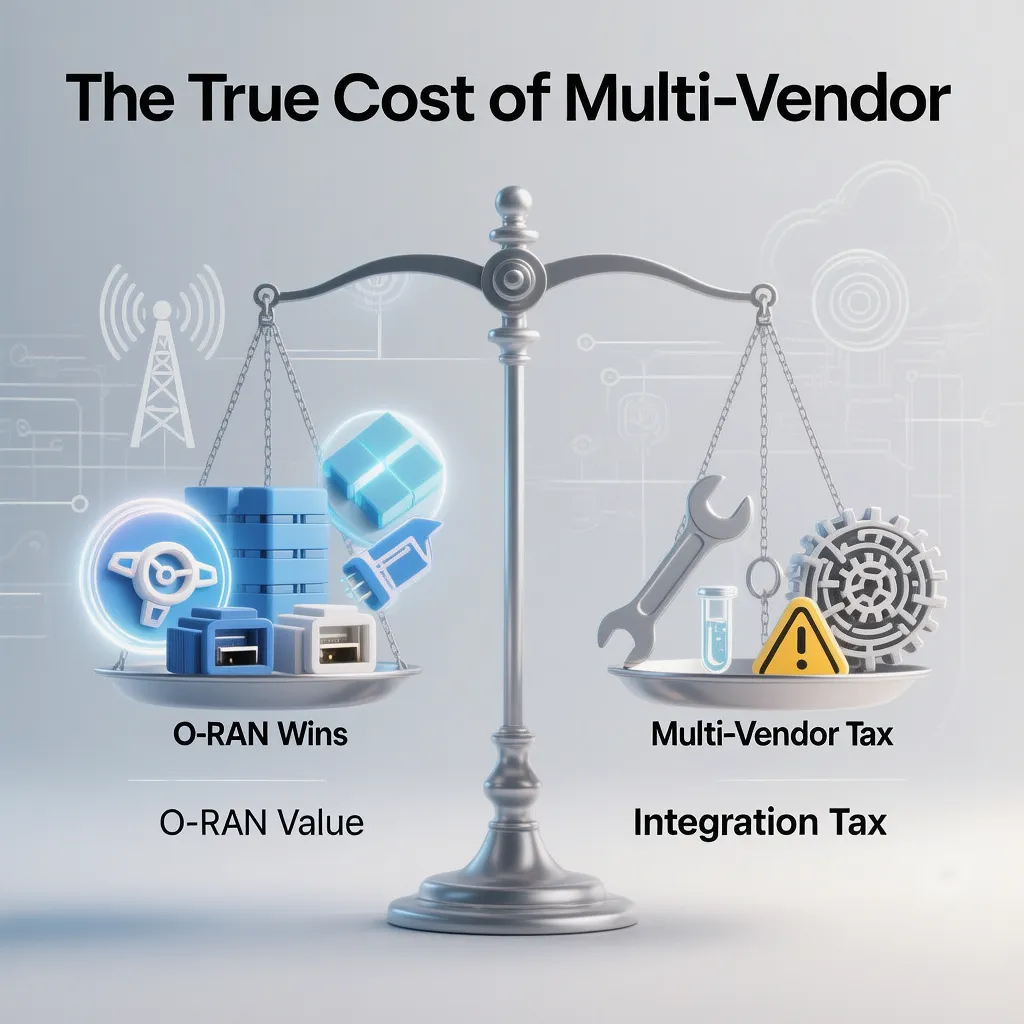
The True Cost Of Multi-Vendor: Where O-RAN Wins, And Where It Doesn’t
Multi-vendor is one of the most attractive promises in telecom: more competition, more flexibility, and less dependency on a single supplier. O-RAN made that promise feel closer than ever. But after the first pilots, many teams discover a hard truth: The biggest cost of multi-vendor is not the hardware. It’s the integration and operations “tax” that follows. This article is a practical guide to understand where O-RAN truly wins, where it doesn’t, and how to avoid turning “openness” into an unexpected OPEX problem.
The Multi-Vendor Tax: What You Pay After You “Save” When a network is delivered by a single vendor, you pay a premium for integration that has already been done for you. When you go multi-vendor, you often reduce unit costs, but you inherit new categories of work:
- Integration engineering, because components must behave like one system.
- Interoperability testing, because every release can break something.
- Tooling alignment, because alarms, counters, and KPIs don’t always match.
- Troubleshooting complexity, because “root cause” crosses boundaries.
- Accountability management, because vendors can point to each other. This is not an argument against O-RAN. It’s a reminder that multi-vendor is a different operating model, not just a different shopping model.
Where O-RAN Wins O-RAN tends to win when openness creates strategic leverage that outweighs the integration tax. 1) When You Have A Strong System Integration Capability If an operator (or its partners) can integrate, validate, and operate multi-vendor consistently, the benefits become real. At that point, vendors compete on modules, not on lock-in. 2) When Roadmap Control Matters More Than Simplicity If your strategy depends on faster feature adoption, differentiated enterprise SLAs, or new automation behaviors, a modular architecture can reduce “waiting time” for a single vendor roadmap. 3) When You Scale Automation Across The Stack O-RAN’s long-term advantage is not only price. It’s programmability. SMO, RIC, rApps, and xApps can become an ecosystem where innovation is deployed like software, not like a hardware refresh cycle. 4) When The Deployment Is Targeted and Value-Driven Greenfield zones, private networks, and specific enterprise clusters often benefit most. Why? Clear boundaries, controlled scope, and a business case tied to outcomes.
Where O-RAN Doesn’t (Or At Least It’s Riskier) This is where many pilots struggle, not because the concept is wrong, but because the execution model is missing. 1) When the Goal Is Only “Cheaper Units” If the business case is purely cost reduction, multi-vendor may disappoint. Savings in radios can be offset by:
- Longer integration cycles.
- Higher testing effort.
- More operational incidents.
- Additional expert headcount. 2) When Operations Are Not Ready A multi-vendor network demands a higher operational maturity:
- Observability across vendors.
- Consistent KPIs and telemetry.
- Strong change management and rollback discipline.
- Automation-first processes. Without this, complexity scales faster than benefits. 3) When Accountability Is Not Defined In single-vendor stacks, accountability is simple. In multi-vendor, it must be engineered through:
- Clear SLAs per domain.
- End-to-end ownership model.
- Joint triage processes.
- Standardized evidence and logging. If this governance is missing, “vendor finger-pointing” becomes a hidden cost. 4) When You Try To Scale Too Fast Most failures happen when a pilot jumps to nationwide scale before the integration and operations model is proven. Multi-vendor amplifies small inconsistencies into large operational friction.
A Framework To Decide: 5 Questions That Save You Money Before going O-RAN multi-vendor at scale, ask:
- Do we have a clear integration owner and continuous test strategy?
- Do we have unified observability and comparable KPIs across vendors?
- Do we have governance for accountability and incident triage?
- Do we have automation maturity to reduce operational friction?
- Is our value case based on strategic control, not only procurement savings? If the answer to most of these is “not yet,” the best next step is not “don’t do O-RAN.” The best step is: build the operating model first.
The Big Takeaway O-RAN can be a win. But the win is not automatic, and it rarely comes from cheaper units alone. Multi-vendor is like moving from a single integrated machine to a modular ecosystem. You gain flexibility and leverage. But you also inherit the responsibility to make the ecosystem work. The operators who succeed with O-RAN won’t be the ones who buy “open.” They’ll be the ones who can operate “open” with discipline.
#ORAN #OpenRAN #5G #RAN #TelecomStrategy #NetworkAutomation #SMO #RIC #DigitalTransformation #TelecomLeadership