SON vs AI in RAN: Evolution or rebranding?
This post explores whether AI in RAN is a true transformation or an evolution of SON, highlighting how AI enhances automation but still depends on strong engineering fundamentals.
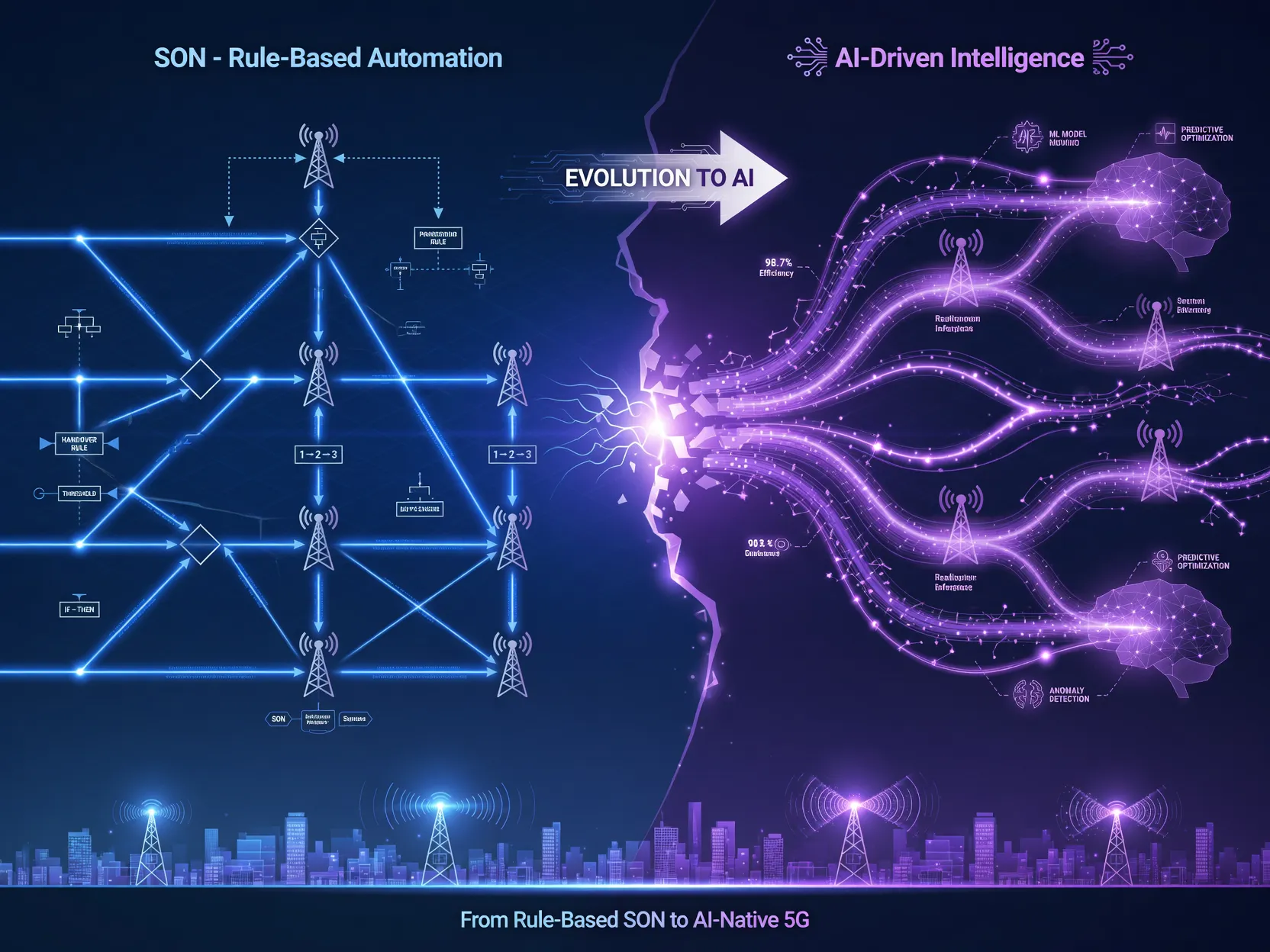
SON vs AI in RAN: Evolution or rebranding?
After exploring DLB, ANR, PCI, and CICO, a natural question comes up:
Are we really entering a new era with AI in RAN… or are we just redefining what SON has been doing for years? For a long time, SON has been the foundation of RAN automation.
It introduced the idea that networks could self-configure, self-optimize, and even self-heal. Features like DLB, ANR, and CICO were early steps toward autonomous networks.
Now, with AI, SMO, and rApps, the narrative has evolved. But has the essence really changed?
From my perspective, the answer is both yes… and no.
Here are some key realities:
• * SON was already based on automation logic, but it operated with predefined rules and limited adaptability. • * AI introduces the ability to learn from large-scale data, enabling more dynamic and context-aware decisions. • * However, both SON and AI rely heavily on data quality, and poor inputs still lead to poor outcomes. • * The complexity of the network has increased significantly, making coordination between features more critical than ever.
What AI is truly changing is not the goal… but the scale and speed.
• * AI can process multi-dimensional data across layers, vendors, and domains in ways SON could not. • * It enables near real-time optimization, instead of periodic adjustments. • * It allows more predictive approaches, rather than purely reactive ones. • * It opens the door to intent-based optimization driven by business and user experience metrics.
But there is a critical point that is often overlooked:
AI does not replace engineering fundamentals. If DLB is poorly tuned, AI will learn from that behavior. If ANR creates inefficient neighbors, AI will optimize around flawed relations. If PCI planning is inconsistent, AI will inherit that ambiguity. In other words…
AI does not fix bad design. It scales it. This is why the transition from SON to AI in RAN should not be seen as a replacement. It is an evolution.
And more importantly, it is an amplification of everything we already do — good or bad. The real challenge is not adopting AI. The real challenge is ensuring that the foundation we build on is solid enough to sustain it. Because in the end, the smartest network is not the one with the most advanced algorithms… It is the one built on the strongest engineering principles.
#5G #RAN #SON #AIinTelecom #ORAN #SMO #RIC #Telecom #NetworkAutomation #FutureOfRAN