SINR Tells A Better Story Than RSRP
Learn why experienced RF engineers often prioritize SINR over RSRP when diagnosing real-world network performance.
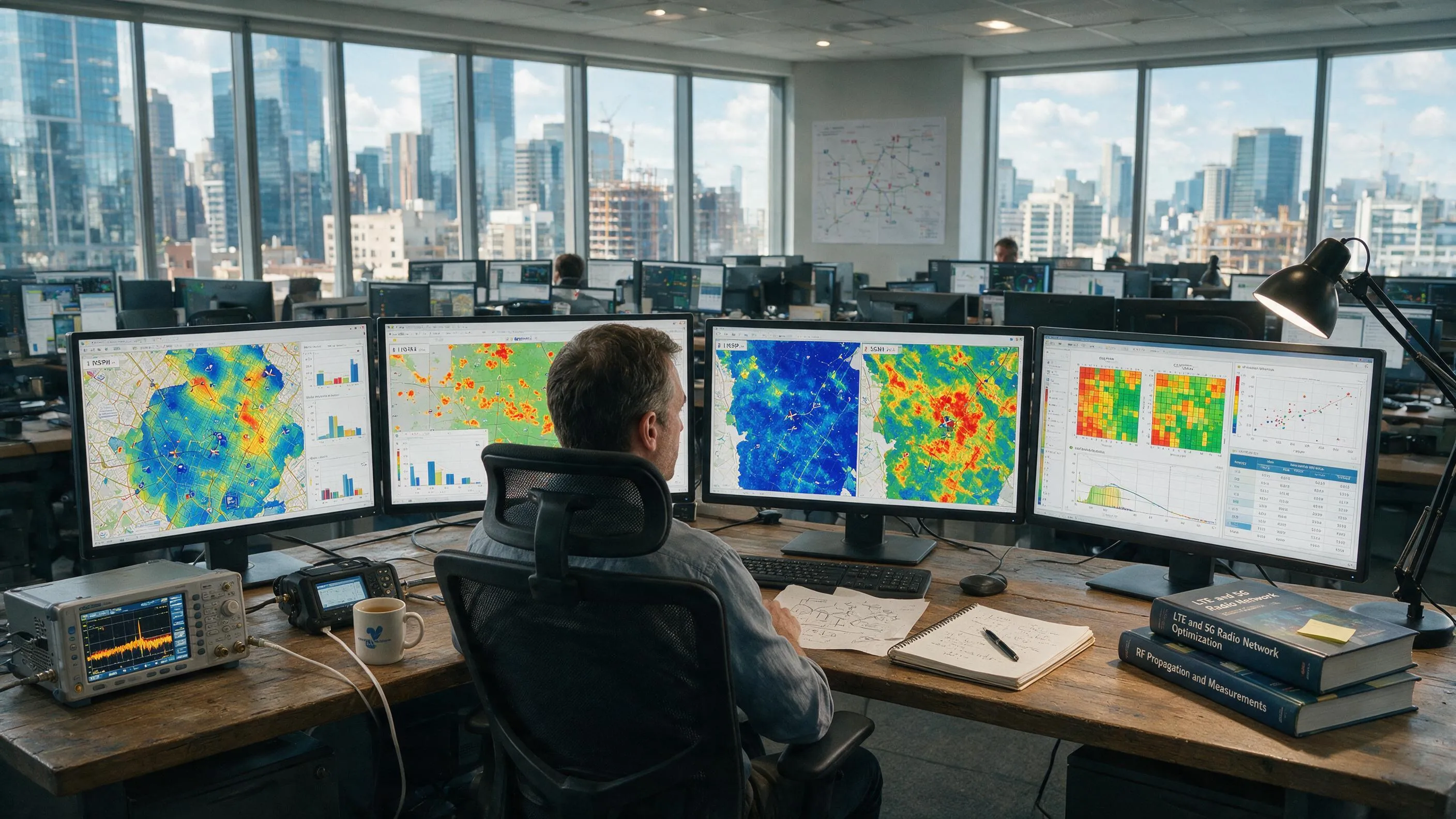
SINR Tells A Better Story Than RSRP
“If I could only look at one RF metric during troubleshooting, it wouldn’t be RSRP.” That statement usually surprises engineers. After all, RSRP has long been one of the most recognized indicators of LTE and 5G radio coverage. And yes… coverage matters. But coverage alone doesn’t guarantee a great user experience. Throughout my career in RF Design and RAN Optimization, I’ve investigated many cases where users experienced poor throughput, unstable connections, or failed handovers—even when RSRP looked perfectly acceptable. The missing piece was often SINR. Why? Because RSRP answers one question: “How strong is the received signal?” SINR answers a much more valuable one: “How usable is that signal?” A strong signal surrounded by interference may deliver worse performance than a weaker signal operating in a clean radio environment. That’s why I’ve learned to look beyond signal strength and focus on signal quality. Consider a few common scenarios:
- A Cell with excellent RSRP may still provide poor user experience because interference limits spectral efficiency.
- Increasing transmit power can improve RSRP while simultaneously degrading SINR for neighboring cells.
- Coverage problems are often easier to identify than interference problems, but interference usually has a much greater impact on capacity and user experience.
This is one of the reasons why successful optimization requires understanding how KPIs interact rather than analyzing them in isolation. No single metric tells the whole story.
- RSRP.
- RSRQ.
- SINR.
- CQI.
- Traffic distribution.
- Mobility.
Each contributes a different piece of the puzzle. Engineering judgment comes from connecting those pieces before making a decision. Over the years, I’ve realized that great RF engineers don’t chase individual KPIs. They seek to understand the behavior of the radio environment as a whole. Because in the end… Customers don’t experience signal strength. They experience network quality.
Which KPI has taught you the most valuable lessons throughout your engineering career?
#5G #LTE #RFEngineering #RAN #RANOptimization #SINR #RSRP #NetworkOptimization #TelecomLeadership #WirelessNetworks