Reliability 101: Why Uu and N3 both matter for critical 5G
This post explains reliability for critical 5G as an end-to-end chain: Uu covers the radio hop (UE↔gNB) and N3 covers the user-plane path (gNB↔UPF), and both must be reliable for SLAs to hold.
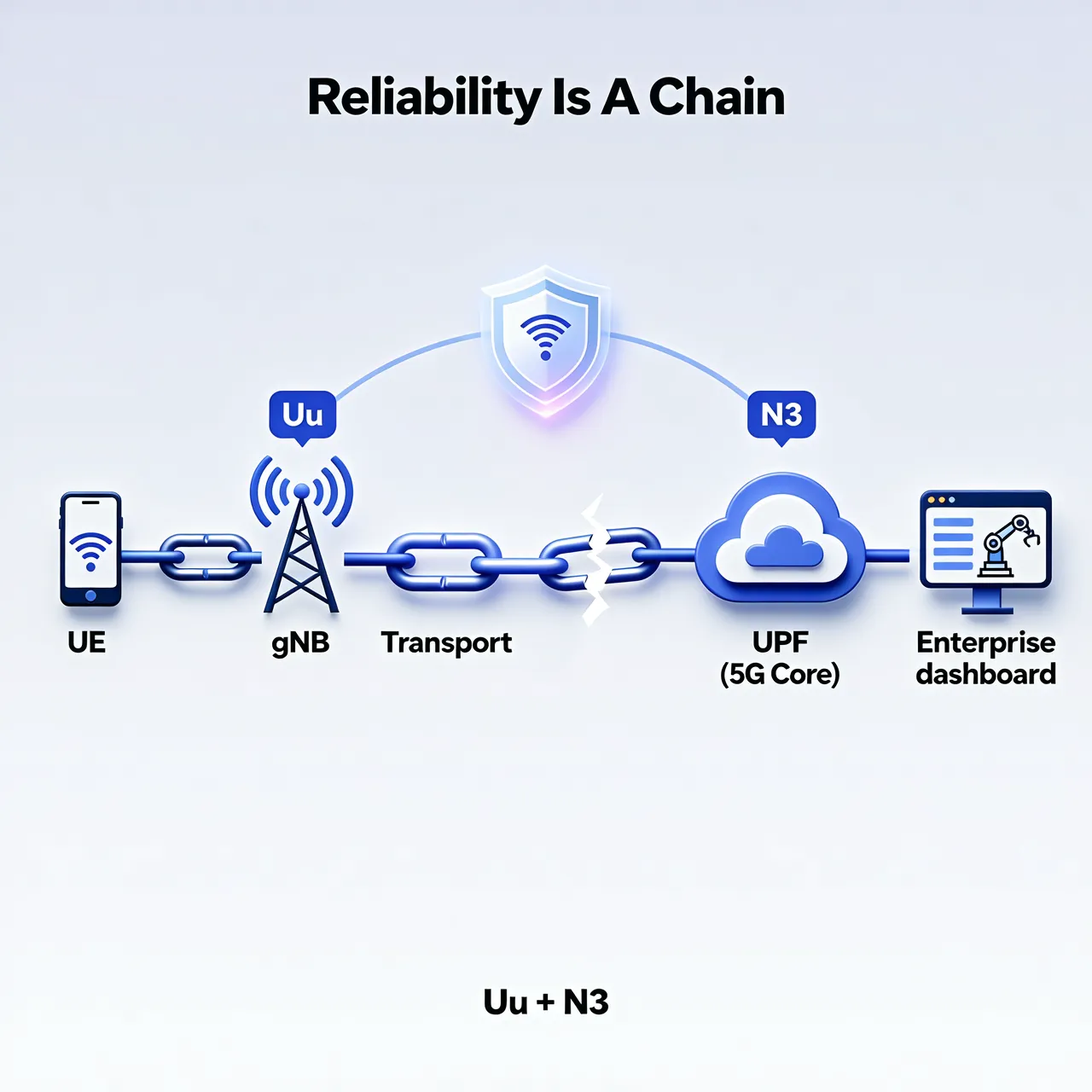
Reliability 101: Why Uu and N3 both matter for critical 5G
When we talk about “reliable 5G,” many people instinctively focus on the radio link. Strong signal, good SINR, fewer drops.
But for critical services, reliability is not a single number. It’s an end-to-end promise. A simple mental model:
Uu is the reliability of the radio hop (gNB ↔ UE). N3 is the reliability of the user-plane path between RAN and Core (gNB ↔ UPF).
If either one fails, the service fails.
That’s why a site can look “healthy” from an RF perspective and still deliver a painful experience: the radio is fine, but packets are being lost, delayed, or disrupted between the gNB and the core. Here’s how to translate it into real-world impact:
• * Uu reliability protects the last-mile experience, because retransmissions and radio instability break real-time control and consistent QoS. • * N3 reliability protects the service continuity, because even perfect radio cannot compensate for transport or core-side user-plane instability. • * Critical 5G use cases care about predictability, because “works most of the time” is not an SLA.
If you’re designing or assuring critical 5G (industrial control, remote operations, private networks, premium slices), don’t ask only “How good is the radio?”
Ask: “Is reliability engineered across both Uu and N3, with visibility and accountability end-to-end?” Because in critical 5G, reliability is a chain. And the chain breaks at the weakest link.
#5G #Reliability #RAN #5GCore #Enterprise5G #NetworkSlicing #TelecomStrategy #NetworkAutomation #SMO #ORAN