The real challenge of rApps: It’s not the algorithm
This post explains why the main challenge of rApps is not the algorithm itself, but the surrounding ecosystem, including data quality, integration, and coordination across the network.
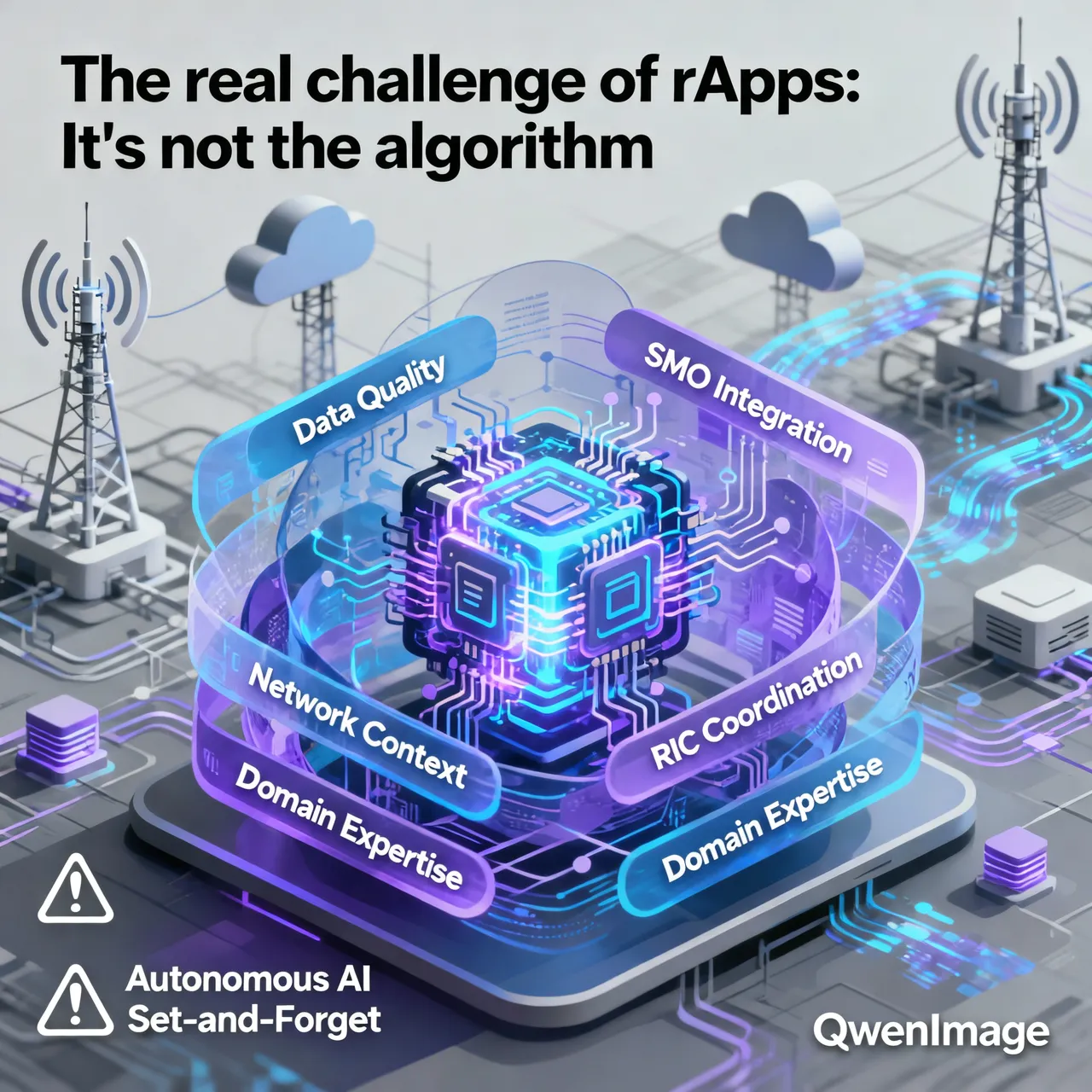
The real challenge of rApps: It’s not the algorithm
After understanding that SMO is not just a new OSS, the next logical step is rApps. And this is where expectations usually go wrong. Most discussions around rApps focus on algorithms:
AI models, ML techniques, prediction accuracy… But in real deployments, the biggest challenge is not the algorithm.
It is everything around it.
Because an rApp does not operate in isolation. It operates inside a complex ecosystem where data, timing, and context define its real value. Here are some common misconceptions I still see:
• * Many assume that a better algorithm will automatically deliver better results, ignoring the dependency on data quality and consistency. • * It is often believed that rApps can be deployed independently, without deep integration with SMO, RIC, and underlying network layers. • * There is an expectation that AI-driven logic will replace domain expertise, when in reality it still depends heavily on it. • * Some think that once deployed, rApps will continuously improve performance, without requiring supervision, validation, and tuning.
In practice, most rApp challenges are not technical in the traditional sense:
• * Data fragmentation across vendors and domains creates inconsistent inputs. • * Lack of standardized KPIs makes it difficult to define what “success” actually means. • * Latency and data freshness can limit the effectiveness of near real-time decisions. • * Conflicts between multiple rApps can lead to unstable or contradictory actions.
This is where many initiatives struggle. Not because the logic is wrong… But because the context is incomplete.
From my experience, successful rApp implementations share a different focus:
• * They prioritize data pipelines and governance before algorithm complexity. • * They clearly define objectives aligned with business and user experience, not just technical KPIs. • * They ensure coordination between rApps to avoid conflicting actions. • * They embed engineering knowledge into the logic, instead of trying to replace it.
Because in the end, an rApp is only as good as the environment it operates in. You can have the most advanced AI model… But if the data is inconsistent, the objectives are unclear, or the system is not aligned… The outcome will still fall short.
As we move deeper into AI-driven RAN, this becomes even more critical. The industry is not lacking algorithms. It is lacking integration, alignment, and context. And that is where the real challenge begins.
#5G #ORAN #rApps #SMO #AIinTelecom #RAN #NetworkAutomation #RIC #Telecom