The Industrialization of RAN Optimization: Moving from Scripts to Software Apps
Transitioning RAN optimization from manual scripts to scalable software apps within the SMO and O-RAN ecosystem.
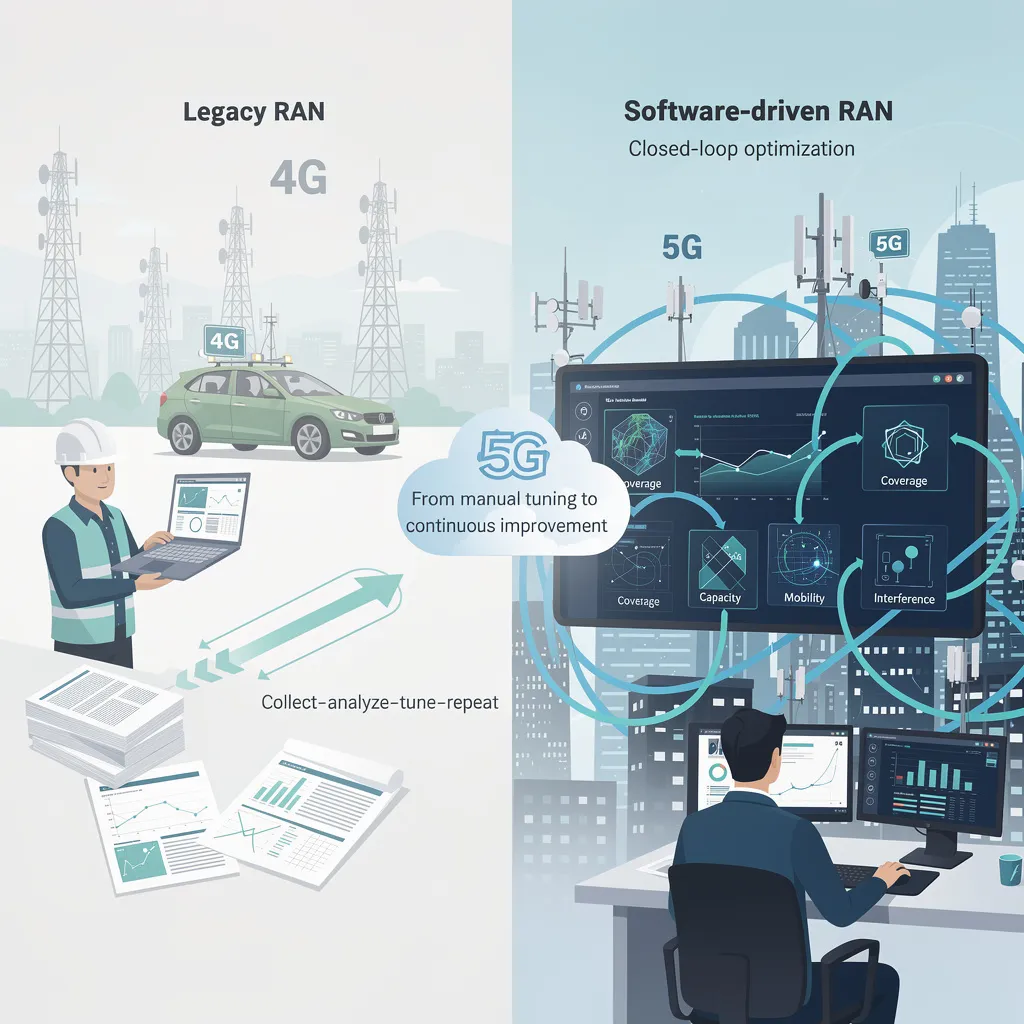
The Industrialization of RAN Optimization: Moving from Scripts to Software Apps
For years, RAN optimization has relied heavily on the expertise of RF engineers and a library of custom scripts. These scripts—often written in Python, Perl, or even Excel macros—were the “secret sauce” that helped manage complex networks. But as we move deep into the 5G era, scripts are no longer enough. We need to industrialize optimization.
The shift from manual scripts to Software Apps (rApps and xApps) within the SMO and O-RAN ecosystem is not just a change in tools; it is a change in philosophy.
Why industrialization matters: • Scalability: A script that works on 100 cells often fails when applied to 10,000. Software apps are built to handle the scale and diversity of modern Tier-1 networks. • Observability: Apps provide a level of logging, monitoring, and tracing that scripts cannot match. This allows us to understand why an optimization action was taken and what its impact was. • Governance: In a multi-vendor environment, apps allow for consistent optimization policies and guardrails that can be enforced across the entire network. • Reliability: Software-driven optimization is less prone to the “human error” that can occur when scripts are manually executed or modified.
Industrializing optimization means treating RAN performance as a continuous software process.
• Data is ingested in real-time through standardized interfaces (O1, A1, E2). • Advanced algorithms (including AI/ML) detect performance degradation patterns that are invisible at the single-cell or single-KPI level. • Optimization actions are no longer isolated parameter changes, but coordinated decisions across coverage, capacity, mobility, and interference. • Closed-loop systems can validate the impact of each action and automatically refine future decisions based on real results.
This shift changes the role of the RF engineer. Instead of spending time reacting to alarms or manually tuning parameters, engineers focus on defining strategies, constraints, and performance objectives that guide the automation.
The real value of software apps in RAN optimization is not speed alone. It is consistency, scalability, and the ability to manage complexity without losing control.
In my experience, the most mature networks are not those that abandoned traditional RF knowledge, but those that embedded it into software-driven workflows. That is how optimization moves from repetitive manual work to continuous performance improvement.
RAN optimization is no longer a cycle. It is a living process.
#5G #RAN #RANOptimization #NetworkAutomation #SON #SMO #ORAN #TelecomEngineering