Can a Digital Twin Become the Sandbox for Autonomous RAN?
Explore how a RAN digital twin can safely validate SON, rApps and AI policies before live deployment on the path to L4 autonomous networks.
Can a Digital Twin Become the Sandbox for Autonomous RAN?
Every conversation about L4 Autonomous Networks hits the same wall. Nobody wants an AI agent learning by trial and error on a live network carrying millions of users.
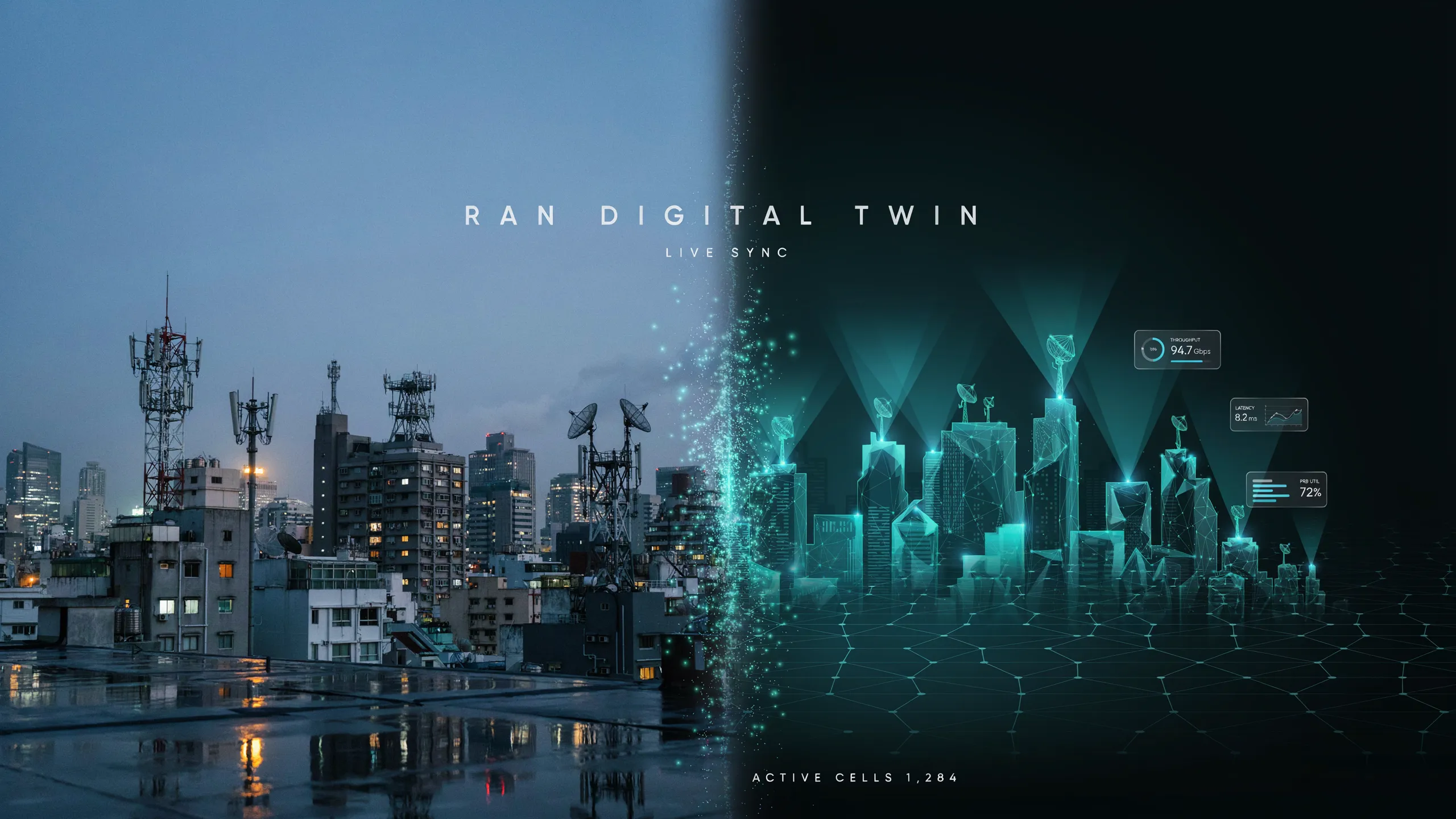
That is why the RAN digital twin is getting so much attention: a virtual replica fed with real CM, PM and topology data, where SON functions, rApps and AI policies can be tested before touching a live cell.
In practice, its value depends on fidelity:
🔹 Propagation needs ray tracing with accurate 3D clutter, or beam and interference behavior will not be believable. 🔹 Traffic must reflect real user patterns, otherwise a policy that looks perfect collapses at the first stadium event. 🔹 Vendor scheduler and RRM behavior is hard to replicate, and small differences there move KPIs more than expected. 🔹 The twin must stay synchronized with the live network, because a model calibrated six months ago describes a different network.
The gap between simulation and reality will never be zero. What matters is closing the loop: the twin validates a change, the live network confirms it under guardrails, and the result recalibrates the twin.
Years of working with SON taught me that automation earns trust one validated change at a time. A good digital twin can accelerate that trust, as long as we treat it as a test bench with known limits and not as an oracle.
That is the realistic path from closed loop SON to autonomous RAN.
#DigitalTwin #AutonomousNetworks #ORAN #SMO #rApps #SON #AIRAN #5G