O-RAN RELEASE 5: WHAT ACTUALLY MATTERS FOR RAN ENGINEERS
Explore O-RAN Release 5 advances in AI/ML, Massive MIMO, D2, O-Cloud, energy efficiency and intelligent RAN operations.
O-RAN RELEASE 5: WHAT ACTUALLY MATTERS FOR RAN ENGINEERS
O-RAN Release 5 is here. But if you are a RAN engineer, the important question is not: “How many specifications changed?” It is: “What can we actually do with them?”
For me, several developments stand out.
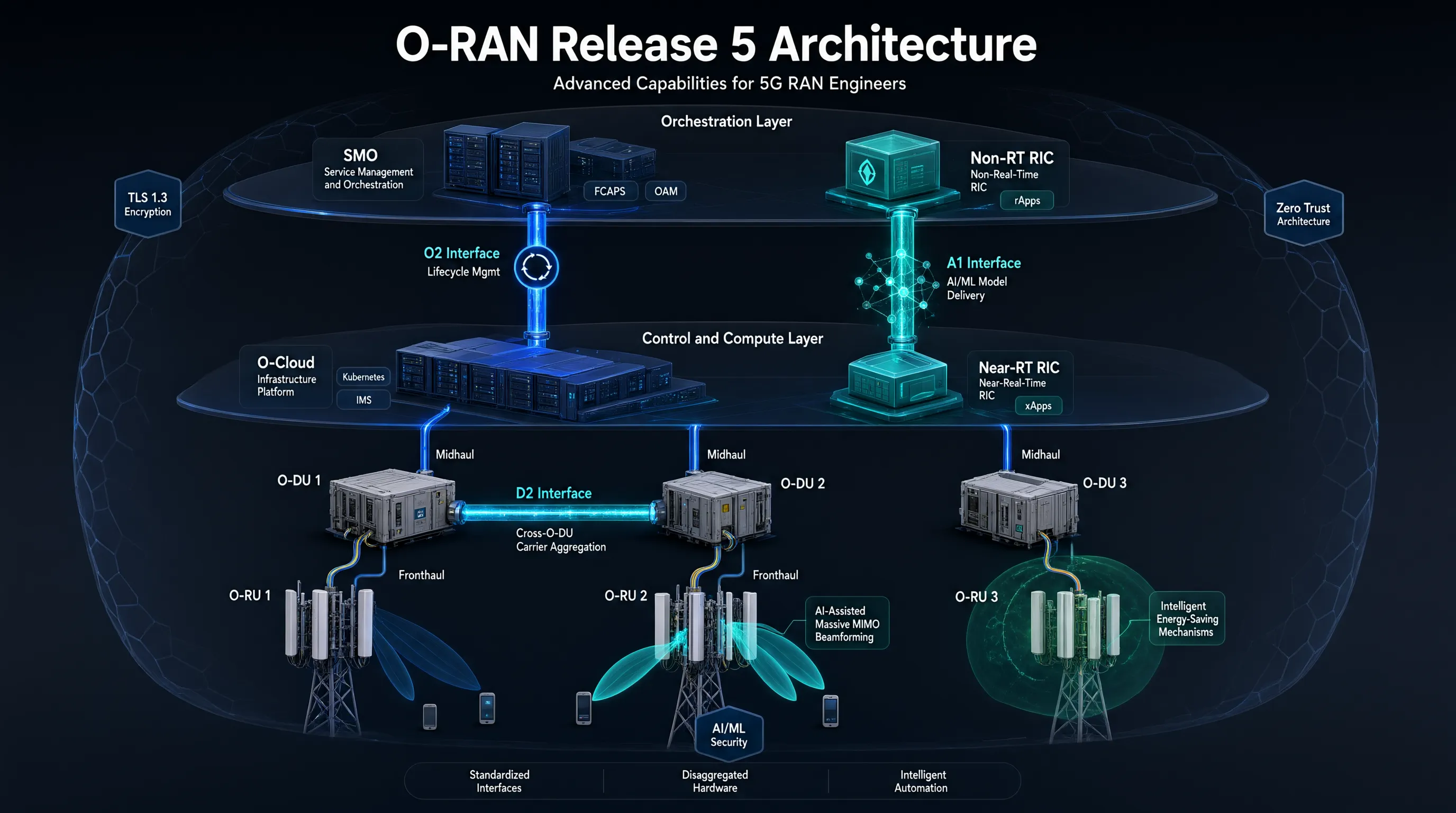
- AI/ML workflows are becoming more practical, connecting model development, training and execution across the Non-RT RIC and Near-RT RIC.
- The new D2 interface enables carrier aggregation across different O-DUs. That is an important step when disaggregation meets real RF capacity requirements.
- Massive MIMO optimization gets deeper support across O-RAN functions, interfaces and data models, opening the door to AI/ML-assisted beamforming optimization.
- Energy saving evolves beyond simply switching resources off, incorporating 3GPP Release 18 capabilities and O-RU-specific mechanisms.
- O-Cloud becomes much more operational, covering provisioning, deployment, lifecycle management, FCAPS and integration with the SMO through O2.
Security also moves forward with TLS 1.3, Zero Trust enhancements and AI/ML security controls. To me, this signals something bigger.
O-RAN is gradually moving from defining an open architecture toward making that architecture operationally intelligent. For RAN engineers, that means RF knowledge does not become less important. It becomes part of a larger system where radio behavior, software, cloud and AI increasingly interact.
The next-generation RAN engineer will need to understand not only how the radio network behaves… but also how software decides what to do with it.
#ORAN #RAN #5G #SMO #RIC #MassiveMIMO #RANAutomation #AIinTelecom