O-RAN in Plain English: What Is Open, And Why It’s Hard
This post explains O-RAN in simple terms: what “open” really means (modular RAN with standard interfaces) and why it’s hard in practice due to integration, continuous testing, and multi-vendor operational complexity.
O-RAN in Plain English: What Is Open, And Why It’s Hard
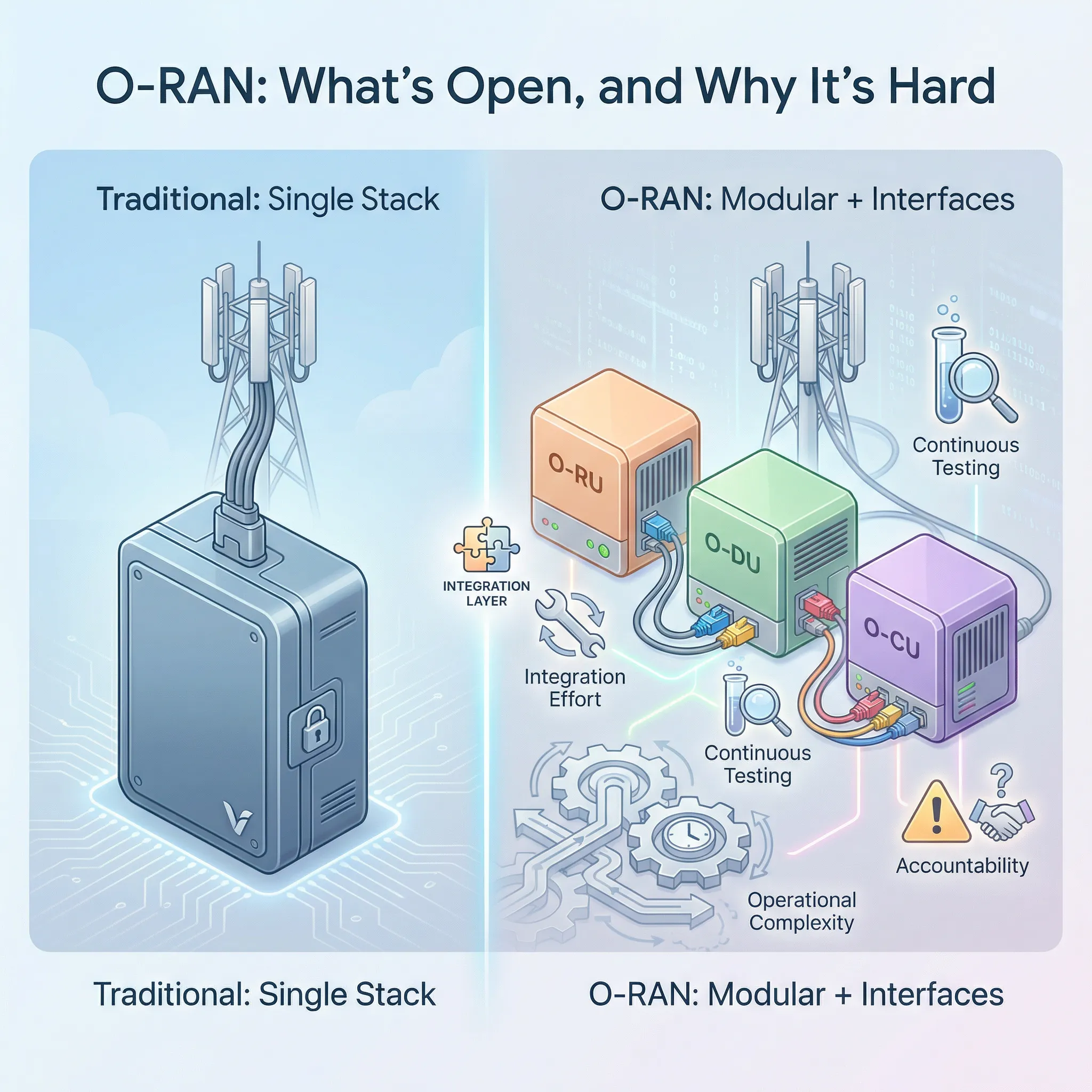
O-RAN is often described with big promises: openness, flexibility, innovation, multi-vendor choice. But for people new to telecom, the simplest definition is this: O-RAN is an attempt to make the RAN more like an IT ecosystem: modular components, standardized interfaces, and the option to mix vendors. So what exactly is “open”? In traditional RAN, one vendor usually provides a tightly integrated stack. It’s like buying a single-brand “all-in-one” system. In O-RAN, the RAN is broken into building blocks (think: radio unit, distributed unit, centralized unit), and “open” means those blocks can connect through standardized interfaces so different vendors can interoperate. That sounds great… so why is it hard? Because “open” doesn’t mean “effortless.” Here are the real challenges most people don’t see:
- Integration becomes your responsibility, because multi-vendor doesn’t magically behave like a single system.
- Testing never ends, because every software update can change interoperability behavior across components.
- Accountability gets blurry, because when performance drops, vendors may point to each other unless governance is strong.
- Operations become more complex, because tools, alarms, KPIs, and troubleshooting workflows must work across a mixed environment.
A useful analogy: Traditional RAN is like buying a car from one manufacturer. O-RAN is like building a car using parts from multiple suppliers. You might get more options and faster innovation. But you also need stronger engineering discipline: standards compliance, system integration, observability, and automation-first operations. My takeaway: O-RAN is not primarily a procurement project. It’s an operating model change. The winners won’t be the operators who “buy open.” They’ll be the ones who can “operate open” with governance, automation, and clear end-to-end ownership.
#ORAN #OpenRAN #5G #RAN #NetworkAutomation #SMO #RIC #TelecomStrategy #DigitalTransformation #TelecomLeadership