Network Automation Maturity: From Scripts to Closed Loops
This article presents a simple 4-level model of network automation maturity, showing how teams evolve from ad-hoc scripts to governed, policy-driven closed loops that reduce “decision latency” and scale 5G operations safely.
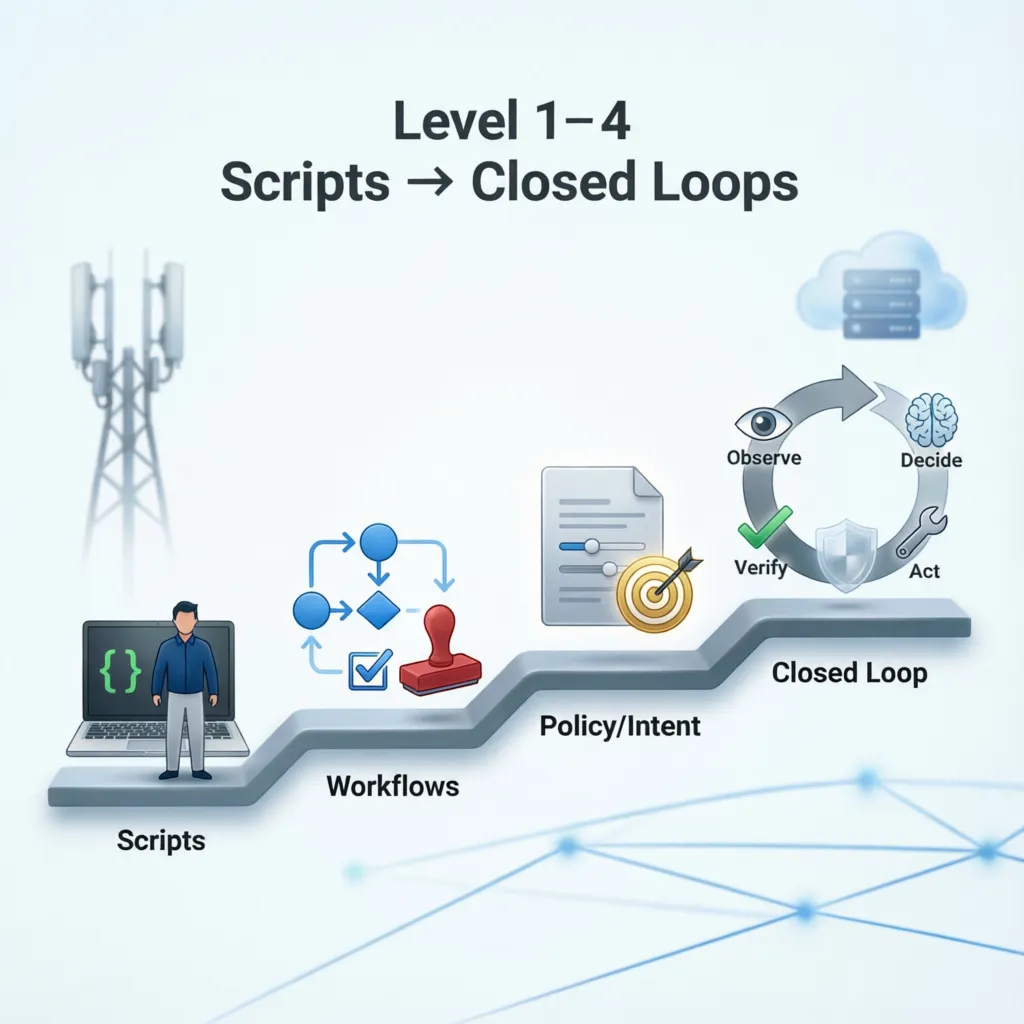
Network Automation Maturity: From Scripts to Closed Loops
Most telecom leaders agree on one thing: automation is no longer optional. But when we say “network automation,” we often mix very different realities under the same label. A Python script that saves two hours a week is automation. A closed-loop system that detects a degradation and fixes it before customers notice is also automation. Same word. Completely different maturity. This article introduces a simple maturity model to help engineers, managers, and executives speak the same language—moving from ad-hoc scripts to scalable closed loops. ──────────────────────────────────────── Why a maturity model matters 5G, cloud-native cores, multi-vendor RAN, and enterprise SLAs increase operational complexity. The traditional approach—manual analysis, manual changes, manual validation—creates a bottleneck that grows with every new feature, band, or integration layer. I call it “decision latency.” Your network can deliver 10–20 ms radio latency, but internal decision latency can take days:
- Approvals.
- Maintenance windows.
- Cross-team handoffs.
- Risk management.
- Validation cycles.
Automation maturity is fundamentally about reducing that decision latency safely. ──────────────────────────────────────── The 4 Levels of Network Automation Maturity Here is a practical model that works for RAN, core, transport, and OSS environments. Level 1: Scripts and Manual Automation This is where most teams begin. Engineers create scripts to:
- Pull logs and counters automatically.
- Generate recurring reports.
- Normalize data sources.
- Automate repetitive configuration tasks.
The value is real: time savings and fewer human errors. But the limitations are also real:
- Automation depends on individuals and tribal knowledge.
- There is little governance or lifecycle control.
- Scripts often break when the environment changes.
At this level, automation helps productivity, but it does not change the operating model. Level 2: Workflow Automation (Orchestration) Here the focus shifts from scripts to repeatable workflows. Instead of “one engineer running a script,” you build an orchestrated process:
- Triggered by an event or schedule.
- Executed the same way every time.
- Logged and auditable.
- Integrated with approvals and change management.
Examples:
- Automated neighbor audits with ticket creation.
- Parameter change rollout with staged validation.
- Self-healing workflows for alarms with guardrails.
This level reduces operational friction and increases consistency. But decisions are still mostly human: the workflow executes steps, but humans decide “what to do.” Level 3: Policy-Driven Automation (Intent-Based) This is where automation starts to become scalable. Instead of manually deciding actions, teams define intent:
- Maintain call setup success above X.
- Keep PRB utilization below Y.
- Protect enterprise SLA customers in a specific area.
- Maintain QoE thresholds for key applications.
The system then selects actions within boundaries:
- Adjust mobility parameters.
- Rebalance load.
- Optimize power, tilts, or feature settings.
- Tune thresholds based on context.
The shift here is important: People stop issuing manual commands and start managing policies. This is where platforms like SMO, SON, and analytics become powerful—because they can apply intent consistently across markets. Level 4: Closed Loop Automation (Observe Decide Act Verify) This is the goal state, and also the most misunderstood. Closed loop does not mean “AI runs the network without humans.” It means the automation cycle includes verification:
- Detect a problem.
- Decide the best action based on policy and context.
- Execute the action safely.
- Verify impact and rollback if needed.
- Learn and refine thresholds.
This level creates operational stability at scale. It is essential for:
-
Multi-vendor environments.
-
Continuous software upgrades.
-
Enterprise SLAs.
-
Dense networks where manual operations cannot keep up. ──────────────────────────────────────── What changes with maturity? Three measurable outcomes As you move up the maturity curve, three outcomes improve predictably:
-
Operational speed improves because decision latency shrinks.
-
Service stability improves because issues are detected and corrected earlier.
-
Business alignment improves because policies can be defined by customer experience and SLA intent.
This is why automation is not only an OPEX story. It is also a revenue protection and revenue enablement story. ──────────────────────────────────────── How to asses where you are (a simple check) If you want to quickly assess your automation maturity, ask:
- Are optimizations dependent on individual experts, or are they repeatable processes?
- Do you have auditability, guardrails, and rollback built into changes?
- Are you managing the network through policies and intent, or through manual commands?
- Do your automations verify outcomes automatically and learn over time?
If most answers lean toward “manual,” you’re likely at Level 1 or 2. ──────────────────────────────────────── A practical roadmap to get started If you’re building this journey, here is a safe and effective progression:
- Start with one repetitive pain point that consumes engineering time every week.
- Standardize data sources and definitions to avoid garbage-in automation.
- Build orchestration with logging, approvals, and rollback.
- Introduce policy boundaries and intent targets.
- Close the loop with verification before adding “AI.”
The biggest mistake is trying to jump directly to Level 4 without building governance and observability. Closed loops require trust. Trust requires discipline. ──────────────────────────────────────── The big takeaway Network automation maturity is not measured by how many scripts you have. It is measured by how reliably you can turn network intent into validated outcomes—at scale, across markets, and across vendors. In 5G, the most important latency is often not in the radio link. It’s in the organization. And automation maturity is how you reduce it.
#5G #NetworkAutomation #SON #SMO #RIC #RAN #TelecomStrategy #AIinTelecom #DigitalTransformation #TelecomLeadership