Latency Myths in 5G: DU vs CU-UP vs “RAN Integrated”
This post explains 5G “latency myths” by breaking end-to-end RAN delay into its main contributors (CU-UP vs DU vs integrated RAN), showing why blaming the air interface alone is often wrong.
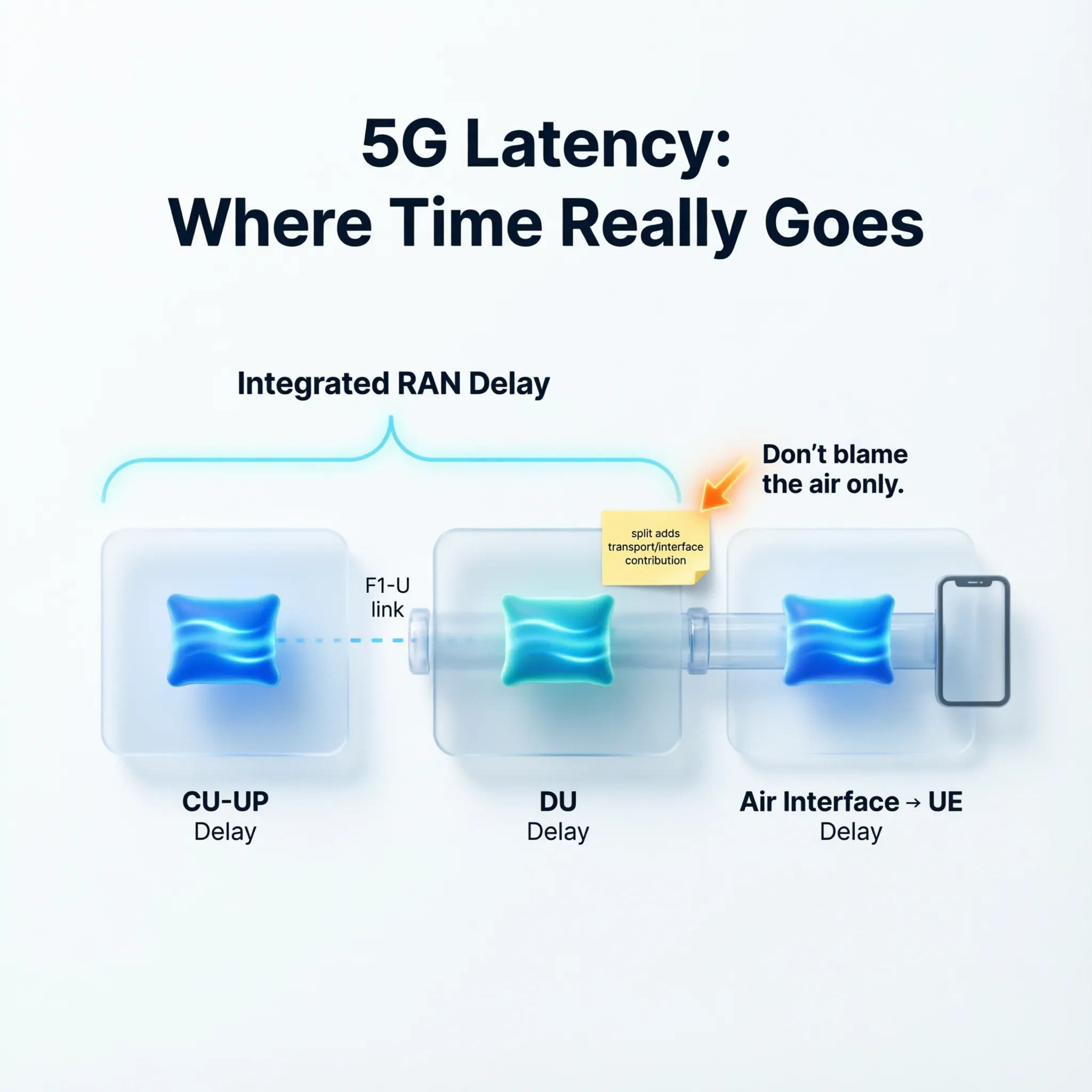
Latency Myths in 5G: DU vs CU-UP vs “RAN Integrated”
When people say “5G latency is high,” the first reaction is often: “The air interface must be the problem.” Not always.
A more useful mental model is to see RAN latency like a relay race: the total time is the sum of multiple runners, not just one. In 3GPP Rel-17 KPIs, the “integrated downlink delay in RAN” is measured from when the IP packet is received in the gNB-CU-UP until the UE receives the last part of the packet (based on HARQ feedback or RLC ACK depending on mode). And here’s the key detail many miss:
• * The integrated RAN delay is modeled as the sum of the CU-UP delay plus the DU delay. So, if you want to “debug latency” without guessing, start by separating the contributors:
• * GNB-CU-UP Delay is the time from receiving the IP packet at CU-UP until the RLC SDU arrives at the DU side (F1-U termination). It includes PDCP-related delay and (when split) the F1 component. • * GNB-DU Delay is the time from RLC SDU arrival at the DU until the UE receives the last part over the air (including RLC and air-interface delay). • * DU Latency is a different lens: it looks at the “first-byte” style timing from packet reception at DU until the first part is transmitted over the air, assuming no prior queue.
One practical takeaway: In a non-split gNB scenario, the standard assumes the F1 delay component is zero (because there is no F1 interface). The big lesson: if you only look at “total latency,” you’ll argue. If you split it into CU-UP vs DU vs integrated, you can act.
#5G #RAN #Latency #5GCore #CloudRAN #ORAN #SMO #NetworkAutomation #TelecomStrategy #RANOptimization