Why Latency Is Overhyped (And When It Actually Matters)
This post explains why latency is often overhyped in 5G: most consumer apps won’t feel a few milliseconds, but real-time, interactive, mission-critical use cases need low and consistent latency to be valuable.
Why Latency Is Overhyped (And When It Actually Matters)
“5G = ultra-low latency.” That line sounds great in a keynote… but in real networks, latency is often the most misunderstood KPI. Because for most everyday apps, latency is not the bottleneck. What people actually notice is:
- Consistency, when the connection feels stable.
- Responsiveness, when apps don’t freeze.
- Reliability, when calls don’t drop and video doesn’t stutter.
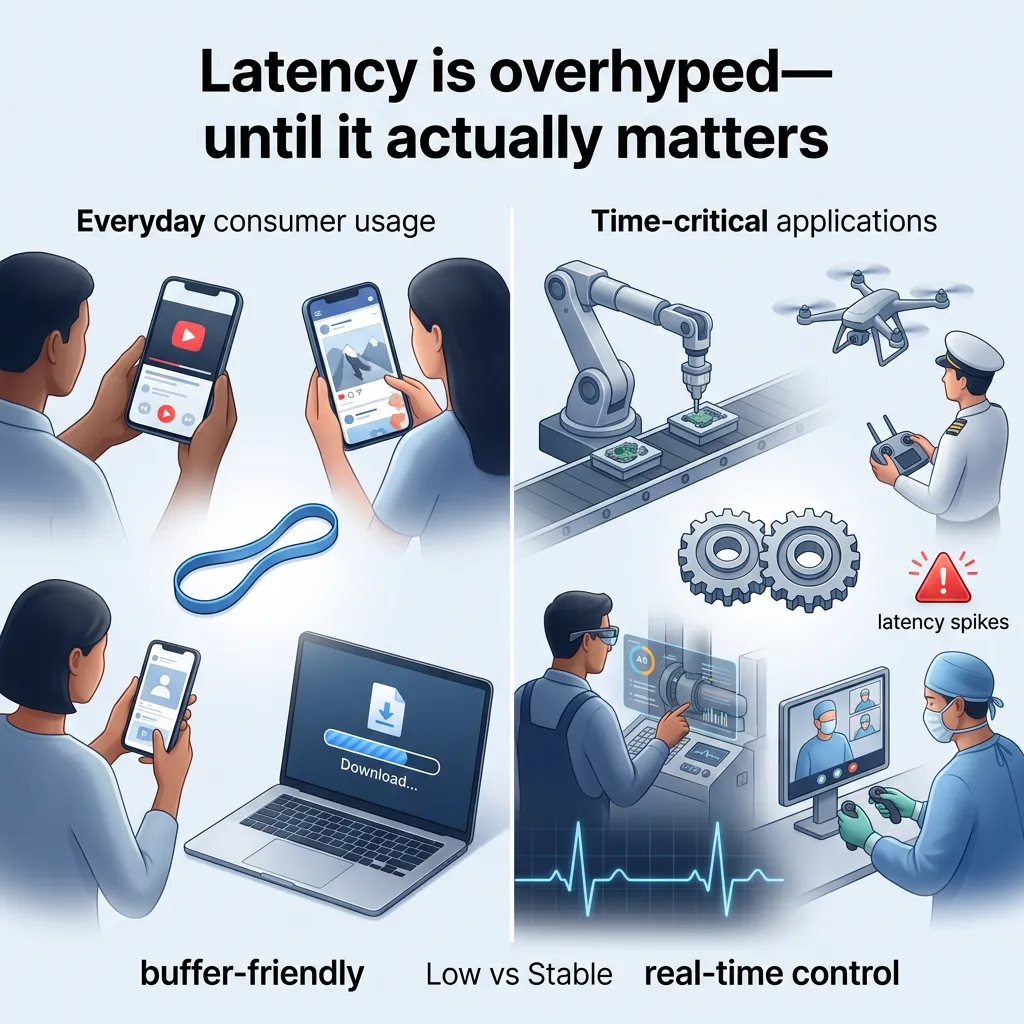
And those are often driven more by coverage quality, congestion, scheduling, and backhaul stability than by shaving a few milliseconds. Here’s a simple way to frame it: Latency matters only when the application is interactive and time-critical If the app can “buffer” (video streaming, downloads, social feeds), latency improvements won’t change the experience dramatically. But when the app is controlling something in real time, latency becomes a business KPI. So, when does latency actually matter?
- Real-time industrial control requires predictable response to avoid errors, downtime, or safety risks.
- Remote operation and robotics need fast feedback loops to feel natural and safe for operators.
- AR-assisted work and real-time collaboration need low delay to avoid motion sickness, misalignment, and poor usability.
- Mission-critical communications depend on stable end-to-end performance, not just “fast sometimes.”
Notice the keyword: predictable. In telecom, low latency “on average” is not enough. What enterprise use cases need is low latency plus consistency. That’s why obsessing over one number can be misleading. A network that delivers 20 ms consistently may be better for business than a network that sometimes hits 8 ms and sometimes spikes to 80 ms. The real latency conversation is not “how low” It’s “how stable.” And that’s where 5G SA, edge computing, automation, and closed-loop optimization start to matter—not as buzzwords, but as tools to control variability. If we want to monetize 5G with serious use cases, we should stop selling latency as a headline… …and start engineering it as a guarantee.
#5G #Latency #TelecomStrategy #Enterprise5G #RAN #NetworkOptimization #EdgeComputing #NetworkAutomation #DigitalTransformation #TelecomLeadership