L4 AUTONOMOUS NETWORKS: IT TAKES MORE THAN AUTOMATION
Understand what L4 Autonomous Networks require beyond automation: intent, guardrails, explainability and data discipline across RAN, SON and SMO.
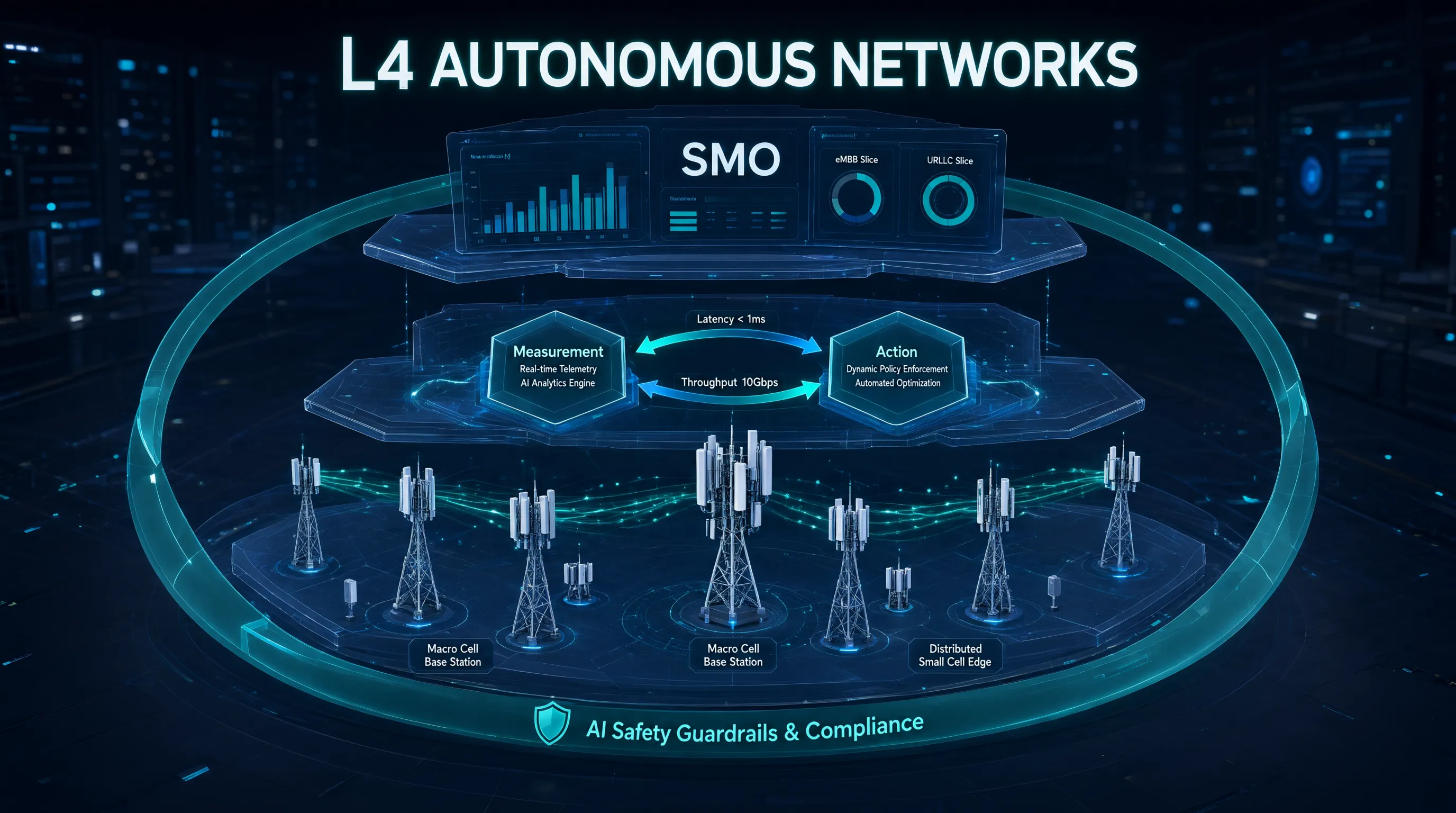
L4 AUTONOMOUS NETWORKS: IT TAKES MORE THAN AUTOMATION
Many operators claim to be on the path to L4 Autonomous Networks. In the field, I still see mostly Level 2 or 3 with a new label.
Automation executes a task an engineer defined. Autonomy decides which task to run, verifies the outcome, and corrects itself. In the TM Forum framework, L4 means closed loop operations with no human in the loop for a defined domain, and people move from operating to supervising.
From my experience in RAN design, optimization, SON and SMO, four things separate the two:
- Intent must be expressed as measurable business outcomes instead of parameter values or scripts.
- Closed loops need guardrails so a power, tilt or beam change never leaves a validated safe envelope.
- Every automated decision must be explainable and auditable, otherwise trust never reaches production.
- Data quality and topology consistency must be managed as a product, because a wrong inventory scales errors in minutes.
Notice that none of these are about the algorithm. The model is often the easy part. The hard part is governance and data discipline.
In O-RAN, this is where the SMO, rApps and xApps come together, with the SMO enforcing policy and limits.
The engineer is not replaced. The engineer designs the intent, the guardrails and the feedback loops that let the network run itself.
Which part of your operation is truly ready for a closed loop today?
#5G #RAN #ORAN #SMO #SON #AutonomousNetworks #TMForum #TelecomInnovation