From KPIs to Experience: A Beginner’s Guide To What Really Matters
This article translates key RAN KPIs (RSRP, SINR, Throughput) into what users actually feel, and explains why “good KPIs” can still produce a bad experience due to congestion, variability, indoor conditions, and end-to-end issues.
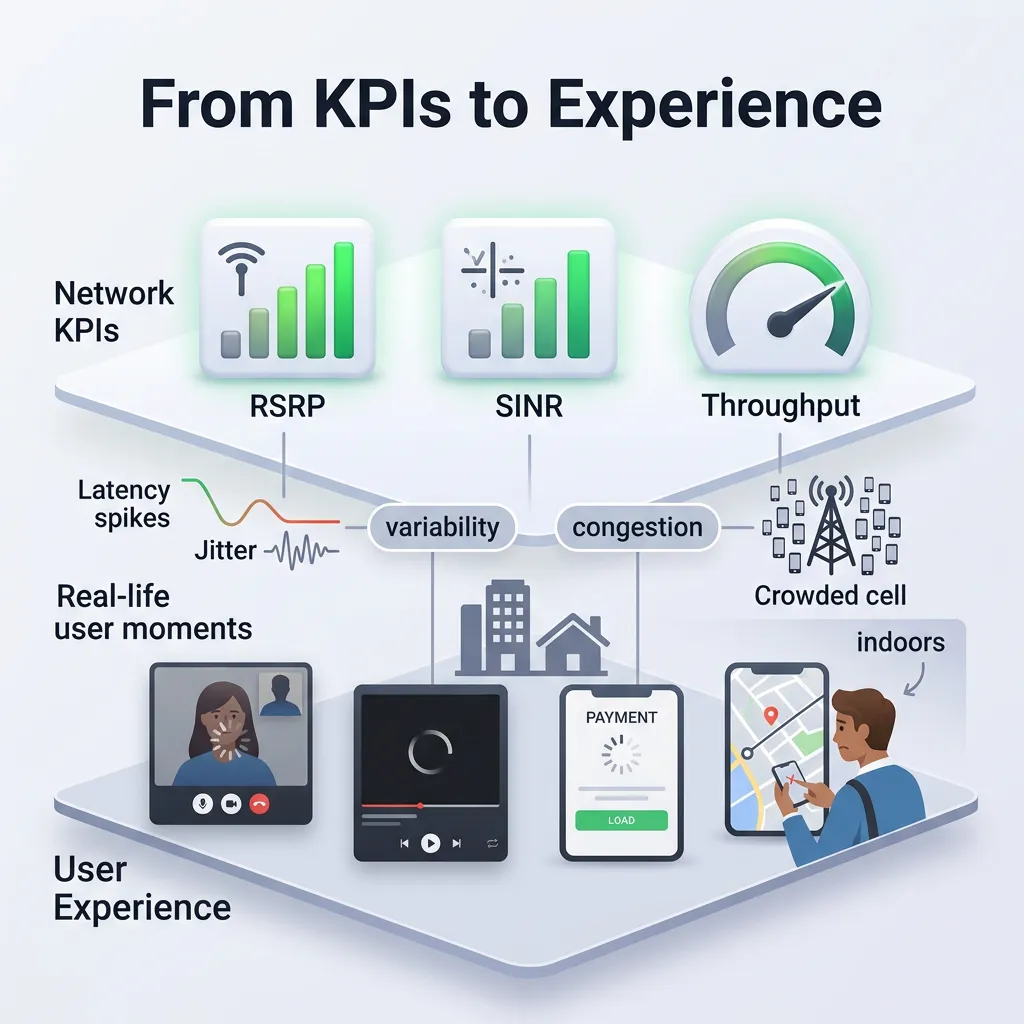
From KPIs to Experience: A Beginner’s Guide To What Really Matters
If you’re new to telecom, it’s easy to get lost in acronyms. RSRP. SINR. Throughput. PRB. BLER. Network teams live by these metrics. But customers don’t. Customers judge the network in a much simpler way: Does it work when I need it? Does it feel fast? Is it stable? Does it fail at the worst time? This article is a beginner-friendly bridge between “engineering KPIs” and “what users actually feel.” Because here’s a truth many people learn the hard way: A network can have “good KPIs” and still deliver a bad experience. Let’s unpack why.
The User Doesn’t Experience KPIs. They Experience Moments
A user doesn’t experience “RSRP = -95 dBm.” They experience:
• * A video call that freezes at the wrong time. • * A payment app that takes too long to confirm. • * A rideshare that fails to load during peak hours. • * A file upload that stalls at 90%.
These moments are shaped by multiple layers, not just the radio signal. That’s why translating KPIs into experience is essential—especially in 5G, where complexity is higher and expectations are higher.
The 3 Most Common KPIs (And What They Feel Like)
1) RSRP: “Do I have Coverage?” RSRP is often the first KPI people learn. Think of it as “signal strength.” What users feel when RSRP is weak:
• * Apps load slowly or fail indoors. • * Calls may drop or sound robotic. • * The phone shows bars, but nothing really works.
But here’s the catch: Strong RSRP alone doesn’t guarantee a good experience. You can have a strong signal and still struggle due to interference or congestion.
2) SINR: “Is The Signal Clean?”
SINR is signal quality, not just strength. A simple analogy: RSRP is how loud the voice is. SINR is how clear the voice is in a noisy room. What users feel when SINR is poor:
• * The network becomes inconsistent. • * Speeds fluctuate wildly. • * Video quality drops even with “full bars.”
This is why sometimes a user says: “I have signal, but the network is terrible.” Often, they’re describing SINR problems.
3) Throughput: “How Fast Is It Right Now?”
Throughput is speed. It’s the KPI most people care about. What users feel when throughput is low:
• * Slow downloads/uploads. • * Streaming drops resolution. • * Cloud apps feel “heavy.”
But here’s another catch: Peak throughput is not the same as consistent throughput. A user doesn’t care that the network can hit 800 Mbps at 3 AM. They care that it works reliably at 6 PM.
Why “Good KPIs” Can Still Mean “Bad Experience”
This happens more often than people think. Here are the most common reasons:
1) Averages Hide Pain
Many KPIs are reported as averages. But users experience the worst 5 seconds, not the average hour. A network with “good average throughput” can still feel bad if it has frequent short drops, spikes, or stalls.
2) Congestion Is A Separate Problem
You can have great RSRP and decent SINR… and still be slow. Why? The cell is loaded. Users feel it as: “It works fine in the morning, but it’s awful at night.” That’s a capacity and scheduling reality, not necessarily a coverage issue.
3) End-to-End Matters
Radio KPIs don’t include everything. A great RAN can still deliver a bad experience if:
• * Backhaul is congested or unstable. • * Core network has latency spikes. • * DNS, routing, or peering is suboptimal. • * App servers are slow (not a network problem, but the user blames the network).
Users don’t care which domain is failing. They just know: “the network is bad.” 4) Indoors Is Where Trust Is Won (Or Lost)
Many networks look great outdoors. But most usage happens indoors: homes, offices, malls. A coverage map can be “green” while indoor experience is still painful due to penetration loss, interference, and traffic hotspots. That’s why users say: “My phone says 5G, but inside my office it feels worse than LTE.”
A Simple Translation Framework (Beginner-Friendly)
If you want a quick mental model, use this:
• * RSRP answers: “Can I hear the network?” • * SINR answers: “Can I hear it clearly?” • * Throughput answers: “How fast can I exchange data right now?” • * Consistency answers: “Will it stay good when it matters?” • * End-to-end answers: “Is the full path stable beyond the radio?”
If you only look at the first three, you will miss the real story.
What Should Operators Focus On?
As networks become more software-driven, the winners will be the ones who translate KPIs into outcomes. That means:
• * Correlating radio KPIs with real user experience signals. • * Designing optimization around consistency, not just peaks. • * Treating indoor experience as a primary product requirement. • * Using automation to reduce time-to-detect and time-to-fix.
Because the customer doesn’t buy RSRP. They buy trust. And trust is built in the moments that KPIs don’t always capture.
#5G #RAN #RANOptimization #CustomerExperience #Telecom #TelecomStrategy #NetworkAutomation #AIinTelecom #DigitalTransformation #SON