Enhanced Support of Non-Public Networks: Why Private 5G Cannot Rely on Generic SON
Why generic SON logic fails in Private 5G environments and how 3GPP Release 17 changes the automation landscape for NPNs.
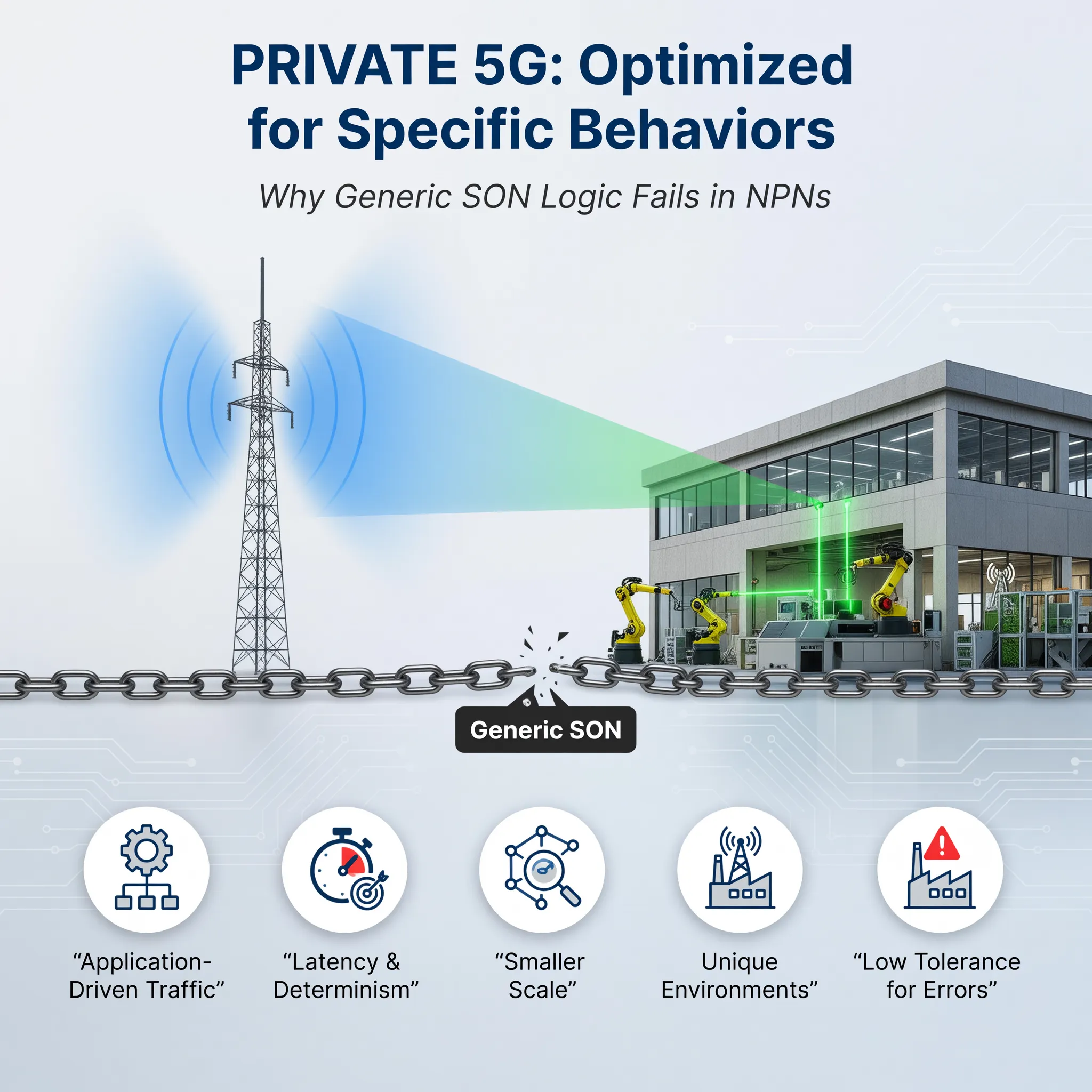
Enhanced Support of Non-Public Networks: Why Private 5G Cannot Rely on Generic SON
Private 5G is often introduced as “public 5G, but smaller”. From an automation and SON perspective, that assumption is one of the biggest sources of failure.
3GPP Release 17 significantly enhances support for Non-Public Networks (NPNs), but those enhancements also make one thing very clear: generic SON logic does not fit private 5G environments.
The reason is simple. Private networks are not optimized for averages; they are optimized for specific behaviors.
Where generic SON breaks down in private 5G:
- Application-driven traffic: Patterns are not user-driven, making mobility and congestion behavior fundamentally different.
- Specific Objectives: Latency stability and reliability matter more than peak throughput.
- Scale: Smaller networks remove the statistical smoothing that generic algorithms rely on.
- Custom Environments: Industrial sites have unique propagation and interference patterns.
- Low Tolerance: A single mis-optimization can impact production or safety.
In private 5G, SON must be intent-driven, context-aware, and tightly aligned with the applications running on top of the network. Optimization logic needs to understand why traffic exists, not just how much of it there is.
This shifts the role of SON from KPI optimizer to behavior enforcer. Policies, guardrails, and closed-loop control become more important than aggressive parameter tuning.
In my experience, the most successful private 5G deployments are not the ones with the most automation enabled, but the ones where automation was deliberately constrained and customized to the environment it serves.
Private 5G does not fail because SON is missing. It fails when SON is generic.
#Private5G #NonPublicNetworks #5G #Release17 #SON #RANOptimization #NetworkAutomation #Industrial5G #TelecomEngineering