From Energy Saving to Energy-Aware RAN
Explore how energy-aware RAN goes beyond timer-based energy saving with traffic prediction, Rel-18 cell DTX/DRX and O-RAN rApps with guardrails.
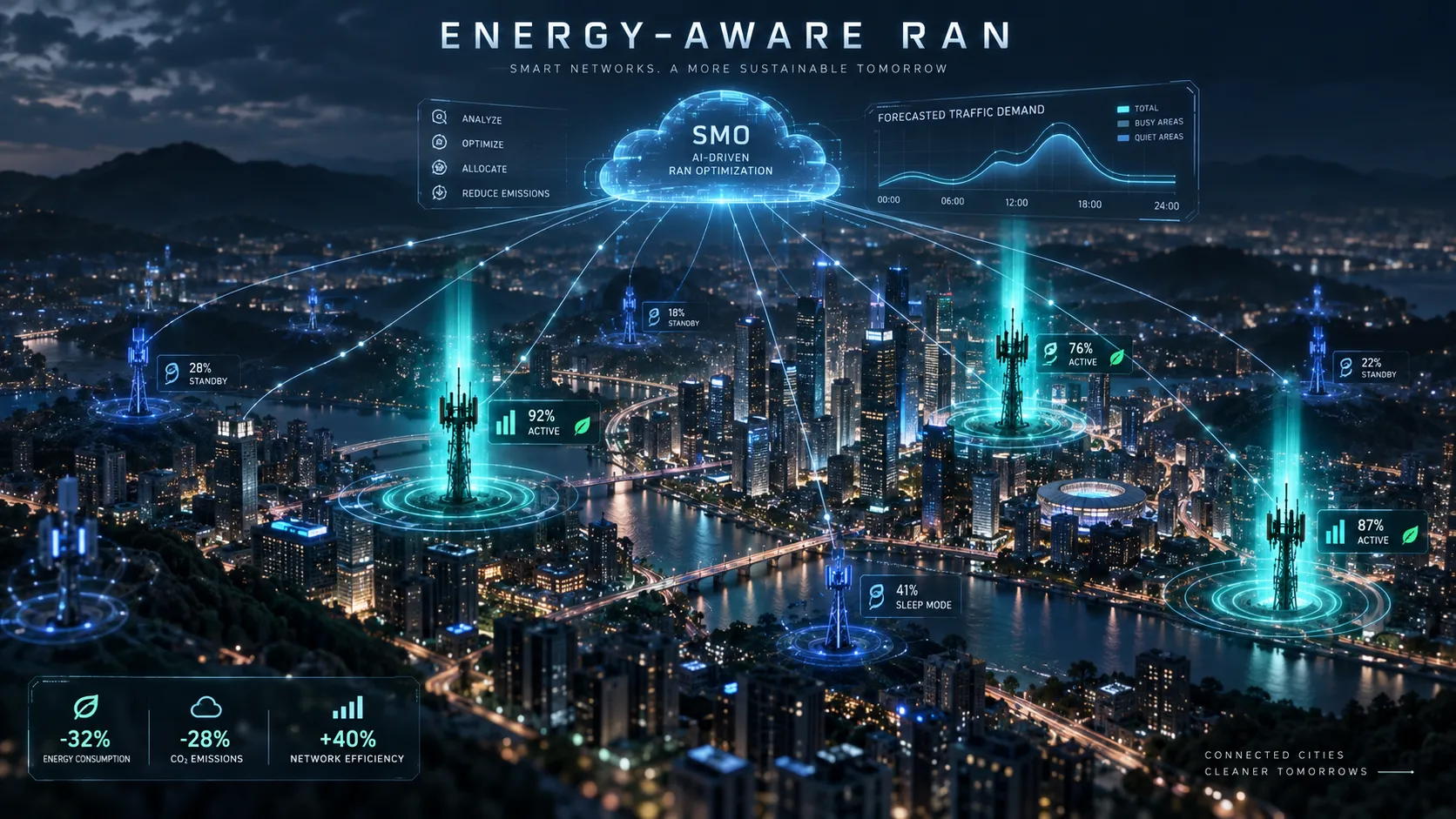
From Energy Saving to Energy-Aware RAN
For years, energy saving in RAN meant one thing: a list of features with timers. Shut down a capacity carrier at 1 a.m., mute some MIMO branches, wake everything up at 6 a.m. It worked, but treated energy as a night shift problem.
That model is reaching its limits. Traffic is less predictable, 5G radios consume more at low load than many expected, and energy cost now reaches board meetings.
An energy-aware RAN looks different:
- Energy becomes a KPI evaluated in every optimization decision, next to accessibility, throughput and user experience.
- Switch off decisions are driven by traffic prediction per cell, so the network sleeps when demand allows, not when the clock says so.
- Neighbors are coordinated, because turning off a layer only makes sense if another layer can absorb those users without degrading them.
- Fast sleep modes at symbol and slot level, along with the cell DTX and DRX work in 3GPP Release 18, save energy even during busy hours.
- In O-RAN, these policies can live as rApps in the SMO, consuming PM data over O1 and applying changes with clear guardrails.
The hard part is knowing what you are trading. Every watt saved has a possible cost in coverage, latency or wake up time, and an energy-aware system has to measure that cost before acting, then verify it afterwards.
This is where I see SON evolving. The first generation of SON optimized radio parameters. The next one will balance quality, capacity and energy at the same time, with AI predicting demand and closed loops validating every decision.
Saving energy was a feature. Being energy-aware is a design philosophy.
#RAN #EnergyEfficiency #ORAN #SMO #SON #5G