DIGITAL TWIN RAN: TEST BEFORE YOU TOUCH THE LIVE NETWORK
Explore Digital Twin RAN as a safe validation layer for AI, automation, optimization and autonomous network decisions.
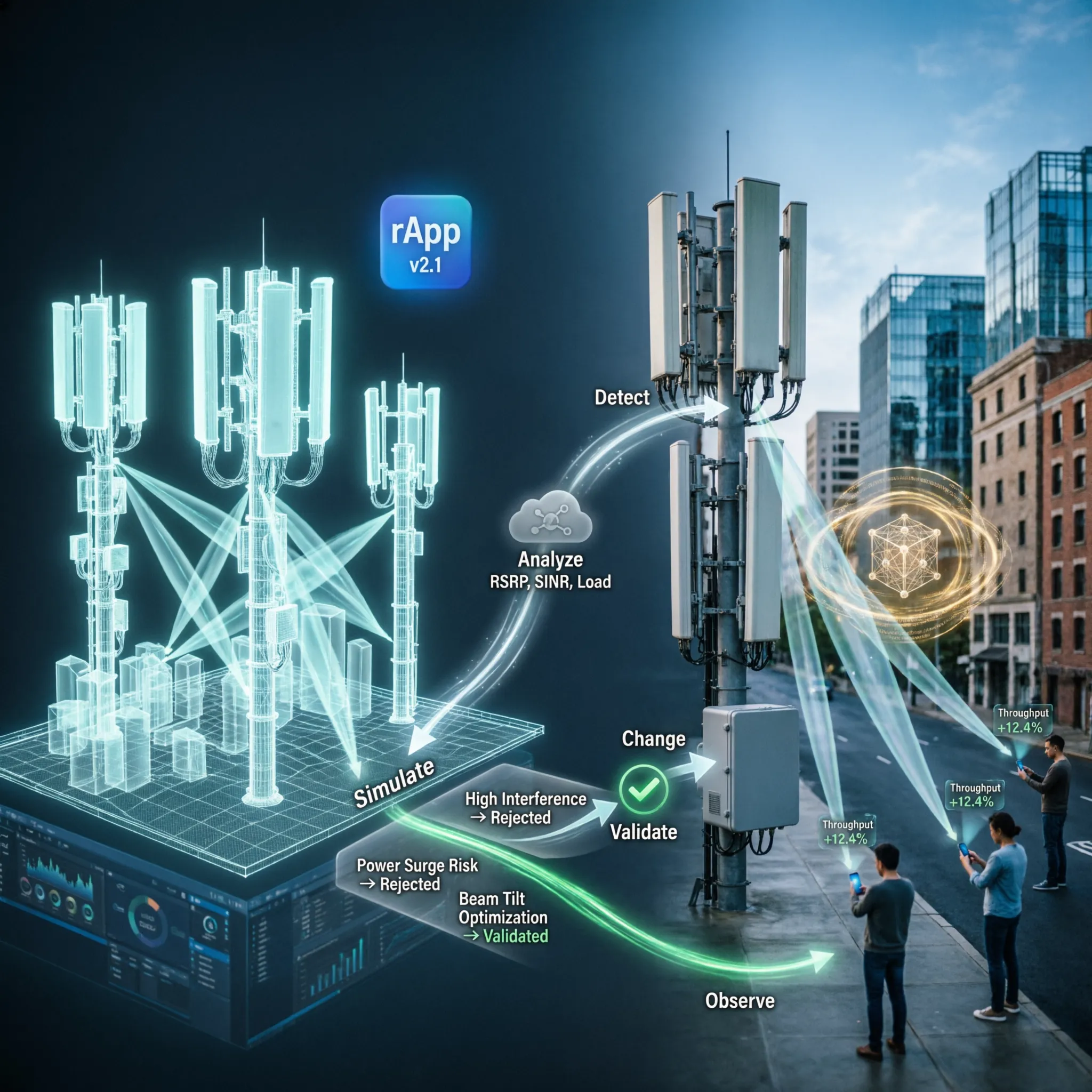
DIGITAL TWIN RAN: TEST BEFORE YOU TOUCH THE LIVE NETWORK
One lesson I learned early while working with RAN optimization software: A technically correct change can still produce the wrong result in a live network. Why? Because networks are not static. Traffic changes. Mobility changes. Interference changes. Neighbor relationships interact. And one parameter adjustment can affect something you were not originally trying to optimize.
This becomes even more important as we move toward AI-driven and autonomous RAN. If an algorithm recommends changing antenna parameters, mobility settings, traffic steering, or energy-saving configurations, should we immediately apply that decision to thousands of cells? Probably not. This is where Digital Twin RAN becomes interesting.
Imagine having a sufficiently accurate virtual representation of the RAN where we could ask: “What happens if I make this change?” Before touching production.
A Digital Twin could reproduce relevant elements of network topology, configuration, traffic behavior, radio conditions and performance, allowing engineers or automation systems to evaluate possible actions in a controlled environment.
That opens powerful possibilities:
- Engineers could evaluate configuration changes before deployment and identify unintended effects.
- AI models could be trained and evaluated without learning through potentially risky experimentation on subscribers.
- Optimization strategies could be compared under different traffic, mobility and interference conditions.
- rApps and automation logic could be validated before being introduced into operational closed loops.
- Network planning decisions could be explored through multiple what-if scenarios before committing CAPEX.
But there is an important point. A Digital Twin is only as useful as its fidelity to the network it represents. An outdated topology, inaccurate propagation assumptions, poor traffic information or incomplete network data can create something that looks sophisticated but produces misleading conclusions. So the real challenge is not simply creating a virtual RAN.
It is keeping the virtual and physical RAN synchronized closely enough that the twin remains trustworthy. And this is where I believe Digital Twin RAN becomes much more than another planning tool. As networks evolve from automation toward autonomy, we need a place where decisions can fail safely.
The traditional sequence has often been: Detect → Analyze → Change → Observe
Digital Twin RAN could introduce an important step: Detect → Analyze → Simulate → Validate → Change → Observe
That additional validation layer may become critical when decisions are no longer made only by engineers, but increasingly by software and AI. In my experience, testing before production has always been good engineering practice. Digital Twin RAN could take that principle to an entirely different scale.
Before we build autonomous networks, we need a safe place for autonomy to make mistakes.
Digital Twin RAN may become exactly that place.
#DigitalTwin #RAN #5G #ORAN #SMO #RANAutomation #AIinTelecom #NetworkOptimization