CLOUD-NATIVE RAN AND DISTRIBUTED ARCHITECTURES
Explores how cloud-native and distributed RAN architectures transform network design while introducing new challenges in performance, latency, and operational complexity
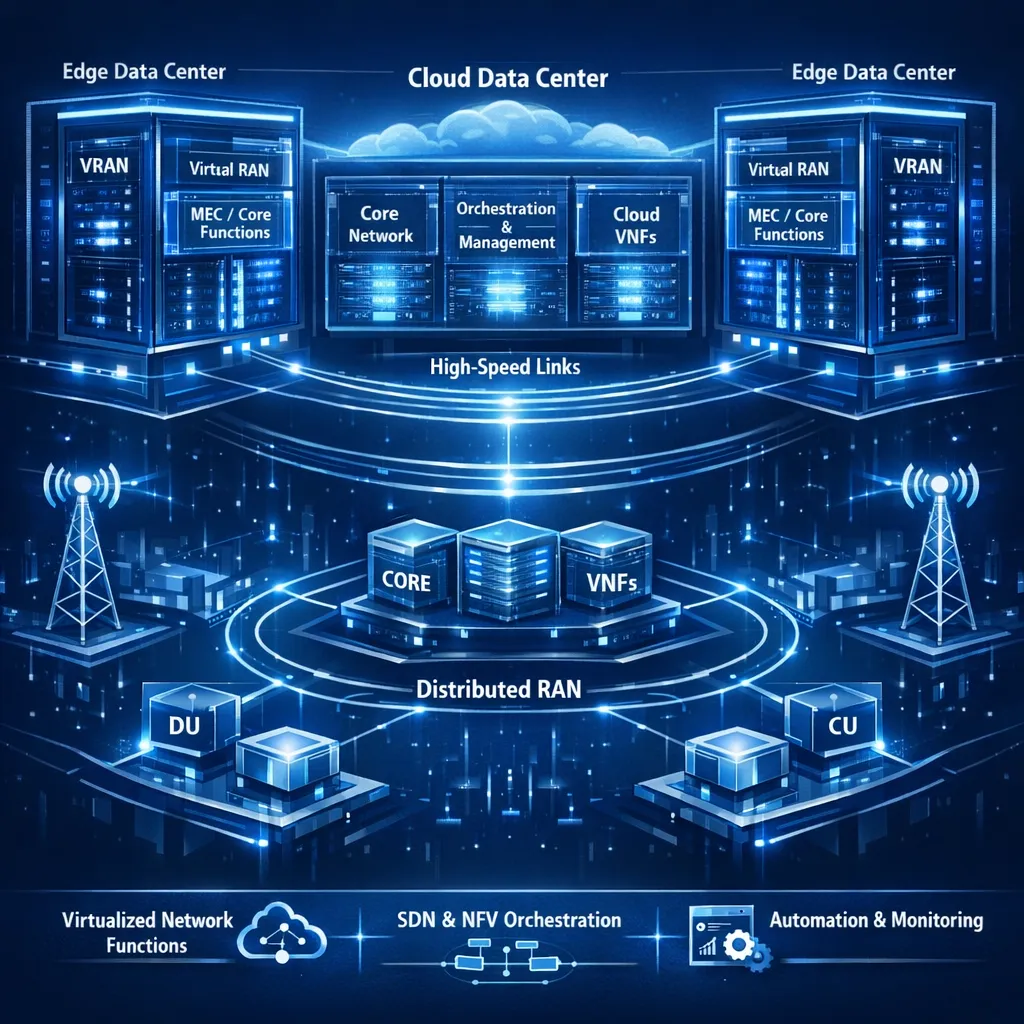
CLOUD-NATIVE RAN AND DISTRIBUTED ARCHITECTURES
For years, RAN was built around a simple principle: Dedicated hardware, deployed on-site, optimized for performance. But that model is changing. With 5G Advanced and beyond, we are moving toward something very different: Cloud-native, distributed RAN architectures.
And this is not just a technological upgrade. It is a fundamental shift in how networks are designed, deployed, and operated.
From my experience, the real impact is not in virtualization itself… It is in what virtualization enables.
- Functions can now be decoupled and deployed across centralized and distributed locations, allowing more flexible architectures.
- Scaling is no longer tied to physical hardware, but to software-defined resources.
- Network evolution becomes faster, with the ability to introduce new features without major infrastructure changes.
But this flexibility comes at a cost. Complexity.
- Latency becomes a critical constraint when functions are distributed across the cloud and edge.
- Synchronization and timing accuracy become harder to guarantee in virtualized environments.
- Performance variability increases due to shared infrastructure and resource contention.
And this is where theory meets reality. Because in lab environments, cloud-native RAN looks clean and efficient. In real networks… It becomes a coordination problem.
- Where should each function be placed to balance latency and efficiency?
- How do we ensure deterministic performance over non-deterministic infrastructure?
- How do we manage multi-vendor, cloud-native deployments at scale?
From an O-RAN and SMO perspective, this is where the real value emerges.
- Intelligent orchestration becomes essential to manage distributed resources.
- Automation is no longer optional, it is required to handle the operational complexity.
- AI-driven optimization can help adapt the network in real time to changing conditions.
But here is the key question: Are we simplifying RAN… Or just moving complexity to another layer?
Because cloud-native RAN is not just about technology. It is about operational maturity. And success will depend not only on architecture… But on how well we can manage it.
What’s your view? Is cloud-native RAN delivering on its promise… or still facing practical limitations?
#5G #CloudRAN #ORAN #SMO #RAN #TelecomInnovation #FutureOfRAN #NetworkAutomation