Why CICO is more than just interference control
This post explains how CICO is not just about interference control, but about managing continuous trade-offs between capacity, coverage, and interference in a dynamic RAN environment.
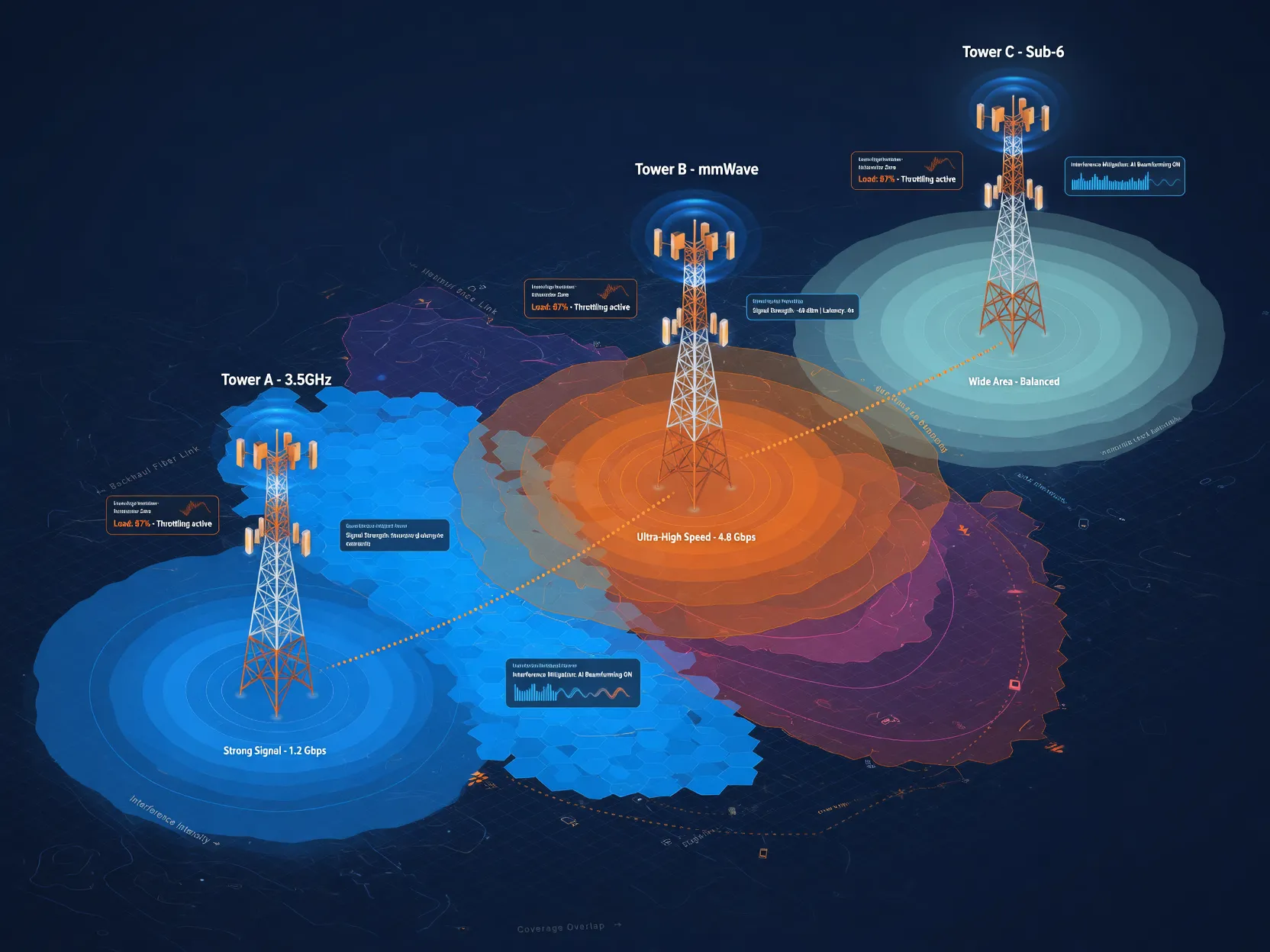
Why CICO is more than just interference control
After discussing DLB, ANR, and PCI, a pattern starts to emerge:
Most RAN features are not isolated mechanisms… they are deeply interconnected. And this is exactly where CICO (Capacity, Interference, and Coverage Optimization) is often misunderstood. Many engineers associate CICO mainly with interference control. Adjust some parameters, reduce interference, improve SINR… done. But in reality, CICO is not about fixing interference.
It is about managing trade-offs.
Because in RAN, every optimization decision comes with a consequence.
Here are some common misconceptions:
• * Many assume interference reduction always improves performance, without considering the potential loss in coverage. • * CICO is often treated as a localized optimization, ignoring its impact on neighboring cells and overall network balance. • * It is commonly believed that increasing capacity is independent from coverage, when both are tightly coupled. • * Some expect CICO algorithms to converge to an “optimal state”, when in reality the network is constantly changing.
In practice, every CICO action is a balancing act:
• * Reducing interference may shrink coverage areas, creating new holes or mobility issues. • * Expanding coverage may increase overlap, leading to higher interference and degraded SINR. • * Pushing capacity in one layer may shift congestion to another layer or frequency band. • * Adjusting parameters in one cluster can trigger unexpected effects in adjacent clusters.
This is why CICO should not be seen as a feature… but as a continuous decision-making process. From my experience, successful CICO strategies share some key principles:
• * They start from a clear understanding of the dominant limitation: coverage, capacity, or interference. • * They prioritize user experience metrics, not just radio KPIs in isolation. • * They consider spatial and temporal traffic distribution, not only static conditions. • * They are aligned with other mechanisms like DLB, ANR, and PCI planning to ensure consistency.
As we move into O-RAN, SMO, and AI-driven optimization, CICO will become more dynamic and data-driven. But one thing will not change:
Optimization is always a compromise… never a perfect state.
And the real value of CICO is not eliminating problems… It is deciding which problems we are willing to accept.
#5G #RAN #CICO #RANOptimization #SON #ORAN #Telecom #NetworkOptimization #AIinTelecom