AI in RAN: What It Can Do Today (And What It Can’t)
This post clarifies what AI can realistically do in RAN today (prediction, anomaly detection, smarter triage, safe recommendations) and what it still can’t do reliably without strong data, governance, and closed-loop guardrails.
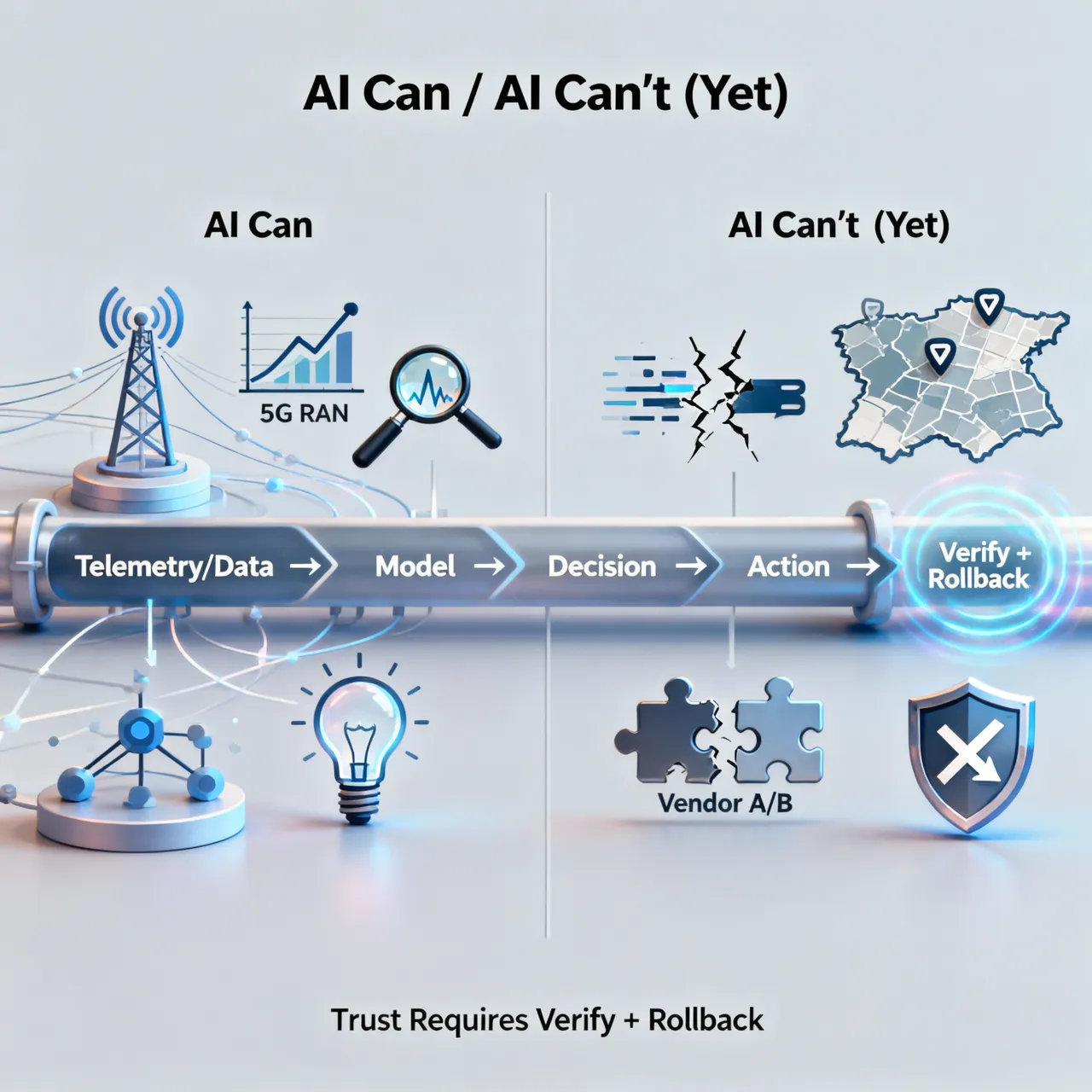
AI in RAN: What It Can Do Today (And What It Can’t)
AI in RAN is everywhere in presentations… but in real operations, the value comes from being very clear about one thing: AI is not a magic button. It’s a capability that depends on data, context, and guardrails. A simple way to explain it is to separate 3 levels of “AI” people often mix: • * Prediction means the model forecasts what might happen next. • * Recommendation means the system suggests actions to a human. • * Automation means the system can act (usually inside a closed loop). Today, most networks are strongest in prediction and recommendation. Full automation exists, but only in well-defined scenarios.
What AI can do well today
• * AI can predict congestion hotspots by learning traffic patterns and seasonality, helping teams plan capacity before users suffer. • * AI can detect anomalies faster than humans by spotting subtle KPI shifts that don’t trigger traditional alarms yet. • * AI can improve triage by clustering incidents and pointing to likely root-cause domains (RAN vs transport vs core) to reduce troubleshooting time. • * AI can optimize repeatable decisions when rules are clear, like parameter ranges, neighbor hygiene, or energy-saving modes with defined thresholds. Notice the common theme: AI helps when the problem is pattern-based and the data is consistent.
What AI still can’t do reliably
• * AI cannot replace RF engineering judgment in messy, real-world scenarios where the “right” action depends on local context, constraints, and trade-offs. • * AI cannot fix bad data. If telemetry is incomplete, inconsistent, or biased, the model will look smart and still be wrong. • * AI cannot guarantee accountability in multi-vendor environments without strong governance, because “who owns the outcome” must be defined operationally. • * AI cannot safely automate high-risk actions without observability, rollback, and policy boundaries, because networks are not a sandbox. This is why many “AI projects” fail: they start with models, not with operating discipline.
The best way to position AI in RAN
AI is most valuable when it reduces decision latency. Not by replacing teams, but by helping them act earlier:
• * Earlier detection. • * Faster prioritization. • * Safer execution. • * Verified outcomes.
If you want AI to create real value in RAN, focus on the fundamentals first:
• * Clean, time-aligned data across domains. • * Clear intents and policies (what “good” looks like). • * Closed-loop design with verification and rollback. • A narrow use case that repeats weekly (where ROI is easy to prove).
Because in RAN, AI doesn’t win by being clever. It wins by being trusted.
#AIinTelecom #RAN #5G #NetworkAutomation #SON #SMO #RIC #RANOptimization #TelecomStrategy #DigitalTransformation