6G Will Not Break the Laws of Physics: What 6G Physics Means for RAN Engineers
Understand the 6G physics behind the hype: Shannon limits, path loss at 7 GHz, uplink power and where real 6G gains will come from.
6G Will Not Break the Laws of Physics: What 6G Physics Means for RAN Engineers
Every generation arrives with impressive numbers, and with 6G we already hear about terabit speeds and near zero latency. The timeline is real: 3GPP has fixed the Release 21 timeline, with the first 6G specs expected in early 2029 and commercial systems around 2030.
What will not change is the physics our networks live with.
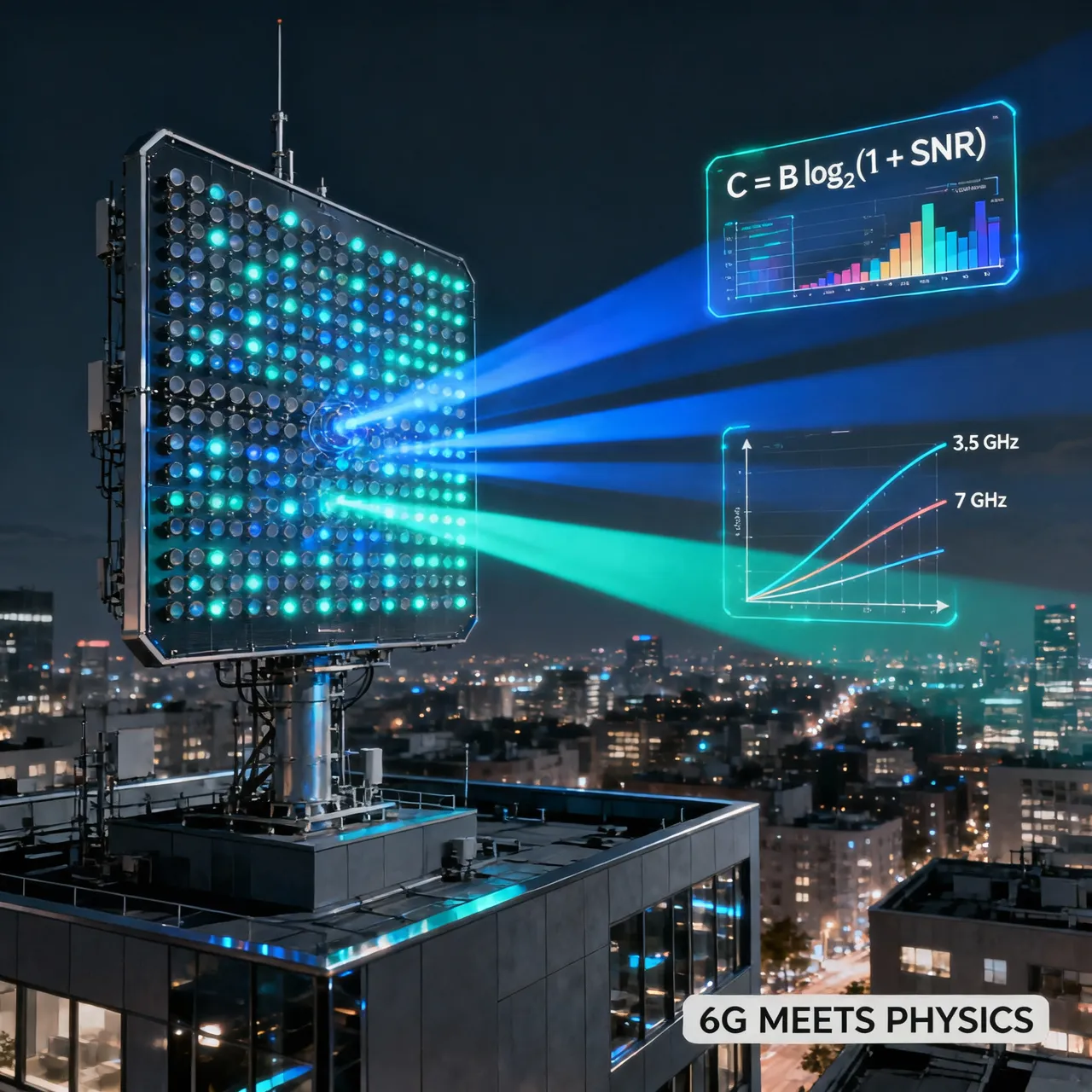
Shannon still sets the ceiling. Capacity grows with bandwidth, but only logarithmically with SNR, and every time you double the bandwidth you also add 3 dB of thermal noise.
Frequency still costs. Moving from 3.5 GHz to the 7 GHz range under study for WRC-27 adds around 6 dB of free space path loss at equal antenna gain, before counting the extra building and foliage losses.
The uplink is still limited by a battery in someone’s pocket. A handset will not suddenly transmit like a base station because the standard has a new name.
So where will the real 6G gains come from? From the same places engineers have always found them:
🔹 Larger antenna arrays that fit more elements in the same aperture and recover the higher path loss through beamforming gain. 🔹 Wider and better harmonized spectrum, especially in the upper mid-band, once regulators finish the sharing studies. 🔹 AI native air interface and network automation that squeeze more efficiency from every MHz and every watt. 🔹 Denser and smarter deployments, where design and optimization matter even more than today.
(For the design principles 6G is being built on, from AI native design to sensing, see 6G Design Principles RAN Engineers Should Learn Now.)
For RAN engineers, this is good news. Link budgets, interference and coverage trade-offs are not going away. 𝗧𝗵𝗲 𝗳𝘂𝗻𝗱𝗮𝗺𝗲𝗻𝘁𝗮𝗹𝘀 𝘄𝗶𝗹𝗹 𝗯𝗲 𝘄𝗼𝗿𝘁𝗵 𝗲𝘃𝗲𝗻 𝗺𝗼𝗿𝗲 𝗻𝗲𝘅𝘁 𝘁𝗶𝗺𝗲.
#6G #5GAdvanced #RAN #RFEngineering #Spectrum #3GPP #WRC27 #MassiveMIMO