TDD 5G: Why Timing Can Become an RF Problem
Diagnose 5G TDD synchronization failures: how GNSS loss, atmospheric ducting and frame misalignment create uplink interference disguised as RF issues.
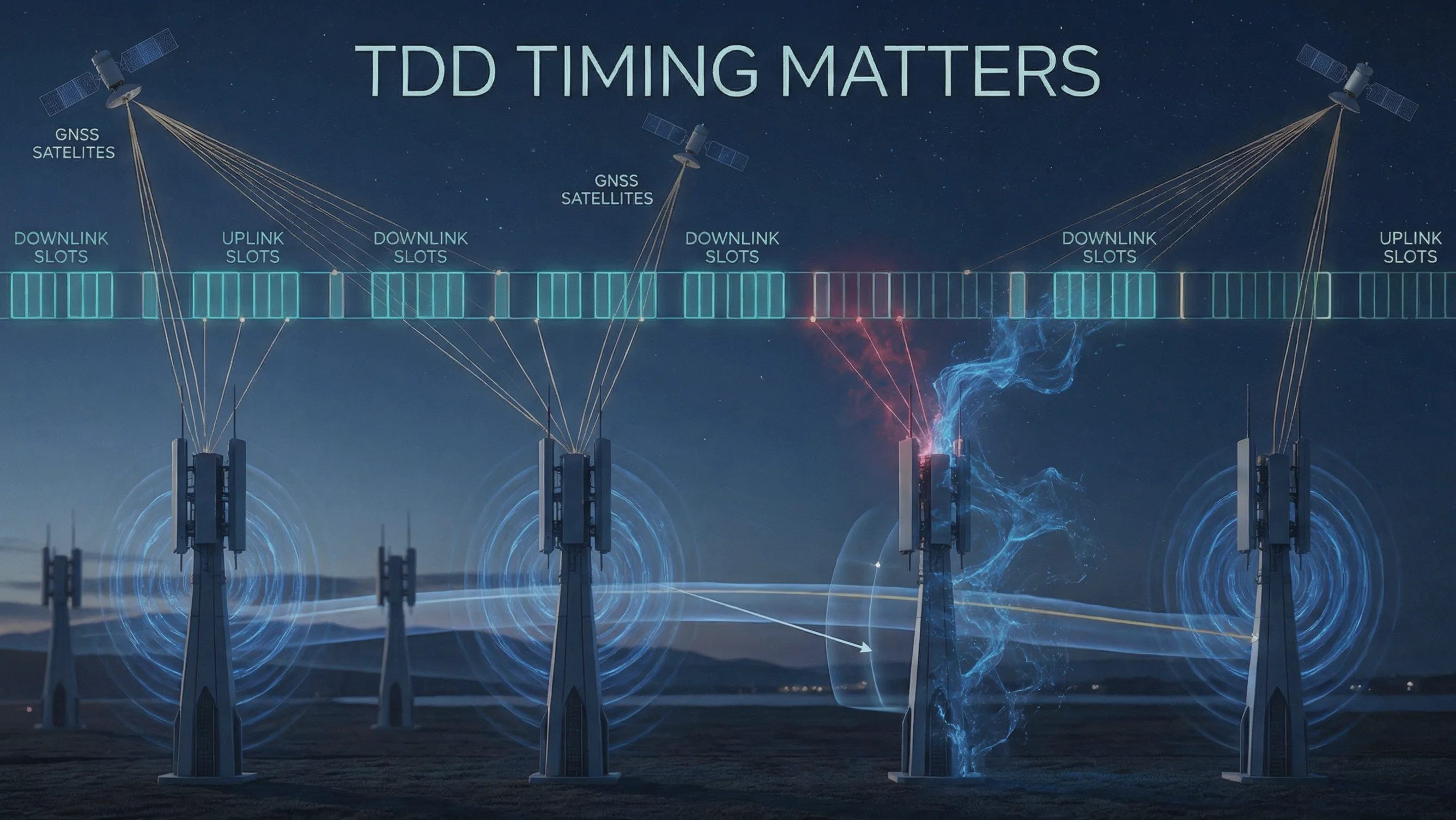
TDD 5G: Why Timing Can Become an RF Problem
Most 5G mid-band networks run on TDD, where uplink and downlink share the same frequency and are separated only in time. Efficient, yes, but with a condition many RF teams underestimate: every gNB in the area must switch between transmitting and listening at practically the same instant, within microseconds.
When that alignment breaks, the symptoms show up in RF KPIs, so troubleshooting usually starts in the wrong place.
- A site that loses its GNSS or PTP reference drifts in phase, and its downlink lands on the uplink slots of its neighbors.
- Uplink noise rises across a whole cluster and accessibility degrades, with no hardware alarm pointing to the cause.
- Atmospheric ducting can carry downlink energy from gNBs hundreds of kilometers away, arriving after the guard period.
- Two operators in adjacent 3.5 GHz blocks with different frame structures create the same effect, even if each one is perfectly synced.
The usual reaction is to change tilts, cut power or start an interference hunt, while the root cause sits in the clock or the frame configuration.
A few clues help. Interference concentrated in the first UL symbols. A pattern that repeats at the same hours, often at night. And when degradation hits a whole area instead of one sector, I would check sync status before touching any antenna.
This is where SON and automation earn their place: correlating holdover alarms with UL interference per symbol turns a week of drive tests into a quick diagnosis.
In TDD, a few microseconds of drift can cost more capacity than a badly planned site.
#5G #TDD #RANOptimization #Synchronization #RFOptimization #SON