Why Good 5G Coverage Can Still Produce Bad Mobility
Diagnose why strong 5G coverage still causes poor 5G mobility: cell overlap, ping-pong handovers, overshooting, missing neighbors and NSA thresholds.
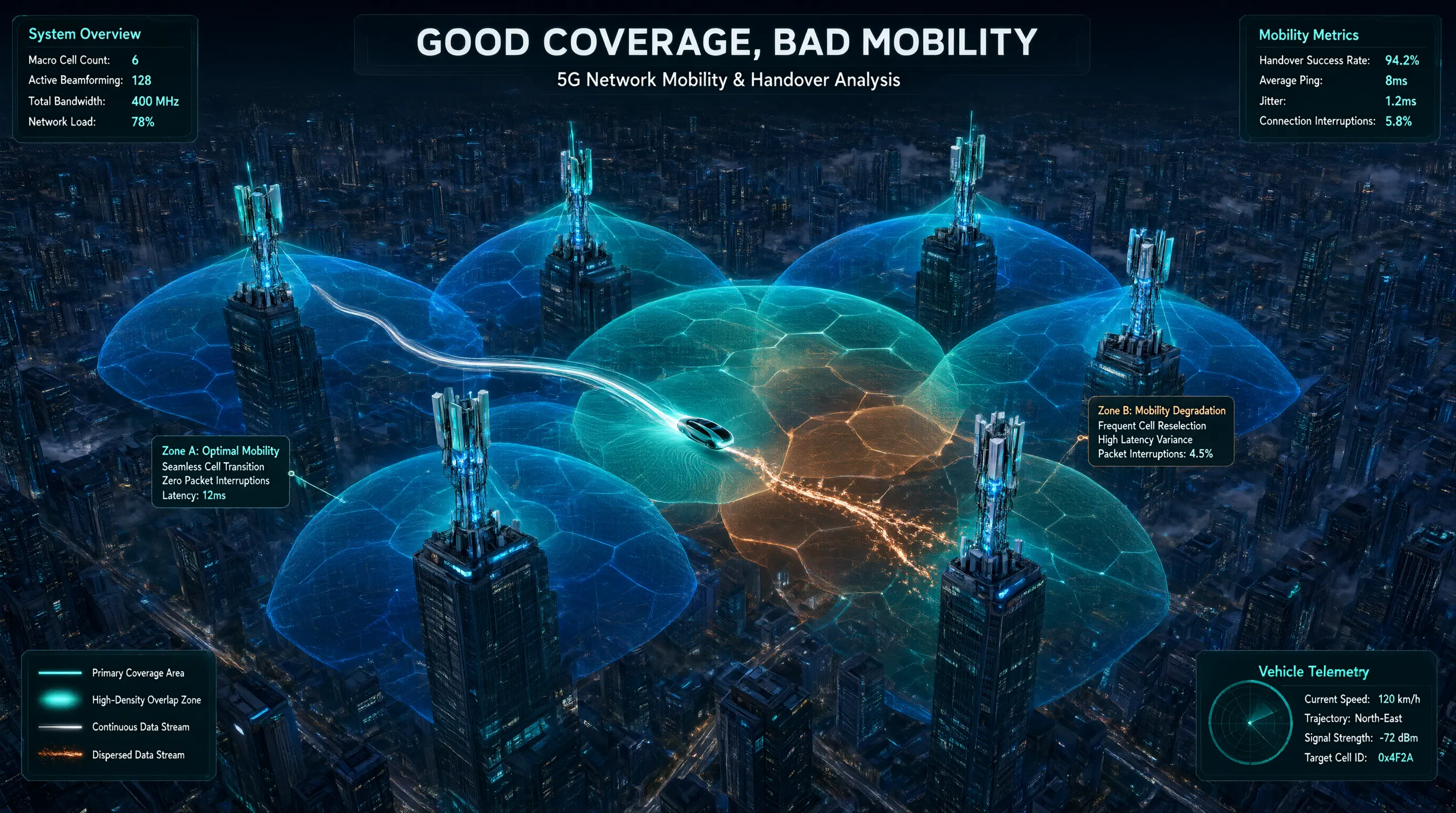
Why Good 5G Coverage Can Still Produce Bad Mobility
I have seen it many times in drive test reviews. The RSRP map is green end to end, the coverage KPIs look healthy, and still users complain about drops and throughput that collapses every few hundred meters.
The explanation is simple once you look closer. Coverage tells you how strong the signal is. Mobility depends on how cleanly one cell hands the user over to the next.
These are the patterns I find most often:
🔹 Excessive overlap creates zones where three or four cells arrive with similar RSRP, so SINR drops and the UE keeps bouncing between them. 🔹 Ping-pong handovers appear when A3 offset, hysteresis and TTT are copied from another cluster without considering local speed and clutter. 🔹 Overshooting cells capture users far from their design area and release them too late, which shows up as RLF instead of a clean handover. 🔹 Missing neighbor relations force reestablishments even when the best target cell is just next door. 🔹 In NSA, poorly tuned B1 and A2 thresholds trigger constant SgNB additions and releases, and the user perceives unstable 5G.
A green RSRP plot hides all of this. The real story lives at the boundaries: handover success rate, too early and too late events, ping-pong ratio and RLF per cell pair.
This is where SON earns its place. Mobility Robustness Optimization can tune these parameters pair by pair, but only with clean data and proper guardrails.
𝗖𝗼𝘃𝗲𝗿𝗮𝗴𝗲 𝗴𝗲𝘁𝘀 𝘂𝘀𝗲𝗿𝘀 𝗰𝗼𝗻𝗻𝗲𝗰𝘁𝗲𝗱. 𝗠𝗼𝗯𝗶𝗹𝗶𝘁𝘆 𝗱𝗲𝗰𝗶𝗱𝗲𝘀 𝗶𝗳 𝘁𝗵𝗲𝘆 𝘀𝘁𝗮𝘆 𝘁𝗵𝗮𝘁 𝘄𝗮𝘆.
#5G #RANOptimization #MobilityManagement #Handover #SON #RFOptimization #NetworkPerformance